
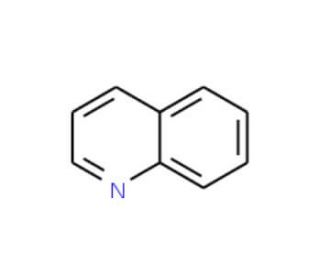

Quinoline (CAS 91-22-5)
QUICK LINKS
Quinoline is an aromatic heterocyclic organic compound. This compound plays a vital role in the chemical and related industries due to its extensive applications. Quinoline serves as an intermediate in the production of a variety of biologically active substances and contributes to the synthesis of dyes, perfumes, and other materials. It′s also involved in the production of photographic materials. Moreover, it facilitates the synthesis of numerous other organic entities, such as quinoline derivatives, and acts as a fundamental ingredient in the production of quinoline-based substances. Quinoline is used in in vitro experiments, specifically in cell culture systems, and aids in studying cellular processes, including cell proliferation, differentiation, and apoptosis. Furthermore, it contributes to the understanding of drug action mechanisms and the evaluation of the safety and effectiveness of emerging substances. The action mechanism of quinoline remains somewhat unclear. However, it′s suggested that the compound acts as an inhibitor of specific enzymes, like cytochrome P450 enzymes involved in substance metabolism. Additionally, quinoline is believed to disrupt the binding of substances to their receptors.
Quinoline (CAS 91-22-5) References
- Quinoline-based antifungals. | Musiol, R., et al. 2010. Curr Med Chem. 17: 1960-73. PMID: 20377510
- Quinoline--a promising fragment in the search for new antimalarials. | Gryzło, B. and Kulig, K. 2014. Mini Rev Med Chem. 14: 332-44. PMID: 24552268
- A review on anticancer potential of bioactive heterocycle quinoline. | Afzal, O., et al. 2015. Eur J Med Chem. 97: 871-910. PMID: 25073919
- Quinoline: a promising antitubercular target. | Keri, RS. and Patil, SA. 2014. Biomed Pharmacother. 68: 1161-75. PMID: 25458785
- Quinoline-based antimalarial hybrid compounds. | Vandekerckhove, S. and D'hooghe, M. 2015. Bioorg Med Chem. 23: 5098-119. PMID: 25593097
- Recent Advances in Metal-Free Quinoline Synthesis. | Ramann, GA. and Cowen, BJ. 2016. Molecules. 21: PMID: 27483222
- Quinoline hybrids and their antiplasmodial and antimalarial activities. | Hu, YQ., et al. 2017. Eur J Med Chem. 139: 22-47. PMID: 28800458
- Biologically active quinoline and quinazoline alkaloids part I. | Shang, XF., et al. 2018. Med Res Rev. 38: 775-828. PMID: 28902434
- Biologically active quinoline and quinazoline alkaloids part II. | Shang, XF., et al. 2018. Med Res Rev. 38: 1614-1660. PMID: 29485730
- Development of Quinoline-Based Theranostic Ligands for the Targeting of Fibroblast Activation Protein. | Lindner, T., et al. 2018. J Nucl Med. 59: 1415-1422. PMID: 29626119
- Quinoline and quinolone dimers and their biological activities: An overview. | Chu, XM., et al. 2019. Eur J Med Chem. 161: 101-117. PMID: 30343191
- Quinoline anticancer agents active on DNA and DNA-interacting proteins: From classical to emerging therapeutic targets. | Lauria, A., et al. 2021. Eur J Med Chem. 220: 113555. PMID: 34052677
- Enzymatic approaches to site-selective oxidation of quinoline and derivatives. | Wang, Z., et al. 2022. Org Biomol Chem. 20: 2580-2600. PMID: 35290426
Ordering Information
| Product Name | Catalog # | UNIT | Price | Qty | FAVORITES | |
Quinoline, 5 g | sc-250829 | 5 g | $42.00 | |||
Quinoline, 100 g | sc-250829A | 100 g | $38.00 |