
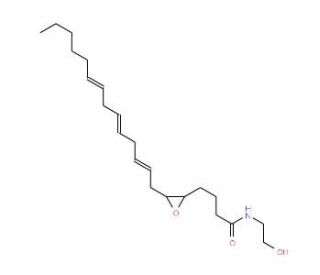

(±)5(6)-EET Ethanolamide
QUICK LINKS
(±)5(6)-EET Ethanolamide is a synthesized analog of epoxyeicosatrienoic acids (EETs), specifically modified by the addition of an ethanolamide group. EETs, which are epoxide derivatives of arachidonic acid, play a notable role in cellular signaling processes, particularly those related to the regulation of vascular functions and inflammatory responses. The introduction of an ethanolamide group in (±)5(6)-EET Ethanolamide modifies its molecular structure, potentially influencing its solubility, stability, and interaction with specific receptors or enzymes within biological systems. In research settings, this compound has been utilized to probe the mechanisms through which EETs and their analogs influence cellular and molecular pathways. The ethanolamide modification typically aims to mimic or modulate the behavior of natural lipid mediators, allowing for detailed studies on how these compounds affect intracellular signaling, including their impact on ion channel activity and gene expression. By using (±)5(6)-EET Ethanolamide, researchers can explore the altered dynamics of EET interactions, providing insights into the regulatory roles of these lipid mediators in various physiological processes without suggesting its application in managing or diagnosing health conditions. This research is crucial for understanding the biochemical landscape of lipid-mediated signaling in more depth.
(±)5(6)-EET Ethanolamide References
- The fatty acid amide hydrolase (FAAH). | Deutsch, DG., et al. 2002. Prostaglandins Leukot Essent Fatty Acids. 66: 201-10. PMID: 12052036
- Metabolism of the endocannabinoids, 2-arachidonylglycerol and anandamide, into prostaglandin, thromboxane, and prostacyclin glycerol esters and ethanolamides. | Kozak, KR., et al. 2002. J Biol Chem. 277: 44877-85. PMID: 12244105
- The endocannabinoid system: drug targets, lead compounds, and potential therapeutic applications. | Lambert, DM. and Fowler, CJ. 2005. J Med Chem. 48: 5059-87. PMID: 16078824
- A cytochrome P450-derived epoxygenated metabolite of anandamide is a potent cannabinoid receptor 2-selective agonist. | Snider, NT., et al. 2009. Mol Pharmacol. 75: 965-72. PMID: 19171674
- Cytochrome P450 epoxygenase pathway of polyunsaturated fatty acid metabolism. | Spector, AA. and Kim, HY. 2015. Biochim Biophys Acta. 1851: 356-65. PMID: 25093613
- Oxidized Lipids in Persistent Pain States. | Osthues, T. and Sisignano, M. 2019. Front Pharmacol. 10: 1147. PMID: 31680947
- Comparative metabolite profiling of rice contrasts reveal combined drought and heat stress signatures in flag leaf and spikelets. | Da Costa, MVJ., et al. 2022. Plant Sci. 320: 111262. PMID: 35643604
- Human CYP2B6 produces oxylipins from polyunsaturated fatty acids and reduces diet-induced obesity. | Heintz, MM., et al. 2022. PLoS One. 17: e0277053. PMID: 36520866
- Anandamide, an endogenous cannabimimetic eicosanoid, binds to the cloned human cannabinoid receptor and stimulates receptor-mediated signal transduction. | Felder, CC., et al. 1993. Proc Natl Acad Sci U S A. 90: 7656-60. PMID: 8395053
Ordering Information
| Product Name | Catalog # | UNIT | Price | Qty | FAVORITES | |
(±)5(6)-EET Ethanolamide, 25 µg | sc-221069 | 25 µg | $93.00 | |||
(±)5(6)-EET Ethanolamide, 50 µg | sc-221069A | 50 µg | $177.00 |