
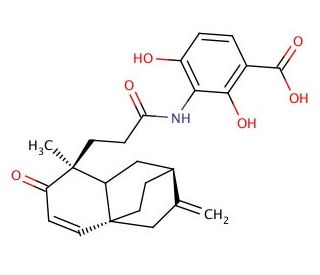

Platencin (CAS 869898-86-2)
LINK RAPIDI
La platencina, un prodotto naturale derivato dallo Streptomyces platensis, è emersa come un composto importante nella ricerca scientifica per la sua potente attività antibatterica e il suo meccanismo d'azione unico. Gli studi hanno spiegato che Platencin agisce sulla sintesi degli acidi grassi batterici inibendo l'enzima FabF, noto anche come β-chetoacil-acil carrier protein sintasi II (KAS II), che catalizza l'allungamento degli acidi grassi nella membrana cellulare batterica. Interrompendo questa via metabolica essenziale, Platencin interferisce con l'integrità e la funzione della membrana batterica, portando infine alla morte della cellula batterica. La ricerca ha esplorato ulteriormente le caratteristiche strutturali di Platencin e le sue interazioni di legame con FabF, fornendo approfondimenti sul suo meccanismo d'azione e sul potenziale per la progettazione di farmaci basati sulla struttura. Inoltre, la platencina è stata studiata per la sua efficacia contro vari patogeni batterici, compresi i ceppi multiresistenti ai farmaci, evidenziando il suo potenziale come composto guida per lo sviluppo di nuovi antibiotici. Inoltre, Platencin è stato uno strumento prezioso per la ricerca in biologia chimica, facilitando lo studio del metabolismo degli acidi grassi e delle sue implicazioni per la fisiologia e la patogenesi batterica. Nel complesso, Platencin rappresenta un candidato promettente per ulteriori esplorazioni nella scoperta di farmaci antibatterici e come strumento per lo studio del metabolismo lipidico batterico.
Platencin (CAS 869898-86-2) Referenze
- Scoperta della platencina, un doppio inibitore di FabF e FabH con proprietà antibiotiche in vivo. | Wang, J., et al. 2007. Proc Natl Acad Sci U S A. 104: 7612-6. PMID: 17456595
- Scoperta e sintesi di 'sfidanti superbatterici' - platensimicina e platencina. | Palanichamy, K. and Kaliappan, KP. 2010. Chem Asian J. 5: 668-703. PMID: 20209576
- Sintesi e proprietà antibatteriche di iso-platencina, Cl-iso-platencina e Cl-platencina: identificazione di una nuova struttura principale. | Tiefenbacher, K., et al. 2010. Chemistry. 16: 9616-22. PMID: 20486112
- Funzionalizzazione stereoselettiva di platensimicina e platencina mediante reazioni sulfa-Michael/aldol. | Qiu, L., et al. 2019. Org Biomol Chem. 17: 4261-4272. PMID: 30816397
- Caratterizzazione strutturale della β-chetoacil ACP sintasi I legata alla platencina e a molecole di screening dei frammenti in due siti di legame del substrato. | Patterson, EI., et al. 2020. Proteins. 88: 47-56. PMID: 31237717
- Caratterizzazione e struttura cristallina di una monoossigenasi di ferro non eme coinvolta nella biosintesi di platensimicina e platencina. | Dong, LB., et al. 2019. J Am Chem Soc. 141: 12406-12412. PMID: 31291107
- Nuovi bersagli per gli antimicrobici. | Gupta, S., et al. 2020. Turk J Pharm Sci. 17: 565-575. PMID: 33177939
- Semisintesi e valutazione biologica di derivati tioeteri della platencina: Inibitori doppi di FabF e FabH contro MRSA. | Li, Y., et al. 2021. ACS Med Chem Lett. 12: 433-442. PMID: 33738071
- Studio computazionale del meccanismo di idrossilazione C5 catalizzato dalla diiron monoossigenasi PtmU3 come parte della biosintesi della platensimicina. | Zhang, S., et al. 2021. Inorg Chem. 60: 17783-17796. PMID: 34762413
- Sviluppo di iperproduttori di platensimicina, platencina e platensilina mediante l'ingegneria del percorso biosintetico e l'ottimizzazione del mezzo di fermentazione. | Fluegel, LL., et al. 2024. J Ind Microbiol Biotechnol. 51: PMID: 38262768
Informazioni ordini
| Nome del prodotto | Codice del prodotto | UNITÀ | Prezzo | Quantità | Preferiti | |
Platencin, 100 µg | sc-202291 | 100 µg | $612.00 |