
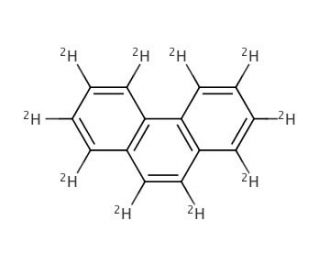

Phenanthrene-d10 (CAS 1517-22-2)
QUICK LINKS
Phenanthrene-d10, a deuterated analogue of phenanthrene, stands as a pivotal compound in the domain of scientific research, particularly in the realms of organic chemistry and environmental sciences. This variant of phenanthrene is uniquely marked by the substitution of its hydrogen atoms with deuterium, a heavier isotope of hydrogen, which endows it with distinct physical and chemical properties compared to its non-deuterated counterpart. The inclusion of deuterium atoms notably increases the molecule′s molecular weight and alters its vibrational modes, making Phenanthrene-d10 an invaluable tool in the study of isotope effects on chemical reactions and processes. Its mechanism of action hinges on these isotopic substitutions, which can influence reaction kinetics and pathways, thereby providing deeper insights into the underlying principles of molecular interactions and stability. In research applications, Phenanthrene-d10 is extensively employed as an internal standard in mass spectrometry and NMR spectroscopy analyses, facilitating the accurate quantification and structural elucidation of phenanthrene and related compounds in complex mixtures. This enhanced understanding is for advancing our knowledge in various fields, including the study of hydrocarbon pollution and its environmental impact, as well as the exploration of organic synthesis mechanisms and the development of novel materials.
Phenanthrene-d10 (CAS 1517-22-2) References
- Determination of bisphenol A and 4-nonylphenol in human milk using alkaline digestion and cleanup by solid-phase extraction. | Otaka, H., et al. 2003. Anal Sci. 19: 1663-6. PMID: 14696933
- Relations between environmental black carbon sorption and geochemical sorbent characteristics. | Cornelissen, G., et al. 2004. Environ Sci Technol. 38: 3632-40. PMID: 15296315
- Organochlorine pesticides in ambient air in selected urban and rural residential areas in the Philippines derived from passive samplers with polyurethane disks. | Santiago, EC. and Cayetano, MG. 2011. Bull Environ Contam Toxicol. 86: 50-5. PMID: 21152891
- Polycyclic aromatic hydrocarbons in PM2.5 in Guangzhou, southern China: spatiotemporal patterns and emission sources. | Gao, B., et al. 2012. J Hazard Mater. 239-240: 78-87. PMID: 23021315
- Application of a silicone rubber passive sampling technique for monitoring PAHs and PCBs at three Belgian coastal harbours. | Monteyne, E., et al. 2013. Chemosphere. 91: 390-8. PMID: 23290177
- Determination of 4-tert-octylphenol in surface water samples of Jinan in China by solid phase extraction coupled with GC-MS. | Yang, X., et al. 2013. J Environ Sci (China). 25: 1712-7. PMID: 24520712
- Adaptation of Sonication-Assisted Matrix Solid Phase Dispersion of Tissues for the Subsequent Extraction of Polycyclic Aromatic Hydrocarbons from Gulf Menhaden (Brevoortia patronus). | Olson, GM., et al. 2014. Biochem Res Int. 2014: 925684. PMID: 24738032
- Predicting bioaccumulation of polycyclic aromatic hydrocarbons in soft-shelled clams (Mya arenaria) using field deployments of polyethylene passive samplers. | Fernandez, LA. and Gschwend, PM. 2015. Environ Toxicol Chem. 34: 993-1000. PMID: 25598269
- Effect of suspended particles with different grain sizes on the bioaccumulation of PAHs by zebrafish (Danio rerio). | Zhai, Y., et al. 2020. Chemosphere. 242: 125299. PMID: 31896194
- Response to letter to the editor on the paper 'occurrence and environmental risks of nonsteroidal anti-inflammatory drugs in urban wastewater in the southwest monsoon region of India'. | Thalla, AK. and Vannarath, AS. 2020. Environ Monit Assess. 192: 609. PMID: 32870411
- Polycyclic aromatic hydrocarbons (PAHs) in urban stream sediments of Suzhou Industrial Park, an emerging eco-industrial park in China: Occurrence, sources and potential risk. | Yuan, Z., et al. 2021. Ecotoxicol Environ Saf. 214: 112095. PMID: 33667735
- Emerging pollutants in Nigeria: A systematic review. | Egbuna, C., et al. 2021. Environ Toxicol Pharmacol. 85: 103638. PMID: 33757839
- Distribution, risk assessment, and source apportionment of polycyclic aromatic hydrocarbons (PAHs) using positive matrix factorization (PMF) in urban soils of East India. | Ambade, B., et al. 2023. Environ Geochem Health. 45: 491-505. PMID: 35201547
- Extraction and recovery of polycyclic aromatic hydrocarbons from environmental solids using supercritical fluids. | Hawthorne, SB. and Miller, DJ. 1987. Anal Chem. 59: 1705-8. PMID: 3662010
Ordering Information
| Product Name | Catalog # | UNIT | Price | Qty | FAVORITES | |
Phenanthrene-d10, 100 mg | sc-250684 | 100 mg | $117.00 | |||
Phenanthrene-d10, 1 g | sc-250684A | 1 g | $369.00 | |||
Phenanthrene-d10, 10 g | sc-250684B | 10 g | $1954.00 | |||
Phenanthrene-d10, 100 g | sc-250684C | 100 g | $14051.00 |