
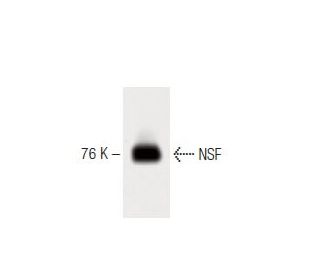


Anticorpo NSF (7): sc-136008
- NSF Antibody 7 è un monoclonale di topo IgG2b fornito in 50 µg/0.5 ml
- generato contro gli amminoacidi 488-601 di NSF di origine human
- raccomandato per il rilevamento di NSF di origine mouse, rat, human e canine in WB, IP e IF
- Al momento non abbiamo ancora completato l'identificazione dei reagenti secondari di rilevazione preferiti per NSF l'anticorpo (7). Questo lavoro è in corso.

LINK RAPIDI
VEDI ANCHE...
Originariamente si pensava che le sintassine fossero proteine di aggancio, ma più recentemente sono state classificate come proteine di ancoraggio che si ancorano alle superfici citoplasmatiche delle membrane cellulari. È stato dimostrato che le sintassine si legano a varie proteine coinvolte nell'esocitosi, tra cui le VAMP (vesicle-associated membrane proteins), NSF (N-ethylmaleimide-sensitive factor), SNAP 25 (synaptosomal-associated protein of 25kDa), SNAPs (soluble NSF attachment proteins) e synaptotagmin. Le VAMP, chiamate anche sinaptobrevine, tra cui VAMP-1 e VAMP-2, e la sinaptotagmina, una proteina che può funzionare come inibitore dell'esocitosi, sono proteine vescicolari. Le SNAP, tra cui α- e γ-SNAP, sono proteine citoplasmatiche che si legano a un complesso recettoriale di membrana composto da VAMP, SNAP 25 e sintassina. Le SNAP mediano il legame alla membrana di NSF, che è essenziale per le reazioni di fusione della membrana.
Alexa Fluor® è un marchio registrato di Molecular Probes Inc., OR., USA
LI-COR® e Odyssey® sono marchi registrati di LI-COR Biosciences
Anticorpo NSF (7) Riferimenti:
- Una libreria di code C-terminali di recettori 7TM. Interazioni con le proteine proposte per lo smistamento post-endocitico ERM-binding phosphoprotein 50 (EBP50), N-ethylmaleimide-sensitive factor (NSF), sorting nexin 1 (SNX1) e G protein-coupled receptor-associated sorting protein (GASP). | Heydorn, A., et al. 2004. J Biol Chem. 279: 54291-303. PMID: 15452121
- Un sito di attacco alla membrana conservato in alfa-SNAP facilita il disassemblaggio del complesso SNARE guidato dal fattore sensibile all'N-etilmaleimide (NSF). | Winter, U., et al. 2009. J Biol Chem. 284: 31817-26. PMID: 19762473
- Il complesso di tethering proteico Dsl1 è un complesso residente nel reticolo endoplasmatico, che interagisce con cinque recettori proteici di attacco NSF (N-ethylmaleimide-sensitive factor) solubili (SNAREs): implicazioni per la fusione e la regolazione della fusione. | Meiringer, CT., et al. 2011. J Biol Chem. 286: 25039-46. PMID: 21550981
- Cambiamenti conformazionali dipendenti dai nucleotidi nel fattore sensibile all'N-Etilmaleimide (NSF) e loro ruolo potenziale nel disassemblaggio del complesso SNARE. | Moeller, A., et al. 2012. J Struct Biol. 177: 335-43. PMID: 22245547
- La disferlina lega le SNARE (recettori della proteina di attacco del fattore solubile N-etilmaleimide (NSF)) e stimola la fusione di membrana in modo sensibile al calcio. | Codding, SJ., et al. 2016. J Biol Chem. 291: 14575-84. PMID: 27226605
- L'attività della chinasi LRRK2 G2019S innesca l'aggregazione neurotossica di NSF. | Pischedda, F., et al. 2021. Brain. 144: 1509-1525. PMID: 33876242
- Effetto rimineralizzante del NSF sulla carie dello smalto artificiale. | Mohamed, OS., et al. 2024. BMC Oral Health. 24: 975. PMID: 39174977
- L'attività ATPasica della proteina di fusione sensibile all'N-etilmaleimide (NSF) è regolata da proteine di attacco NSF solubili. | Morgan, A., et al. 1994. J Biol Chem. 269: 29347-50. PMID: 7961908
- La proteina di fusione sensibile all'N-etilmaleimide (NSF) è espressa preferenzialmente nel sistema nervoso. | Püschel, AW., et al. 1994. FEBS Lett. 347: 55-8. PMID: 8013662
- Stimolazione selettiva del dominio D1 ATPasi della proteina di fusione sensibile all'N-etilmaleimide (NSF) da parte di proteine di attacco NSF solubili. | Steel, GJ. and Morgan, A. 1998. FEBS Lett. 423: 113-6. PMID: 9506852
Informazioni ordini
| Nome del prodotto | Codice del prodotto | UNITÀ | Prezzo | Quantità | Preferiti | |
NSF Anticorpo (7) | sc-136008 | 50 µg/0.5 ml | $322.00 |