
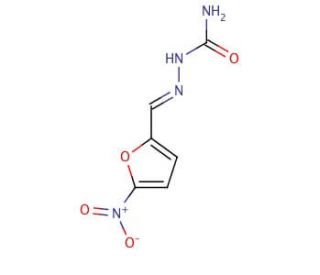

Nitrofurazone (CAS 59-87-0)
Direktverknüpfungen
Nitrofurazon, ein Nitrofuranderivat, hat aufgrund seines breiten antimikrobiellen Wirkungsspektrums und seiner vielfältigen Anwendungsmöglichkeiten in der wissenschaftlichen Forschung große Aufmerksamkeit erregt. Sein Wirkmechanismus beruht in erster Linie auf der Störung des bakteriellen Zellstoffwechsels und der DNA-Synthese. Nitrofurazon wird in den Bakterienzellen in reaktive Zwischenprodukte umgewandelt, die anschließend mit zellulären Makromolekülen, einschließlich Proteinen und Nukleinsäuren, interagieren. Diese Wechselwirkung führt zur Hemmung von Schlüsselenzymen, die am bakteriellen Stoffwechsel und an der DNA-Replikation beteiligt sind, was letztlich zum Tod der Bakterienzellen führt. Die Forschung hat die Wirksamkeit von Nitrofurazon gegen verschiedene bakterielle Krankheitserreger untersucht, darunter sowohl grampositive als auch gramnegative Bakterien sowie einige Protozoen. Darüber hinaus wurde in Studien das Potenzial von Nitrofurazon für den Einsatz in der Landwirtschaft als Veterinärdesinfektionsmittel und als antimikrobielles Mittel in der Aquakultur untersucht. Darüber hinaus wurde Nitrofurazon auf seine wundheilenden Eigenschaften untersucht, wobei sich die Forschung auf seine Fähigkeit konzentrierte, die Geweberegeneration zu fördern und die bakterielle Besiedlung von verletztem Gewebe zu reduzieren. Insgesamt treibt die vielseitige antimikrobielle Aktivität von Nitrofurazon die laufenden Forschungsanstrengungen zur Erforschung seiner potenziellen Anwendungen in verschiedenen Bereichen weiter voran.
Nitrofurazone (CAS 59-87-0) Literaturhinweise
- Die Entfernung von Nitrofurazon aus Wasser wird durch die Kopplung von Photokatalyse und biologischem Abbau verbessert. | Smułek, W., et al. 2021. Int J Mol Sci. 22: PMID: 33671749
- Nitrofurazon-Repurposing für die Entwicklung und Synthese neuartiger apoptoseabhängiger Antikrebsmittel und antimikrobieller Wirkstoffe: Biologische Bewertung, kinetische Studien und molekulare Modellierung. | El-Wakil, MH., et al. 2021. Bioorg Chem. 113: 104971. PMID: 34051413
- Furacin: Mehr als nur Kontaktdermatitis durch Nitrofurazon. | Cuevas Bravo, C., et al. 2021. Ann Allergy Asthma Immunol. 127: 389-390. PMID: 34087479
- Ein gemeindebasierter Ansatz zur Analyse der Ökotoxizität von Nitrofurazon unter Verwendung von periphytischen Protozoen. | Kazmi, SSUH., et al. 2022. Mar Pollut Bull. 175: 113165. PMID: 34839952
- Einblicke in die Ökotoxizität von Nitrofurazon in marinen Ökosystemen anhand von Körpergrößenspektren periphytischer Wimpertierchen. | Kazmi, SSUH., et al. 2022. Mar Pollut Bull. 174: 113217. PMID: 34864466
- Elektrochemische Messung von Nitrofurazon auf einem mit Ru(bpy)32+ funktionalisierten Polyoxometallat in Kombination mit einer mit Graphen modifizierten Elektrode. | Cai, S., et al. 2022. Food Chem. 378: 132084. PMID: 35030464
- Auswirkungen von Nitrofurazon auf die Funktion von Ökosystemen in der Meeresumwelt: Eine Fallstudie zur mikrobiellen Fauna. | Uroosa, ., et al. 2022. Mar Pollut Bull. 184: 114216. PMID: 36215761
- Das Antibiotikum Nitrofurazon steuert die funktionelle Dynamik der periphytischen Protozoenfauna in Meeresumgebungen. | Kazmi, SSUH., et al. 2023. Sci Total Environ. 874: 162405. PMID: 36858212
- Forschungsfortschritt bei Metaboliten von Nitrofurazon in Wasserprodukten. | Yang, G., et al. 2024. Heliyon. 10: e29735. PMID: 38681547
Bestellinformation
| Produkt | Katalog # | EINHEIT | Preis | ANZAHL | Favoriten | |
Nitrofurazone, 100 mg | sc-212400 | 100 mg | $89.00 | |||
Nitrofurazone, 100 g | sc-212400A | 100 g | $129.00 |