
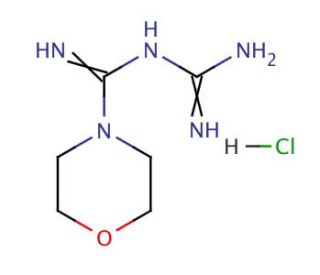

Moroxydine hydrochloride (CAS 3160-91-6)
QUICK LINKS
Moroxydine hydrochloride is a chemical compound known for its role as a nucleic acid synthesis inhibitor, particularly affecting the replication process of certain viruses. This compound has been utilized extensively in research to explore its mechanisms of action and potential applications in the study of viral behaviors and replication strategies. The primary mechanism of action of moroxydine hydrochloride involves the inhibition of viral DNA polymerases and, to some extent, RNA polymerases. This inhibition is achieved by interfering with the synthesis of nucleic acids, which is essential for viral replication. By blocking these polymerases, moroxydine hydrochloride prevents the proper transcription and replication of viral genetic material, leading to a reduction in viral proliferation. In scientific research, moroxydine hydrochloride has been used to study its antiviral properties against a range of viruses. Researchers have explored how this compound affects the replication of viruses like influenza and other RNA viruses, providing insights into the viral life cycle and identifying potential targets for antiviral interventions. Additionally, moroxydine hydrochloride is employed in the study of virus-host interactions. By examining how treatment with this compound changes the course of infection, researchers can observe how viruses adapt to host defenses and how these interactions might be manipulated to prevent or mitigate infection.
Moroxydine hydrochloride (CAS 3160-91-6) References
- Study of molecularly imprinted solid-phase extraction of diphenylguanidine and its structural analogs. | Fan, J., et al. 2009. Anal Chim Acta. 639: 42-50. PMID: 19345756
- Pharmacokinetics and tissue residues of moroxydine hydrochloride in gibel carp, Carassius gibelio after oral administration. | Liu, W., et al. 2016. J Vet Pharmacol Ther. 39: 398-404. PMID: 26763124
- Eugenol confers resistance to Tomato yellow leaf curl virus (TYLCV) by regulating the expression of SlPer1 in tomato plants. | Sun, WJ., et al. 2016. N Biotechnol. 33: 345-54. PMID: 26776605
- Moroxydine hydrochloride inhibits grass carp reovirus replication and suppresses apoptosis in Ctenopharyngodon idella kidney cells. | Yu, XB., et al. 2016. Antiviral Res. 131: 156-65. PMID: 27188236
- In vitro antiviral efficacy of moroxydine hydrochloride and ribavirin against grass carp reovirus and giant salamander iridovirus. | Yu, XB., et al. 2016. Dis Aquat Organ. 121: 189-199. PMID: 27786157
- Effects of moroxydine hydrochloride and ribavirin on the cellular growth and immune responses by inhibition of GCRV proliferation. | Yu, XB., et al. 2018. Res Vet Sci. 117: 37-44. PMID: 29175011
- Recovery of NanoLuc Luciferase-Tagged Canine Distemper Virus for Facilitating Rapid Screening of Antivirals in vitro. | Liu, F., et al. 2020. Front Vet Sci. 7: 600796. PMID: 33363240
- Rescue of dual reporter-tagged parainfluenza virus 5 as tool for rapid screening of antivirals in vitro. | Liu, F., et al. 2021. Vet Microbiol. 259: 109154. PMID: 34237497
- Insights into a rapid screening method for anti-cucumber mosaic virus compounds. | Yan, Y., et al. 2022. J Virol Methods. 301: 114402. PMID: 34871628
- Design, Synthesis, and Anti-PVY Biological Activity of 1,3,5-Triazine Derivatives Containing Piperazine Structure. | Bai, L., et al. 2023. Int J Mol Sci. 24: PMID: 37175986
Ordering Information
| Product Name | Catalog # | UNIT | Price | Qty | FAVORITES | |
Moroxydine hydrochloride, 1 g | sc-235894 | 1 g | $87.00 |