
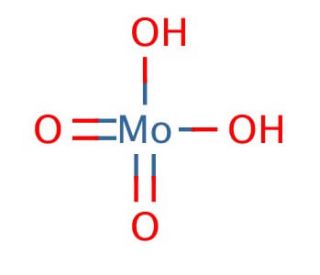

Molybdic acid (CAS 7782-91-4)
QUICK LINKS
Molybdic acid, a pivotal compound in scientific exploration, showcases distinctive mechanisms of action and a wide array of research applications. In research, molybdic acid is predominantly utilized as a versatile reagent and catalyst due to its unique chemical properties. One notable mechanism of action involves its ability to form complexes with various organic and inorganic compounds, facilitating diverse chemical reactions. Molybdic acid is extensively employed in analytical chemistry for the detection and quantification of phosphorus, arsenic, and other elements through colorimetric methods. Additionally, it serves as a catalyst or co-catalyst in organic synthesis, promoting crucial transformations such as oxidation, hydroxylation, and desulfurization reactions. Its catalytic activity stems from its ability to coordinate with substrates and facilitate electron transfer processes, leading to the formation of desired products with high efficiency and selectivity. Furthermore, molybdic acid finds application in materials science, where it contributes to the synthesis of functional materials such as molybdenum oxides and heteropolyacids. These materials exhibit promising properties for various technological applications, including gas sensing, photocatalysis, and energy storage. Moreover, molybdic acid-based catalysts are investigated for their potential in environmental remediation, particularly in wastewater treatment and air purification processes. Overall, the diverse mechanisms of action and broad research applications of molybdic acid underscore its significance as a valuable tool in advancing scientific knowledge and technological innovation across multiple disciplines.
Molybdic acid (CAS 7782-91-4) References
- Controllable size, shape and morphology of molybdic acid self-aggregated with rhodamine B to construct functional material. | Guan, ZS., et al. 2006. J Colloid Interface Sci. 302: 113-22. PMID: 16814800
- [Notes on the molecular size of molybdic acid in aqueous solution]. | CARPENI, G. 1947. C R Hebd Seances Acad Sci. 224: 1060-2. PMID: 20248824
- Bis(isopropyl-ammonium) tetra-sulfido-molybdate(VI). | Srinivasan, BR., et al. 2007. Acta Crystallogr Sect E Struct Rep Online. 64: m66-7. PMID: 21200636
- Antimicrobial activity of transition metal acid MoO(3) prevents microbial growth on material surfaces. | Zollfrank, C., et al. 2012. Mater Sci Eng C Mater Biol Appl. 32: 47-54. PMID: 23177771
- Freestanding MoO2/Mo2C imbedded carbon fibers for Li-ion batteries. | Li, H., et al. 2017. Phys Chem Chem Phys. 19: 2908-2914. PMID: 28079206
- Characterization of santalene synthases using an inorganic pyrophosphatase coupled colorimetric assay. | Hua, G., et al. 2018. Anal Biochem. 547: 26-36. PMID: 29438678
- Developing a colorimetric assay for Fe(II)/2-oxoglutarate-dependent dioxygenase. | Guo, C., et al. 2018. Anal Biochem. 548: 109-114. PMID: 29499175
- Nature of Monomeric Molybdenum(VI) Cations in Acid Solutions Using Theoretical Calculations and Raman Spectroscopy. | Zhang, N., et al. 2019. J Phys Chem B. 123: 3304-3311. PMID: 30913876
- Molybdic Acid-Functionalized Nano-Fe3O4@TiO2 as a Novel and Magnetically Separable Catalyst for the Synthesis of Coumarin-Containing Sulfonamide Derivatives. | Gholtash, JE., et al. 2020. Acta Chim Slov. 67: 866-875. PMID: 33533418
- Industrial-Scale Technology for Molybdic Acid Production from Waste Petrochemical Catalysts. | Leszczyńska-Sejda, K., et al. 2023. Materials (Basel). 16: PMID: 37687455
Ordering Information
| Product Name | Catalog # | UNIT | Price | Qty | FAVORITES | |
Molybdic acid, 100 g | sc-211918 | 100 g | $49.00 | |||
Molybdic acid, 500 g | sc-211918A | 500 g | $151.00 |