
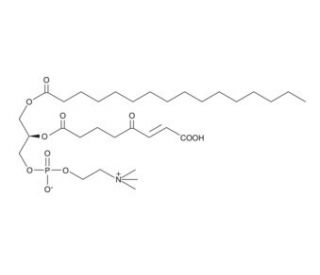

KOdiA-PC (CAS 439904-33-3)
ACCÈS RAPIDE AUX LIENS
KOdiA-PC, également connu sous le nom de 1-O-hexadécyl-2-O-(9Z-octadécénoyl)-sn-glycéro-3-phosphocholine, est un composé chimique qui a été largement étudié dans la recherche scientifique, en particulier dans le domaine de la lipidomique et de la biologie membranaire. Il constitue un outil important pour l'étude du métabolisme des lipides et des processus de signalisation cellulaire. KOdiA-PC est un dérivé phospholipidique synthétique qui imite la structure des phospholipides naturels présents dans les membranes cellulaires. Il a été utilisé pour explorer la dynamique et les fonctions des phospholipides dans les membranes cellulaires. Les chercheurs ont étudié l'incorporation et le métabolisme du KOdiA-PC dans les cellules, en examinant ses interactions avec les enzymes et les protéines impliquées dans la synthèse, le remodelage et la dégradation des phospholipides. En outre, le KOdiA-PC a été utilisé pour étudier les interactions lipides-protéines, les événements de fusion membranaire et le rôle des phospholipides dans l'organisation et la fonction des membranes. En manipulant les niveaux ou les ratios d'espèces lipidiques spécifiques, les chercheurs peuvent mieux comprendre le rôle des phospholipides dans les processus cellulaires tels que le trafic membranaire, la signalisation cellulaire et l'homéostasie lipidique. L'étude de la KOdiA-PC contribue à faire progresser la compréhension des mécanismes complexes du métabolisme des lipides et des rôles des phospholipides dans la physiologie cellulaire. Cette recherche a des implications pour diverses applications de recherche liées à la lipidomique, à la biologie des membranes et aux voies de signalisation cellulaire.
KOdiA-PC (CAS 439904-33-3) Références
- Le récepteur piégeur CD36 des macrophages est le principal récepteur des LDL modifiées par les espèces réactives de l'azote générées par les monocytes. | Podrez, EA., et al. 2000. J Clin Invest. 105: 1095-108. PMID: 10772654
- Identification d'une nouvelle famille de phospholipides oxydés qui servent de ligands pour le récepteur piégeur de macrophages CD36. | Podrez, EA., et al. 2002. J Biol Chem. 277: 38503-16. PMID: 12105195
- Une nouvelle famille de phospholipides oxydés athérogènes favorise la formation de cellules spumeuses par les macrophages via le récepteur CD36 et est présente dans les lésions athérosclérotiques. | Podrez, EA., et al. 2002. J Biol Chem. 277: 38517-23. PMID: 12145296
- Cartographie et caractérisation du site de liaison pour les phospholipides oxydés spécifiques et les lipoprotéines de faible densité oxydées du récepteur de piégeage CD36. | Kar, NS., et al. 2008. J Biol Chem. 283: 8765-71. PMID: 18245080
- Des phospholipides oxydés spécifiques inhibent l'absorption sélective d'esters de cholestérol par les récepteurs scavenger bi-médiés. | Ashraf, MZ., et al. 2008. J Biol Chem. 283: 10408-14. PMID: 18285332
- Base structurelle de la reconnaissance des phospholipides oxydés dans les lipoprotéines de basse densité oxydées par les récepteurs de piégeage de classe B CD36 et SR-BI. | Gao, D., et al. 2010. J Biol Chem. 285: 4447-54. PMID: 19996318
- Des phospholipides oxydés étroitement liés modulent de manière différentielle les propriétés physicochimiques des particules lipidiques. | Kar, S., et al. 2011. Chem Phys Lipids. 164: 54-61. PMID: 21074521
- Système d'essai basé sur des peptides synthétiques pour détecter la liaison entre CD36 et une lipoprotéine de basse densité oxydée. | Tsuzuki, S., et al. 2013. Biosci Biotechnol Biochem. 77: 132-7. PMID: 23291771
- Analyse de la relation entre la structure des phospholipides oxydés et l'interaction avec les récepteurs scavenger de classe B. | Gao, D., et al. 2015. Methods Mol Biol. 1208: 29-48. PMID: 25323497
- CHARMM GUI Membrane Builder pour la modélisation et la simulation de membranes de phospholipides oxydés. | Brown, TP., et al. 2024. Curr Opin Struct Biol. 86: 102813. PMID: 38598982
Informations pour la commande
| Nom du produit | Ref. Catalogue | COND. | Prix HT | QTÉ | Favoris | |
KOdiA-PC, 500 µg | sc-224033 | 500 µg | $84.00 | |||
KOdiA-PC, 1 mg | sc-224033A | 1 mg | $158.00 | |||
KOdiA-PC, 50 mg | sc-224033B | 50 mg | $5722.00 | |||
KOdiA-PC, 100 mg | sc-224033C | 100 mg | $10404.00 |