
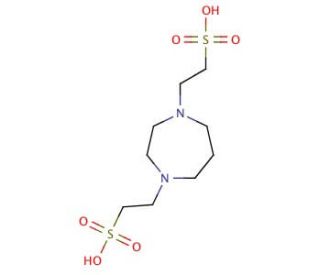

Homopiperazine-1,4-bis(2-ethanesulfonic acid) (CAS 202185-84-0)
See product citations (2)
QUICK LINKS
Homopiperazine-1,4-bis(2-ethanesulfonic acid), a sulfonated diazepane derivative, finds extensive use in scientific research. This water-soluble organic compound holds broad applications in both biological and chemical investigations. Notably, it serves as a vital chemical reagent for synthesizing diverse compounds and acts as a buffering agent in aqueous solutions. In experiments involving plant cells at low pH, Homopiperazine-1,4-bis(2-ethanesulfonic acid) is employed as a buffer. Moreover, Homopiperazine-N,N′-bis-[2-(ethanesulfonic acid)] acts as a nutrient that can be assimilated by plants to synthesize mevalonate, an essential process in abiotic and biotic environments for nutrient uptake. This nutrient is absorbed through the roots of plants and transported to the cytosol, where it undergoes conversion into mevalonate. It possesses an efflux transporter gene that regulates its exit from the cell, with the process occurring in the mitochondria and cytoplasmic membrane. Notably, Homopiperazine-N,N′-bis-[2-(ethanesulfonic acid)] can be utilized as a nutrient solution in hydroponics systems.
Homopiperazine-1,4-bis(2-ethanesulfonic acid) (CAS 202185-84-0) References
- Erwinia amylovora expresses fast and simultaneously hrp/dsp virulence genes during flower infection on apple trees. | Pester, D., et al. 2012. PLoS One. 7: e32583. PMID: 22412891
- Altered cell wall properties are responsible for ammonium-reduced aluminium accumulation in rice roots. | Wang, W., et al. 2015. Plant Cell Environ. 38: 1382-90. PMID: 25444246
- Characterization of the dTDP-Fuc3N and dTDP-Qui3N biosynthetic pathways in Campylobacter jejuni 81116. | Li, ZZ., et al. 2017. Glycobiology. 27: 358-369. PMID: 28096310
- Evaluation of buffers toxicity in tobacco cells: Homopiperazine-1,4-bis (2-ethanesulfonic acid) is a suitable buffer for plant cells studies at low pH. | Borgo, L. 2017. Plant Physiol Biochem. 115: 119-125. PMID: 28364708
- Low phosphate activates STOP1-ALMT1 to rapidly inhibit root cell elongation. | Balzergue, C., et al. 2017. Nat Commun. 8: 15300. PMID: 28504266
- Experimental Evolution of Escherichia coli K-12 at High pH and with RpoS Induction. | Hamdallah, I., et al. 2018. Appl Environ Microbiol. 84: PMID: 29802191
- Ammonium Alleviates Manganese Toxicity and Accumulation in Rice by Down-Regulating the Transporter Gene OsNramp5 Through Rhizosphere Acidification. | Hu, AY., et al. 2019. Front Plant Sci. 10: 1194. PMID: 31632426
- Novel cultivated endophytic Verrucomicrobia reveal deep-rooting traits of bacteria to associate with plants. | Bünger, W., et al. 2020. Sci Rep. 10: 8692. PMID: 32457320
- The Class III Peroxidase Encoding Gene AtPrx62 Positively and Spatiotemporally Regulates the Low pH-Induced Cell Death in Arabidopsis thaliana Roots. | Graças, JP., et al. 2020. Int J Mol Sci. 21: PMID: 33003393
Ordering Information
| Product Name | Catalog # | UNIT | Price | Qty | FAVORITES | |
Homopiperazine-1,4-bis(2-ethanesulfonic acid), 25 g | sc-228311 | 25 g | $505.00 |