
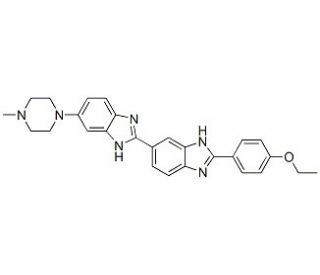


Hoechst 33342 trihydrochloride (CAS 23491-52-3)
인용논문 보기 (15)
빠른 링크
ho스트 33342 삼염화물은 세포 DNA를 시각화하는 데 널리 사용되는 플루오로크롬으로, 그 구조와 기능에 대한 귀중한 통찰력을 제공한다. 이 A:T 특이적 DNA 마이너 그루브 리간드는 연구에서 다양한 용도로 사용된다. 단백질 및 지질과 같은 세포 성분의 식별 및 정량을 용이하게 한다. 또한, 약물 전달 응용에서 유용성을 발견하여 특정 세포 또는 조직으로의 표적 전달을 가능하게 한다. 염료의 여기는 약 350 nm에서 발생하며, 최대 방출은 약 461 nm이다. ho스트 3342는 다른 ho스트 염료에 비해 에틸기가 추가되어 향상된 친유성을 갖는다. 이는 알려진 여러 DNA 인터칼레이터를 대체하고, 아드리아마이신(sc-200923)과 함께 DNA 염료 흡수를 방해할 수 있다. 이 화합물은 FACS를 이용한 DNA 함량에 기초한 살아있는 세포 분류, 살아있는 세포 내 염색질 분포 가시화, BrdU 혼입 검출, 현미경으로 고정된 세포의 검사 등 다양한 용도로 사용된다. 또한, 초기 세포 사멸 단계 및 세포 주기 분포를 연구하는 역할을 한다. 특히, -스트 3342는 세포 유형에 따라 다양한 효과를 나타낸다. 세포 분화를 유도하고, 프렌드 적혈구와 가역적으로 결합하고, Topo I(토포이소머라제 I)을 억제하며, HL-60 세포의 세포 사멸을 유도하고, Ca2+ 유출을 조절하며, 접합 근막 세망 세포의 세포 분화에 영향을 미친다. ho스트 3342 삼염화물은 비공유 결합을 통해 DNA와 상호 작용하여 형광 복합체를 형성한다. 이 염료는 특이적으로 이중 가닥 DNA의 마이너 그루브에 결합하여 결합 시 형광 소광을 일으킨다. 단일 가닥 및 이중 가닥 DNA 모두에 결합할 수 있지만, 후자의 경우 친화력이 더 높다. ho스트 33342는 RNA와도 결합할 수 있지만, RNA에 대한 결합 친화력은 DNA에 비해 낮다.
Hoechst 33342 trihydrochloride (CAS 23491-52-3) 참고자료
- Hoechst 33342에 의한 세포 사멸은 면역 반응성 토포이소머라제 I 및 토포이소머라제 I-DNA 복합체 형성 감소와 관련이 있습니다. | Zhang, X. and Kiechle, F. 2001. Ann Clin Lab Sci. 31: 187-98. PMID: 11337909
- Hoechst 33258과 송아지 흉선 DNA, 폴리[d(A-T)] 및 d(CCGGAATTCCGG)의 결합 특성: 다중 화학량론 및 광범위한 부위 친화도를 가진 긴밀한 결합의 결정. | Loontiens, FG., et al. 1990. Biochemistry. 29: 9029-39. PMID: 1702995
- 형광 항생제인 미트라마이신, 크로모마이신, 올리보마이신을 사용한 DNA의 특정 염색. | Crissman, HA. and Tobey, RA. 1990. Methods Cell Biol. 33: 97-103. PMID: 1707496
- 형광 염료 Hoechst 33342에 의한 시험관 내 EC 세포의 분화. | Steuer, B., et al. 1990. Exp Cell Res. 186: 149-57. PMID: 2298232
- DNA 복제 세포에서 브로모데옥시우리딘을 신속하고 민감하게 검출하는 새로운 방법. | Crissman, HA. and Steinkamp, JA. 1987. Exp Cell Res. 173: 256-61. PMID: 2960553
- 유량 미세 형광 분석법을 통한 중요한 DNA 염색 및 세포 분류. | Lydon, MJ., et al. 1980. J Cell Physiol. 102: 175-81. PMID: 6154714
- Hoechst 33342 형광 염색을 통한 살아있는 PTO 세포의 염색질 분포 시각화. | Gregoire, M., et al. 1984. Exp Cell Res. 152: 38-46. PMID: 6201374
- 포유류 세포에서 막 투과성 변화의 프로브로서 Hoechst 33342 염료 흡수. | Lalande, ME., et al. 1981. Proc Natl Acad Sci U S A. 78: 363-7. PMID: 6941251
- 데옥시리보핵산 함량에 따른 살아있는 세포의 분석 및 분류. | Arndt-Jovin, DJ. and Jovin, TM. 1977. J Histochem Cytochem. 25: 585-9. PMID: 70450
- 인간 흑색종 세포에서 비스벤지미다졸 유도체의 분화, 선택적 독성 및 ATGCAAAT 결합의 전사 조절. | Wong, SS., et al. 1994. Biochem Pharmacol. 47: 827-37. PMID: 7510966
- 고정되지 않은 세포에서 세포 주기 분석과 세포 사멸을 동시에 측정하기 위해 Hoechst 33342와 요오드화 프로피듐을 사용하는 유세포 분석법입니다. | Belloc, F., et al. 1994. Cytometry. 17: 59-65. PMID: 7528124
- 세포사멸 흉선세포의 막 투과성 증가: 유세포 분석 연구. | Ormerod, MG., et al. 1993. Cytometry. 14: 595-602. PMID: 8404365
- 데옥시리보핵산 합성의 형광 검출에 유용한 33258 Hoechst 및 관련 비스벤지미다졸 염료에 대한 스펙트럼 연구. | Latt, SA. and Stetten, G. 1976. J Histochem Cytochem. 24: 24-33. PMID: 943439
주문정보
| 제품명 | 카탈로그 번호 | 단위 | 가격 | 수량 | 관심품목 | |
Hoechst 33342 trihydrochloride, 100 mg | sc-200908 | 100 mg | $142.00 |