
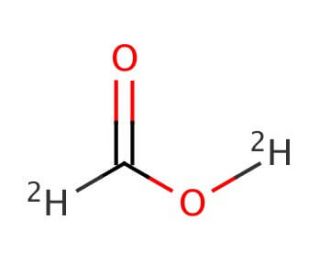

Formic acid-D2 (CAS 920-42-3)
QUICK LINKS
Formic acid-D2, also known as deuterium-labeled formic acid, is a stable isotopic variant of formic acid. It is characterized by the substitution of hydrogen atoms with deuterium (D), a stable heavy isotope of hydrogen. Formic acid-D2 shares similar properties and characteristics with its non-deuterated counterpart, formic acid (HCOOH). It is a colorless liquid with a pungent odor. The deuterium substitution in formic acid-D2 provides unique advantages in various scientific and research applications. The incorporation of deuterium in formic acid-D2 allows for the use of nuclear magnetic resonance (NMR) spectroscopy. NMR spectroscopy is a powerful analytical technique that provides information about the molecular structure, dynamics, and interactions of compounds. By utilizing formic acid-D2 in NMR studies, researchers can gain valuable insights into chemical reactions, kinetics, and mechanisms. Formic acid-D2 is employed as a tracer in biological and metabolic studies. Its stable isotope labeling allows researchers to track and identify specific pathways and metabolic processes. It has been utilized in studies involving protein synthesis, fatty acid metabolism, and drug metabolism research. Furthermore, formic acid-D2 is utilized in various chemical synthesis and organic reactions. Its unique isotopic properties can be advantageous in distinguishing reaction products and understanding reaction mechanisms. Overall, formic acid-D2 serves as useful in scientific research, enabling investigations into molecular structures, metabolic processes, and organic reactions. Its deuterium labeling provides a means to probe and study a wide range of chemical and biological systems, contributing to advancements in various fields of study.
Formic acid-D2 (CAS 920-42-3) References
- Chiral monodentate phosphine ligand MOP for transition-metal-catalyzed asymmetric reactions. | Hayashi, T. 2000. Acc Chem Res. 33: 354-62. PMID: 10891053
- Mechanistic study of the enantiomeric recognition of a basic compound with negatively charged single-isomer gamma-cyclodextrin derivatives using capillary electrophoresis, nuclear magnetic resonance spectroscopy, and infrared spectroscopy. | Zhou, L., et al. 2003. Electrophoresis. 24: 2448-55. PMID: 12900855
- Hair analysis for drugs of abuse. IV. Determination of total morphine and confirmation of 6-acetylmorphine in monkey and human hair by GC/MS. | Nakahara, Y., et al. 1992. Arch Toxicol. 66: 669-74. PMID: 1482290
- A comparison of capillary-scale LC-NMR with alternative techniques: spectroscopic and practical considerations. | Lewis, RJ., et al. 2005. Magn Reson Chem. 43: 783-9. PMID: 16049949
- Reaction of naphthalene-2,3-dicarboxaldehyde with enkephalins for LC-fluorescence and LC-MS analysis: conformational studies by molecular modeling and H/D exchange mass spectrometry. | Lacroix, M., et al. 2007. J Am Soc Mass Spectrom. 18: 1706-13. PMID: 17689094
- Evaluation of Chitosan Derivative Microparticles Encapsulating Superparamagnetic Iron Oxide and Doxorubicin as a pH-Sensitive Delivery Carrier in Hepatic Carcinoma Treatment: An in vitro Comparison Study. | Bai, MY., et al. 2018. Front Pharmacol. 9: 1025. PMID: 30298001
- Modulating oxygen coverage of Ti3C2Tx MXenes to boost catalytic activity for HCOOH dehydrogenation. | Hou, T., et al. 2020. Nat Commun. 11: 4251. PMID: 32843636
- Formic acid catalyzed isomerization and adduct formation of an isoprene-derived Criegee intermediate: experiment and theory. | Vansco, MF., et al. 2020. Phys Chem Chem Phys. 22: 26796-26805. PMID: 33211784
- A new synthetic pathway to adenine-2-d, 9-alkyladenine-2-d, adenosine-2-d, and 2'-deoxyadenosine-2-d. | Fujii, T., et al. 1986. Nucleic Acids Symp Ser. 33-6. PMID: 3494233
- A flow electrochemistry-enabled synthesis of 2-substituted N-(methyl-d)piperidines. | Al-Hadedi, AAM., et al. 2022. J Labelled Comp Radiopharm. 65: 361-368. PMID: 36272110
- Mass spectrometric based analysis of whole eggs dissolved in formic acid. | Wolfer, JD., et al. 2023. Food Chem. 405: 134846. PMID: 36368107
Ordering Information
| Product Name | Catalog # | UNIT | Price | Qty | FAVORITES | |
Formic acid-D2, 5 ml | sc-263339 | 5 ml | $191.00 |