
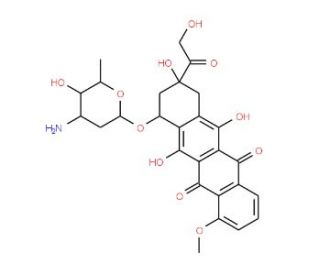

Epirubicin (CAS 56420-45-2)
See product citations (2)
QUICK LINKS
Epirubicin, an anthracycline antineoplastic agent, has been extensively studied in scientific research for its mechanism of action and potential applications in cancer biology and chemotherapy. This compound exerts its cytotoxic effects by intercalating into DNA strands, inhibiting topoisomerase II activity, and inducing DNA strand breaks, ultimately leading to cell cycle arrest and apoptosis in proliferating cells. Researchers have utilized epirubicin as a tool to investigate cancer cell biology, tumor heterogeneity, and drug resistance mechanisms. Studies have focused on elucidating the molecular pathways involved in epirubicin-induced cytotoxicity, as well as identifying predictive biomarkers for patient response to anthracycline-based chemotherapy regimens. Furthermore, epirubicin has been employed in research to evaluate its efficacy in various cancer models, including breast, ovarian, and lung cancers. Beyond cancer research, epirubicin has found applications in studies investigating drug delivery systems, nanoparticle formulations, and novel drug combinations to enhance its efficacy and minimize off-target toxicity. With ongoing advancements in cancer biology and drug development, epirubicin remains a valuable tool in scientific investigations aimed at understanding tumor biology.
Epirubicin (CAS 56420-45-2) References
- Metabolism of doxorubicin, daunorubicin and epirubicin in human and rat hepatoma cells. | Le Bot, MA., et al. 1991. Pharmacol Res. 24: 243-52. PMID: 1659695
- Differences in accumulation of anthracyclines daunorubicin, doxorubicin and epirubicin in rat tissues revealed by immunocytochemistry. | Shin, M., et al. 2010. Histochem Cell Biol. 133: 677-82. PMID: 20424853
- Hepatic uptake of epirubicin by isolated rat hepatocytes and its biliary excretion after intravenous infusion in rats. | Shin, DH., et al. 2014. Arch Pharm Res. 37: 1599-606. PMID: 25373308
- Epirubicin inhibits growth and alters the malignant phenotype of the U‑87 glioma cell line. | Wang, XF., et al. 2015. Mol Med Rep. 12: 5917-23. PMID: 26300546
- A functional assessment of the relative cardiotoxicity of adriamycin and epirubicin in the rat. | Yeung, TK., et al. 1989. Radiother Oncol. 15: 275-84. PMID: 2772255
- Angiographic Evaluation of Vascular Damage in Rat Liver After Administration of Epirubicin or Miriplatin. | Kishimoto, S., et al. 2018. Anticancer Res. 38: 247-251. PMID: 29277779
- Different cytotoxicity and metabolism of doxorubicin, daunorubicin, epirubicin, esorubicin and idarubicin in cultured human and rat hepatocytes. | Le Bot, MA., et al. 1988. Biochem Pharmacol. 37: 3877-87. PMID: 3190734
- Epirubicin: Biological Properties, Analytical Methods, and Drug Delivery Nanosystems. | Luiz, MT., et al. 2023. Crit Rev Anal Chem. 53: 1080-1093. PMID: 34818953
- Epirubicin toxicity in rat's ovary and uterus: A protective role of 3-Indolepropionic acid supplementation. | Owumi, SE., et al. 2023. Chem Biol Interact. 374: 110414. PMID: 36822302
- Pretreatment with ischaemia attenuates acute epirubicin-induced cardiotoxicity in isolated rat hearts. | Schjøtt, J., et al. 1996. Pharmacol Toxicol. 78: 381-6. PMID: 8829197
- Enhanced in vitro cytotoxicity of idarubicin compared to epirubicin and doxorubicin in rat prostate carcinoma cells. | Siegsmund, MJ., et al. 1997. Eur Urol. 31: 365-70. PMID: 9129933
Ordering Information
| Product Name | Catalog # | UNIT | Price | Qty | FAVORITES | |
Epirubicin, 25 mg | sc-279016 | 25 mg | $450.00 |