
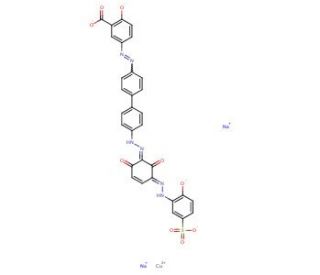

Molecular structure of Direct Brown 95, CAS Number: 16071-86-6
Direct Brown 95 (CAS 16071-86-6)
Alternate Names:
C.I. Direct Brown 95; C.I. 30145
CAS Number:
16071-86-6
Molecular Weight:
760.11
Molecular Formula:
C31H18CuN6O9S•2Na
For Research Use Only. Not Intended for Diagnostic or Therapeutic Use.
* Refer to Certificate of Analysis for lot specific data.
QUICK LINKS
Ordering Information
Description
Technical Information
Safety Information
SDS & Certificate of Analysis
Direct Brown 95, a synthetic dye, finds extensive application in the textile industry for imparting color to fabrics. Its use is not limited to textiles but also extends to paper, leather, and various other materials. This complex organic compound is synthesized through a multi-step process. Furthermore, Direct Brown 95 plays a pivotal role in scientific research. It serves as a stain in histology and cytology, aiding in the differentiation of diverse cell types. Additionally, it serves as a marker in molecular biology, facilitating the detection of DNA and RNA. Its versatility extends to environmental studies, where it is employed to identify and quantify pollutants present in water and soil samples.
Direct Brown 95 (CAS 16071-86-6) References
- 13-week subchronic toxicity studies of direct blue 6, direct black 38, and direct brown 95 dyes. | ,. 1978. Natl Cancer Inst Carcinog Tech Rep Ser. 108: 1-117. PMID: 12799683
- DNA adduct formation by 12 chemicals with populations potentially suitable for molecular epidemiological studies. | Uziel, M., et al. 1992. Mutat Res. 277: 35-90. PMID: 1376441
- The reduction of azo dyes by the intestinal microflora. | Chung, KT., et al. 1992. Crit Rev Microbiol. 18: 175-90. PMID: 1554423
- Sorption of some textile dyes by beech wood sawdust. | Dulman, V. and Cucu-Man, SM. 2009. J Hazard Mater. 162: 1457-64. PMID: 18656305
- Appearance and reappearance of mutagens in urine from rats after oral administration of direct brown 95, due to coprophagy. | Bos, RP., et al. 1986. Toxicology. 39: 85-92. PMID: 3515634
- Internal exposure of rats to benzidine derived from orally administered benzidine-based dyes after intestinal azo reduction. | Bos, RP., et al. 1986. Toxicology. 40: 207-13. PMID: 3726894
- Mutagenicity of azo dyes in the Salmonella/microsome assay using in vitro and in vivo activation. | Joachim, F., et al. 1985. Mutat Res. 156: 131-8. PMID: 3889630
- Direct black 38, direct blue 6, direct brown 95, benzidine derived dyes. | Thomas, AW., et al. 1978. Am Ind Hyg Assoc J. 39: A-18-A-24. PMID: 581253
- Mutagenicity of benzidine and benzidine-congener dyes and selected monoazo dyes in a modified Salmonella assay. | Prival, MJ., et al. 1984. Mutat Res. 136: 33-47. PMID: 6371512
- Induction of unscheduled DNA synthesis in primary rat hepatocytes by benzidine-congener-derived azo dyes in the in vitro and in vivo/in vitro assays. | Joachim, F. and Decad, GM. 1984. Mutat Res. 136: 147-52. PMID: 6371517
- Metabolism of benzidine-based dyes and the appearance of mutagenic metabolites in urine of rats after oral or intraperitoneal administration. | Bos, RP., et al. 1984. Toxicology. 31: 271-82. PMID: 6740702
- The release of 4,4'-diaminobiphenyls from azodyes in the rat. | Kennelly, JC., et al. 1982. Carcinogenesis. 3: 947-51. PMID: 7127676
- Chemical monitoring of urine from workers potentially exposed to benzidine-derived azo dyes. | Lowry, LK., et al. 1980. Toxicol Lett. 7: 29-36. PMID: 7292513
Ordering Information
| Product Name | Catalog # | UNIT | Price | Qty | FAVORITES | |
Direct Brown 95, 1 g | sc-493232 | 1 g | $474.00 |