
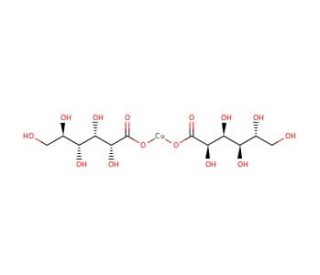

Struttura molecolare di Copper(II) D-gluconate, Numero CAS: 527-09-3
Copper(II) D-gluconate (CAS 527-09-3)
Nomi alternativi:
D-Gluconic acid copper(II) salt
Numero CAS:
527-09-3
Peso molecolare:
453.84
Formula molecolare:
C12H22CuO14
Solo per uso in Ricerca. Non previsto per Uso Diagnostico o Terapeutico.
* Vedere Certificato di Analisi per informazioni sul lotto specifico (incluso il contenuto d'acqua).
LINK RAPIDI
Informazioni ordini
Descrizione
Informazione tecnica
Informazioni di sicurezza
SDS & Certificato d'analisi
Il D-gluconato di rame (II) è un composto formato da rame e acido gluconico, un acido zuccherino presente in natura. Questo composto è un minerale traccia essenziale presente in numerosi alimenti e svolge un ruolo fondamentale in vari enzimi. Presenta un ampio spettro di effetti biochimici, tra cui il miglioramento dell'assorbimento di minerali come il ferro e lo zinco. Si ritiene che agisca come chelante, in grado di legarsi a metalli e altre molecole, influenzandone il comportamento.
Copper(II) D-gluconate (CAS 527-09-3) Referenze
- Blocco della formazione di cellule staminali del cancro al seno indotte da radiazioni. | Wang, Y., et al. 2014. Oncotarget. 5: 3743-55. PMID: 25003837
- Il rame migliora l'attività anti-angiogenica del disulfiram attraverso la via EGFR/Src/VEGF nei gliomi. | Li, Y., et al. 2015. Cancer Lett. 369: 86-96. PMID: 26254539
- Il bersaglio ALDH1A1 mediante il complesso disulfiram/rame inibisce la recidiva del tumore al polmone non a piccole cellule guidata da cellule staminali tumorali positive all'ALDH. | Liu, X., et al. 2016. Oncotarget. 7: 58516-58530. PMID: 27542268
- Una nuova chemioradio che ha come bersaglio le cellule tumorali pancreatiche staminali e non staminali grazie alla riproposizione del disulfiram. | Cong, J., et al. 2017. Cancer Lett. 409: 9-19. PMID: 28864067
- Il disulfiram combinato con il rame inibisce le metastasi e la transizione epitelio-mesenchimale nel carcinoma epatocellulare attraverso le vie NF-κB e TGF-β. | Li, Y., et al. 2018. J Cell Mol Med. 22: 439-451. PMID: 29148232
- La soppressione dell'autofagia aumenta l'apoptosi indotta da disulfiram/rame nel carcinoma polmonare non a piccole cellule. | Wu, X., et al. 2018. Eur J Pharmacol. 827: 1-12. PMID: 29547841
- Processo di morte cellulare immunogenica causato dal disulfiram come candidato anti-colorettale. | You, SY., et al. 2019. Biochem Biophys Res Commun. 513: 891-897. PMID: 31003768
- Influenza dell'integrazione minerale sui risultati dell'analisi del contenuto di glicosidi flavonolici negli integratori alimentari di Ginkgo biloba. | Lee, JK., et al. 2019. Prev Nutr Food Sci. 24: 75-83. PMID: 31008100
- Induzione dell'apoptosi autofagia-dipendente nelle cellule tumorali attraverso l'attivazione dello stress ER: un meccanismo antitumorale scoperto dal disulfiram, farmaco antialcolico. | Zhang, X., et al. 2019. Am J Cancer Res. 9: 1266-1281. PMID: 31285958
- Il disulfiram/rame induce un'attività antitumorale sia contro le cellule del cancro nasofaringeo sia contro i fibroblasti associati al cancro attraverso le vie ROS/MAPK e della ferroptosi. | Li, Y., et al. 2020. Cancers (Basel). 12: PMID: 31935835
- Il disulfiram e il rame, che colpiscono le cellule staminali del cancro, sensibilizzano il condrosarcoma radioresistente alle radiazioni. | Wang, K., et al. 2021. Cancer Lett. 505: 37-48. PMID: 33582212
- Miglioramento dell'efficacia terapeutica del sorafenib per il carcinoma epatocellulare attraverso la riproposizione del disulfiram. | Zhang, G., et al. 2022. Front Oncol. 12: 913736. PMID: 35912209
- Proprietà degli ossidi compositi Ti-Li-M di tipo spinello (M = Li, Na, Cu e Ag) previste dalla teoria funzionale della densità. | Tada, K., et al. 2022. Phys Chem Chem Phys. 24: 28055-28068. PMID: 36377526
Informazioni ordini
| Nome del prodotto | Codice del prodotto | UNITÀ | Prezzo | Quantità | Preferiti | |
Copper(II) D-gluconate, 100 g | sc-257261 | 100 g | $60.00 |