
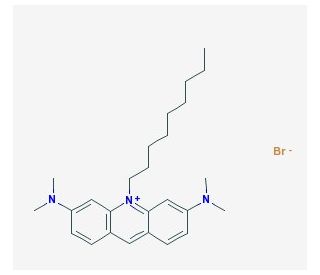


Acridine Orange 10-nonyl bromide (CAS 75168-11-5)
See product citations (2)
QUICK LINKS
Acridine Orange 10-nonyl bromide, a derivative of the basic dye Acridine Orange, is a cationic fluorescent compound used extensively in scientific research, particularly in the study of cellular and molecular structures. The chemical structure of this compound enhances its ability to intercalate into nucleic acids, making it a valuable tool for staining DNA and RNA in cells and tissue samples. The mechanism of action of Acridine Orange 10-nonyl bromide involves its insertion between the stacked base pairs of the DNA or RNA helix, where it fluoresces, allowing researchers to visualize nucleic acid components within cells under fluorescent microscopy. This staining is not merely differential but also metachromatic, meaning that the dye emits different colors depending on the type of nucleic acid it binds to—typically emitting green fluorescence when bound to DNA and red when associated with RNA. This property is particularly useful in apoptosis studies, where changes in the nuclear chromatin can be observed as a function of the apoptotic process. Additionally, it has been used in cytogenetics to differentiate chromosomes and to detect chromosomal aberrations. In environmental microbiology, Acridine Orange 10-nonyl bromide facilitates the rapid detection of bacterial cells in environmental samples, enhancing visualization under fluorescence microscopy. The dye′s ability to emit fluorescence at different wavelengths based on the molecular environment also makes it an excellent tool for studying cell cycle dynamics and cellular compartmentalization of nucleic acids, contributing to its wide application in cell biology research.
Acridine Orange 10-nonyl bromide (CAS 75168-11-5) References
- Quantitative characterization of crude synaptosomal fraction (P-2) components by flow cytometry. | Gylys, KH., et al. 2000. J Neurosci Res. 61: 186-92. PMID: 10878591
- Preparation and flow cytometry of uniform silica-fluorescent dye microspheres. | Bele, M., et al. 2002. J Colloid Interface Sci. 254: 274-82. PMID: 12702398
- A new water-based topical carrier with polar skin-lipids. | Silvander, M., et al. 2006. Lipids Health Dis. 5: 12. PMID: 16672068
- Targeting of mitochondria by 10-N-alkyl acridine orange analogues: role of alkyl chain length in determining cellular uptake and localization. | Rodriguez, ME., et al. 2008. Mitochondrion. 8: 237-46. PMID: 18514589
- Nanoparticle coated emulsions as novel dermal delivery vehicles. | Eskandar, NG., et al. 2009. Curr Drug Deliv. 6: 367-73. PMID: 19534710
- Mechanistic insight into the dermal delivery from nanoparticle-coated submicron O/W emulsions. | Eskandar, NG., et al. 2010. J Pharm Sci. 99: 890-904. PMID: 19655375
- Akt and c-Myc differentially activate cellular metabolic programs and prime cells to bioenergetic inhibition. | Fan, Y., et al. 2010. J Biol Chem. 285: 7324-33. PMID: 20018866
- In vitro cytotoxic activity of cationic paclitaxel nanoparticles on MDR-3T3 cells. | Niu, G., et al. 2010. J Drug Target. 18: 468-76. PMID: 20059301
- Altered mitochondrial membrane potential, mass, and morphology in the mononuclear cells of humans with type 2 diabetes. | Widlansky, ME., et al. 2010. Transl Res. 156: 15-25. PMID: 20621033
- Superior fluorescent probe for detection of cardiolipin. | Leung, CW., et al. 2014. Anal Chem. 86: 1263-8. PMID: 24372165
Ordering Information
| Product Name | Catalog # | UNIT | Price | Qty | FAVORITES | |
Acridine Orange 10-nonyl bromide, 100 mg | sc-214487 | 100 mg | $179.00 |