
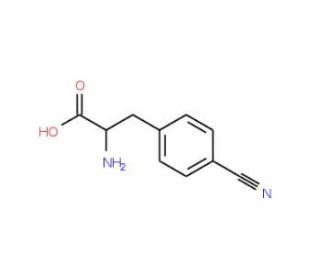

4-Cyano-L-phenylalanine (CAS 104531-20-6)
QUICK LINKS
4-Cyano-L-phenylalanine is an amino acid derivative and belongs to the class of aromatic amino acids. 4-Cyano-L-phenylalanine is characterized by the presence of a cyano (CN) group attached to the phenylalanine molecule. In scientific research, 4-Cyano-L-phenylalanine finds various applications due to its unique chemical properties. It is used as a building block or precursor in peptide synthesis and drug discovery. The cyano group can serve as a versatile functional group, allowing for the introduction of diverse chemical modifications and creating peptide analogs with altered biological activities. One of the key applications of 4-Cyano-L-phenylalanine is in the field of medicinal chemistry. Researchers utilize this compound to develop novel peptides with enhanced bioactivity, stability, or pharmacokinetic properties. By incorporating 4-Cyano-L-phenylalanine into peptide sequences, scientists can modulate the peptide′s interactions with biological targets, such as receptors or enzymes, potentially leading to improved therapeutic efficacy. The mechanism of action of 4-Cyano-L-phenylalanine depends on the specific context and the peptide or molecule it is incorporated into. As an amino acid derivative, 4-Cyano-L-phenylalanine can participate in peptide bond formation during synthesis, contributing to the overall structure and function of the resulting peptide. The presence of the cyano group can influence the peptide′s interactions with biological targets by altering its conformation, stability, or receptor binding affinity. Furthermore, the cyano group can undergo chemical reactions, allowing for further modifications or functionalizations of the peptide. These modifications can impact the peptide′s solubility, membrane permeability, or metabolic stability, influencing its behavior in biological systems.
4-Cyano-L-phenylalanine (CAS 104531-20-6) References
- New chromogenic substrates of human neutrophil cathepsin G containing non-natural aromatic amino acid residues in position P(1) selected by combinatorial chemistry methods. | Wysocka, M., et al. 2007. Mol Divers. 11: 93-9. PMID: 17653609
- Expanding the utility of 4-cyano-L-phenylalanine as a vibrational reporter of protein environments. | Bazewicz, CG., et al. 2012. J Phys Chem B. 116: 10824-31. PMID: 22909326
- Rational design of a zinc phthalocyanine binding protein. | Mutter, AC., et al. 2014. J Struct Biol. 185: 178-85. PMID: 23827257
- Sensitive, site-specific, and stable vibrational probe of local protein environments: 4-azidomethyl-L-phenylalanine. | Bazewicz, CG., et al. 2013. J Phys Chem B. 117: 8987-93. PMID: 23865850
- The 'gate keeper' role of Trp222 determines the enantiopreference of diketoreductase toward 2-chloro-1-phenylethanone. | Ma, H., et al. 2014. PLoS One. 9: e103792. PMID: 25072248
- Isolation and Synthetic Diversification of Jadomycin 4-Amino-l-phenylalanine. | Martinez-Farina, CF., et al. 2015. J Nat Prod. 78: 1208-14. PMID: 26035093
- Improved Incorporation of Noncanonical Amino Acids by an Engineered tRNA(Tyr) Suppressor. | Rauch, BJ., et al. 2016. Biochemistry. 55: 618-28. PMID: 26694948
- Probing the effectiveness of spectroscopic reporter unnatural amino acids: a structural study. | Dippel, AB., et al. 2016. Acta Crystallogr D Struct Biol. 72: 121-30. PMID: 26894540
- Comparison of biological chromophores: photophysical properties of cyanophenylalanine derivatives. | Martin, JP., et al. 2016. Phys Chem Chem Phys. 18: 20750-7. PMID: 27412819
- Minimalist IR and fluorescence probes of protein function. | Gosavi, PM. and Korendovych, IV. 2016. Curr Opin Chem Biol. 34: 103-109. PMID: 27599185
- Exploring local solvation environments of a heme protein using the spectroscopic reporter 4-cyano-l-phenylalanine. | Kearney, C., et al. 2018. RSC Adv. 8: 13503-13512. PMID: 29780583
- Crystal structures of green fluorescent protein with the unnatural amino acid 4-nitro-L-phenylalanine. | Maurici, N., et al. 2018. Acta Crystallogr F Struct Biol Commun. 74: 650-655. PMID: 30279317
- Structural and spectrophotometric investigation of two unnatural amino-acid altered chromophores in the superfolder green fluorescent protein. | Olenginski, GM., et al. 2021. Acta Crystallogr D Struct Biol. 77: 1010-1018. PMID: 34342274
- De novo designed peptides for cellular delivery and subcellular localisation. | Rhys, GG., et al. 2022. Nat Chem Biol. 18: 999-1004. PMID: 35836017
- Unraveling Complex Local Protein Environments with 4-Cyano-l-phenylalanine. | Lee, B., et al. 2022. J Phys Chem B. 126: 8957-8969. PMID: 36317866
Ordering Information
| Product Name | Catalog # | UNIT | Price | Qty | FAVORITES | |
4-Cyano-L-phenylalanine, 1 g | sc-290253 | 1 g | $156.00 | |||
4-Cyano-L-phenylalanine, 5 g | sc-290253A | 5 g | $604.00 |