
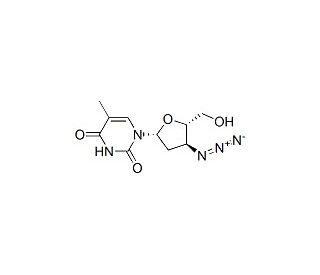

3′-Azido-3′-deoxythymidine (CAS 30516-87-1)
See product citations (2)
QUICK LINKS
3′-Azido-3′-deoxythymidine (AZT), a nucleoside analog, has been extensively researched for its biochemical properties and its role in nucleic acid synthesis. As a nucleoside reverse transcriptase inhibitor (NRTI), AZT impedes the replication of retroviruses, including HIV, by competitively inhibiting the reverse transcriptase enzyme essential for viral DNA synthesis. AZT has been pivotal in elucidating the molecular mechanisms of retroviral replication and the development of antiviral therapies. Researchers have employed AZT as a tool to dissect the intricacies of reverse transcription and to explore potential targets for antiretroviral therapy development. Moreover, AZT′s incorporation into viral DNA by reverse transcriptase and subsequent chain termination have provided insights into the structure-function relationship of nucleoside analogs and their impact on DNA synthesis. Studies have focused on optimizing AZT′s pharmacokinetic properties and enhancing its antiviral efficacy through chemical modifications. Furthermore, AZT has been utilized in research investigating nucleoside analog toxicity and resistance mechanisms. By studying AZT′s interactions with cellular enzymes and nucleic acids, researchers aim to improve the design and efficacy of antiviral agents while minimizing adverse effects.
3′-Azido-3′-deoxythymidine (CAS 30516-87-1) References
- Effects of AZT on cellular iron homeostasis. | Bozzi, A., et al. 2004. Biometals. 17: 443-50. PMID: 15259365
- The 3'-azido group is not the primary determinant of 3'-azido-3'-deoxythymidine (AZT) responsible for the excision phenotype of AZT-resistant HIV-1. | Sluis-Cremer, N., et al. 2005. J Biol Chem. 280: 29047-52. PMID: 15970587
- Mechanisms of zidovudine-induced mitochondrial toxicity and myopathy. | Scruggs, ER. and Dirks Naylor, AJ. 2008. Pharmacology. 82: 83-8. PMID: 18504416
- Renal secretion of 3'-azido-3'-deoxythymidine by the rat. | Chatton, JY., et al. 1990. J Pharmacol Exp Ther. 255: 140-5. PMID: 2213549
- Comparative pharmacokinetics of 3'-azido-3'-deoxythymidine (AZT) and 3'-azido-2',3'-dideoxyuridine (AZddU) in mice. | Doshi, KJ., et al. 1989. Drug Metab Dispos. 17: 590-4. PMID: 2575492
- Synthesis and antiviral activity of several 2,5'-anhydro analogues of 3'-azido-3'-deoxythymidine, 3'-azido-2',3'-dideoxyuridine, 3'-azido-2',3'-dideoxy-5-halouridines, and 3'-deoxythymidine against human immunodeficiency virus and Rauscher-murine leukemia virus. | Lin, TS., et al. 1989. J Med Chem. 32: 1891-5. PMID: 2754712
- Functional characteristics of 3'-azido-3'-deoxythymidine transport at the blood-testis barrier. | Ito, T., et al. 2022. Int J Pharm. 625: 122044. PMID: 35902057
- Interaction of 3'-azido-3'-deoxythymidine with the organic base transporter in a cultured renal epithelium. | Bendayan, R., et al. 1995. Pharmacotherapy. 15: 338-44. PMID: 7667167
- Reduction of 3'-azido-3'-deoxythymidine to 3'-amino-3'-deoxythymidine in human liver microsomes and its relationship to cytochrome P450. | Placidi, L., et al. 1993. Clin Pharmacol Ther. 54: 168-76. PMID: 8354026
Ordering Information
| Product Name | Catalog # | UNIT | Price | Qty | FAVORITES | |
3′-Azido-3′-deoxythymidine, 10 mg | sc-203319 | 10 mg | $61.00 |