
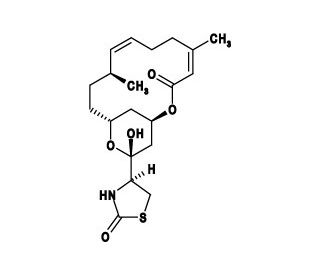

16-epi-Latrunculin B
Direktverknüpfungen
16-epi-Latrunculin B ist ein Derivat der natürlich vorkommenden marinen Verbindung Latrunculin B, die aus dem Meeresschwamm Latrunculia magnifica isoliert wird. Diese Verbindung gehört zur Familie der Latrunculine, die für ihre Fähigkeit bekannt sind, an Aktin zu binden und das Mikrofilament-Netzwerk innerhalb der Zelle zu unterbrechen, das für die Aufrechterhaltung der Zellform, -teilung und -beweglichkeit entscheidend ist. Der primäre Wirkmechanismus von 16-epi-Latrunculin B besteht darin, dass es an Aktinmonomere bindet und deren Polymerisation zu Aktinfilamenten verhindert. Dies führt zu einer Destabilisierung des Zytoskeletts, das für verschiedene zelluläre Prozesse, einschließlich der Aufrechterhaltung der Zellform, der Motilität und des intrazellulären Transports, wesentlich ist. Im Gegensatz zu Latrunculin A weist 16-epi-Latrunculin B eine leichte strukturelle Veränderung auf, die seine Bindungsaffinität und -spezifität gegenüber Aktin beeinflussen kann. In der wissenschaftlichen Forschung wird 16-epi-Latrunculin B ausgiebig zur Untersuchung der Dynamik des Zytoskeletts eingesetzt. Die Forscher nutzen diese Verbindung, um zu verstehen, wie Veränderungen im Aktinnetzwerk das Zellverhalten beeinflussen können. Dies ist besonders nützlich bei Studien, die sich mit der Zellmotilität, der Morphologie und der Mechanik der Zellmigration befassen, sowie bei der Erforschung der Frage, wie sich die Unterbrechung der Aktinpolymerisation auf zelluläre Prozesse auswirken kann. Darüber hinaus wurde 16-epi-Latrunculin B in verschiedenen experimentellen Modellen verwendet, um die Rolle des Zytoskeletts bei Prozessen wie der Endozytose, der Bildung von Zellverbindungen und den Mechanotransduktionswegen, die mechanische Reize in chemische Aktivität umwandeln, zu untersuchen. Durch die Anwendung von 16-epi-Latrunculin B können Wissenschaftler kontrollierte Störungen des Zytoskeletts herbeiführen und die daraus resultierenden Veränderungen in diesen Prozessen beobachten.
16-epi-Latrunculin B Literaturhinweise
- Auf dem Weg zur Berechnung relativer Konfigurationen: 16-epi-latrunculin B, ein neues Stereoisomer des Aktinpolymerisationsinhibitors Latrunculin B. | Hoye, TR., et al. 2002. J Am Chem Soc. 124: 7405-10. PMID: 12071749
- Eine neue Dimension der biosynthetischen Produkte, die aus dem Schwamm Negombata magnifica isoliert wurden. | Vilozny, B., et al. 2004. J Nat Prod. 67: 1055-7. PMID: 15217296
- Abgeleitete Totalsynthese: Herstellung einer gezielten Bibliothek von Latrunculin-Analoga und Bewertung ihrer Aktin-bindenden Eigenschaften. | Fürstner, A., et al. 2005. Proc Natl Acad Sci U S A. 102: 8103-8. PMID: 15917332
- Vollständige Synthese der Aktin-bindenden Makrolide Latrunculin A, B, C, M, S und 16-Epi-Latrunculin B. | Fürstner, A., et al. 2007. Chemistry. 13: 115-34. PMID: 17091520
- Latrunculin-Analoga mit verbesserten biologischen Profilen durch 'umgeleitete Totalsynthese': Herstellung, Bewertung und rechnerische Analyse. | Fürstner, A., et al. 2007. Chemistry. 13: 135-49. PMID: 17091521
- Semisynthetische Latrunculin-B-Analoga: Studien zum Andocken an Aktin unterstützen einen vorgeschlagenen Mechanismus für die Bioaktivität von Latrunculin. | Kudrimoti, S., et al. 2009. Bioorg Med Chem. 17: 7517-22. PMID: 19800245
- Unterschiedliche Bindung von Latrunculinen an G-Aktin: eine molekulardynamische Studie. | Helal, MA., et al. 2013. J Chem Inf Model. 53: 2369-75. PMID: 23988111
- Repertoire an Naturprodukten aus dem Roten Meer. | El-Hossary, EM., et al. 2020. Mar Drugs. 18: PMID: 32899763
- Magnificine A und B, antimikrobielle marine Alkaloide mit einem Tetrahydrooxazolo[3,2-a]azepin-2,5(3H,6H)-dion-Grundgerüst aus dem Rotmeerschwamm Negombata magnifica. | Youssef, DTA., et al. 2021. Mar Drugs. 19: PMID: 33921326
Bestellinformation
| Produkt | Katalog # | EINHEIT | Preis | ANZAHL | Favoriten | |
16-epi-Latrunculin B, 100 µg | sc-220638 | 100 µg | $196.00 |