
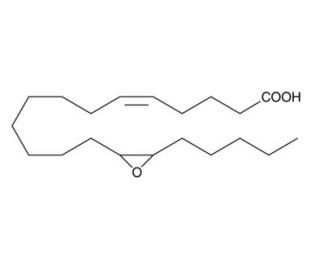

14,15-EE-(5Z)-E (CAS 519038-92-7)
QUICK LINKS
14,15-EE-(5Z)-E, identified by CAS number 519038-92-7, is a specialized epoxyeicosatrienoic acid (EET) derivative, a class of compounds derived from the cytochrome P450-mediated oxidation of arachidonic acid. EETs like 14,15-EE-(5Z)-E are crucial for understanding the biochemical pathways involved in the regulation of cellular functions through their interactions with intracellular signaling mechanisms. Specifically, 14,15-EE-(5Z)-E acts as a signaling molecule that can influence various cellular processes, including those involved in the modulation of inflammation and vascular tone. In research contexts, this compound has been extensively used to study the role of EETs in cellular signaling pathways, particularly how they affect endothelial cells and the regulation of blood flow and pressure in non-medical experimental setups. The compound′s actions are typically mediated through direct effects on specific ion channels or through G-protein coupled receptors, which facilitate the study of signal transduction pathways that are fundamental to cellular physiology. Furthermore, 14,1514,15-EE-(5Z)-E, identified by CAS number 519038-92-7, is a specialized epoxyeicosatrienoic acid (EET) derivative, a class of compounds derived from the cytochrome P450-mediated oxidation of arachidonic acid. EETs like 14,15-EE-(5Z)-E are crucial for understanding the biochemical pathways involved in the regulation of cellular functions through their interactions with intracellular signaling mechanisms. Specifically, 14,15-EE-(5Z)-E acts as a signaling molecule that can influence various cellular processes, including those involved in the modulation of inflammation and vascular tone. In research contexts, this compound has been extensively used to study the role of EETs in cellular signaling pathways, particularly how they affect endothelial cells and the regulation of blood flow and pressure in non-medical experimental setups. The compound′s actions are typically mediated through direct effects on specific ion channels or through G-protein coupled receptors, which facilitate the study of signal transduction pathways that are fundamental to cellular physiology. Furthermore, 14,15-EE-(5Z)-E′s involvement in the pathways of lipid signaling provides insights into the broader role of lipids in cellular communication and function, aiding in the exploration of lipidomics as a significant area of biochemical research.
14,15-EE-(5Z)-E (CAS 519038-92-7) References
- 14,15-Epoxyeicosa-5(Z)-enoic acid: a selective epoxyeicosatrienoic acid antagonist that inhibits endothelium-dependent hyperpolarization and relaxation in coronary arteries. | Gauthier, KM., et al. 2002. Circ Res. 90: 1028-36. PMID: 12016270
- Not so EEZE: the 'EDHF' antagonist 14, 15 epoxyeicosa-5(Z)-enoic acid has vasodilator properties in mesenteric arteries. | Harrington, LS., et al. 2004. Eur J Pharmacol. 506: 165-8. PMID: 15588737
- Characterization of epoxyeicosatrienoic acid binding site in U937 membranes using a novel radiolabeled agonist, 20-125i-14,15-epoxyeicosa-8(Z)-enoic acid. | Yang, W., et al. 2008. J Pharmacol Exp Ther. 324: 1019-27. PMID: 18171909
- 20-125Iodo-14,15-epoxyeicosa-5(Z)-enoic acid: a high-affinity radioligand used to characterize the epoxyeicosatrienoic acid antagonist binding site. | Chen, Y., et al. 2009. J Pharmacol Exp Ther. 331: 1137-45. PMID: 19762546
- Adrenic acid metabolites as endogenous endothelium-derived and zona glomerulosa-derived hyperpolarizing factors. | Kopf, PG., et al. 2010. Hypertension. 55: 547-54. PMID: 20038752
- 14,15-Dihydroxy-eicosa-5(Z)-enoic acid selectively inhibits 14,15-epoxyeicosatrienoic acid-induced relaxations in bovine coronary arteries. | Bukhari, IA., et al. 2011. J Pharmacol Exp Ther. 336: 47-55. PMID: 20881018
- 11,12,20-Trihydroxy-eicosa-8(Z)-enoic acid: a selective inhibitor of 11,12-EET-induced relaxations of bovine coronary and rat mesenteric arteries. | Bukhari, IA., et al. 2012. Am J Physiol Heart Circ Physiol. 302: H1574-83. PMID: 22307677
- Role of Epoxyeicosatrienoic Acids in Acetylcholine-Induced Dilation of Rat Retinal Arterioles in Vivo. | Mori, A., et al. 2021. Biol Pharm Bull. 44: 82-87. PMID: 33390554
- EETs/sEHi alleviates nociception by blocking the crosslink between endoplasmic reticulum stress and neuroinflammation in a central poststroke pain model. | Liu, T., et al. 2021. J Neuroinflammation. 18: 211. PMID: 34530836
- Enhancement of the liver's neuroprotective role ameliorates traumatic brain injury pathology. | Dai, Y., et al. 2023. Proc Natl Acad Sci U S A. 120: e2301360120. PMID: 37339206
Ordering Information
| Product Name | Catalog # | UNIT | Price | Qty | FAVORITES | |
14,15-EE-(5Z)-E, 25 µg | sc-205011 | 25 µg | $70.00 | |||
14,15-EE-(5Z)-E, 50 µg | sc-205011A | 50 µg | $134.00 |