
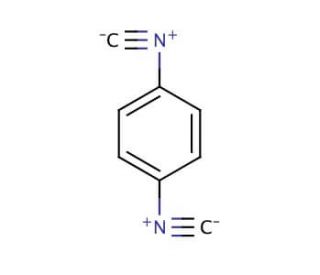

1,4-Phenylene diisocyanide (CAS 935-16-0)
ACCÈS RAPIDE AUX LIENS
Le diisocyanure de phénylène 1,4 appartient à la famille des composés diisocyanures et se compose d'un anneau de phénylène (benzène) avec deux groupes fonctionnels isocyanures (-NC) attachés aux positions 1 et 4. Il s'agit d'un élément de construction polyvalent utilisé en synthèse organique et en chimie de coordination. Par exemple, le 1,4-Diisocyanobenzène est utilisé dans la synthèse du mésylate d'imatinib, un médicament antitumoral. Le diisocyanure de 1,4-phénylène est connu pour sa capacité à former des complexes stables avec les métaux de transition, ce qui le rend précieux pour la préparation de cadres métallo-organiques (MOF), de polymères de coordination et d'autres assemblages supramoléculaires.
1,4-Phenylene diisocyanide (CAS 935-16-0) Références
- Mesures de conductance à basse température de monocouches auto-assemblées de diisocyanure de 1,4-phénylène. | Dupraz, CJ., et al. 2003. Chemphyschem. 4: 1247-52. PMID: 14653008
- Auto-assemblage du diisocyanure de 1,4-phénylène et de l'acide téréphtalique sur Ni, Cu et Pt. | Pranger, L. and Tannenbaum, R. 2005. J Colloid Interface Sci. 292: 71-8. PMID: 15978605
- Spectroscopie Raman améliorée par la surface et mesures de la conductivité électrique du 1,4-phénylène diisocyanide dans des jonctions électroniques moléculaires. | Jaiswal, A., et al. 2006. Anal Chem. 78: 120-4. PMID: 16383318
- Étude spectroscopique Raman améliorée par la surface du diisocyanure de 1,4-phénylène adsorbé sur des électrodes d'or et de métaux de transition du groupe du platine. | Gruenbaum, SM., et al. 2006. J Phys Chem B. 110: 4782-92. PMID: 16526715
- Stabilité chimique et caractérisation des polymères de coordination rhodium-diisocyanide. | Carson, CG., et al. 2007. J Phys Chem B. 111: 14114-20. PMID: 18047318
- Coopérativité du cytochrome P450 1A2: interactions du 1,4-phénylène diisocyanide et du 1-isopropoxy-4-nitrobenzène. | Isin, EM., et al. 2008. Arch Biochem Biophys. 473: 69-75. PMID: 18328798
- Liaison de nanoparticules d'or avec des oligomères conducteurs de 1,4-phénylène diisocyanide-or. | Kestell, J., et al. 2013. Chem Commun (Camb). 49: 1422-4. PMID: 23310932
- Adsorption unidirectionnelle de 1,4-phénylène diisocyanide bifonctionnel sur la surface Ge(100)-2 × 1. | Shong, B., et al. 2015. J Phys Chem Lett. 6: 1037-41. PMID: 26262866
- Détermination des structures d'adsorption du diisocyanure de phénylène-1,4 sur l'or. | Kestell, J., et al. 2014. J Phys Chem Lett. 5: 3577-81. PMID: 26278612
- Chimisorption coopérative induite par la physisorption de molécules de CO2 par des chaînes métallo-organiques. | Feng, M., et al. 2015. ACS Nano. 9: 12124-36. PMID: 26548479
- Nanostructuration de Au(111) lors de l'adsorption d'un isocyanure aromatique à partir d'une solution. | Ghalgaoui, A., et al. 2017. Langmuir. 33: 91-99. PMID: 27996271
- Nanoarchitectures bimétalliques Au@M (M = Ag, Pd, Fe et Cu) médiées par la fonctionnalisation du 1,4-phénylène diisocyanide. | Kang, JS., et al. 2018. Langmuir. 34: 2849-2855. PMID: 29400974
- Stratégies d'auto-assemblage chimique pour la conception de circuits électroniques moléculaires. | Olson, D., et al. 2019. Chem Commun (Camb). 55: 13872-13875. PMID: 31674624
Informations pour la commande
| Nom du produit | Ref. Catalogue | COND. | Prix HT | QTÉ | Favoris | |
1,4-Phenylene diisocyanide, 1 g | sc-223061 | 1 g | $315.00 |