
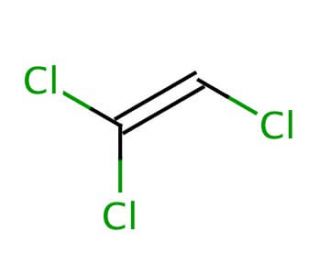

Trichloroethylene (CAS 79-01-6)
LINK RAPIDI
Il tricloroetilene, comunemente abbreviato in TCE, è un idrocarburo clorurato con formula chimica C2HCl3. Questo liquido incolore e non infiammabile ha un odore dolce ed è noto soprattutto per il suo ampio utilizzo come solvente in applicazioni industriali. La struttura chimica del TCE, caratterizzata da tre atomi di cloro attaccati a uno scheletro di carbonio a doppio legame, conferisce un elevato grado di volatilità e la capacità di sciogliere un'ampia gamma di materiali organici, il che lo ha reso storicamente il solvente preferito nelle operazioni di sgrassaggio delle parti metalliche. Al di là dei suoi usi industriali, il tricloroetilene ha svolto un ruolo significativo nella ricerca scientifica, in particolare nello studio della sintesi organica e della scienza dei materiali. Negli ambienti di ricerca, il TCE viene spesso utilizzato come solvente per estrarre, purificare e ricristallizzare i composti organici, grazie alla sua efficacia nel dissolvere sostanze non polari senza alterare o danneggiare strutture chimiche sensibili. Inoltre, le sue proprietà sono state sfruttate nello studio degli effetti dei solventi sui meccanismi di reazione, aiutando i chimici a capire come le variazioni di polarità e reattività dei solventi influenzino i risultati delle reazioni chimiche. Il tricloroetilene è stato anche oggetto di ricerca in campo ambientale a causa della sua persistenza e del suo impatto sugli ecosistemi, portando a studi incentrati sulla sua degradazione, sul destino ambientale e sullo sviluppo di tecnologie di bonifica per affrontare la contaminazione da TCE nei suoli e nelle acque sotterranee.
Trichloroethylene (CAS 79-01-6) Referenze
- Necroptosi delle cellule tubulari renali: Un nuovo meccanismo di danno renale nei topi con sindrome di ipersensibilità al tricloroetilene. | Wang, Y., et al. 2021. J Immunotoxicol. 18: 173-182. PMID: 34788186
- Il tricloroetilene modifica i metaboliti energetici nel liquido amniotico dei ratti Wistar. | Su, AL., et al. 2022. Reprod Toxicol. 109: 80-92. PMID: 35301063
- Esposizione professionale al tricloroetilene e anticorpi antinucleari: uno studio trasversale in Cina. | Purdue, M., et al. 2022. Occup Environ Med. 79: 717-720. PMID: 35504721
- Bonifica del tricloroetilene utilizzando ferro zero-valente con argilla caolino, carbone attivo e batteri. | Zhu, J., et al. 2022. Water Res. 226: 119186. PMID: 36244142
- Recenti progressi e tendenze della biodegradazione del tricloroetilene: Una revisione critica. | Wu, Z., et al. 2022. Front Microbiol. 13: 1053169. PMID: 36620007
- [Panoramica delle malattie professionali indotte dal tricloroetilene e ricerca di base associata]. | Nasu Nakajima, T., et al. 2023. Sangyo Eiseigaku Zasshi. 65: 171-182. PMID: 37211415
- L'acetilazione di HMGB 1 media il danno renale immunitario indotto dal tricloroetilene facilitando la comunicazione tra cellule endoteliali e podociti. | Zhang, X., et al. 2023. Ecotoxicol Environ Saf. 259: 115042. PMID: 37216866
- L'esposizione per inalazione a basse dosi di tricloroetilene induce neurodegenerazione dopaminergica nei roditori. | Adamson, A., et al. 2023. Toxicol Sci. 196: 218-228. PMID: 37669148
- Materiali a rilascio controllato per la bonifica della contaminazione da tricloroetilene nelle acque sotterranee. | Zhao, S., et al. 2023. Materials (Basel). 16: PMID: 37959642
- La malattia di Parkinson è prevalentemente una malattia ambientale. | Dorsey, ER. and Bloem, BR. 2024. J Parkinsons Dis. 14: 451-465. PMID: 38217613
Informazioni ordini
| Nome del prodotto | Codice del prodotto | UNITÀ | Prezzo | Quantità | Preferiti | |
Trichloroethylene, 500 ml | sc-251310 | 500 ml | $66.00 | |||
Trichloroethylene, 1 L | sc-251310A | 1 L | $110.00 |