
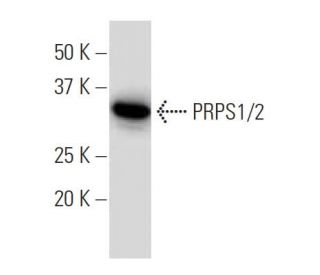

PRPS1/2 Antibody (EE-17): sc-100822
- PRPS1/2 Antibody (EE-17) is a mouse monoclonal IgG3 PRPS1/2 antibody, cited in 7 publications, provided at 100 µg/ml
- raised against recombinant PRPS1/2 of human origin
- recommended for detection of PRPS1 and PRPS2 of mouse, rat and human origin by WB and IP
- At present, we have not yet completed the identification of the preferred secondary detection reagent(s) for PRPS1/2 Antibody (EE-17). This work is in progress.

PRPS1/2 Antibody (EE-17) is a mouse monoclonal IgG3 antibody that detects PRPS1/2 protein of mouse, rat, and human origin by western blotting (WB) and immunoprecipitation (IP). Anti-PRPS1/2 antibody (EE-17) is available as the non-conjugated format. The PRPS (phosphoribosyl pyrophosphate synthetase) proteins are crucial enzymes that catalyze the synthesis of phosphoribosyl pyrophosphate (PRPP), a key substrate in nucleotide biosynthesis. The three human PRPS isoforms, encoded by distinct genes, include PRPS1 and PRPS2, which are ubiquitously expressed, while PRPS3 is specific to the testis. PRPP is synthesized from MgATP and ribose-5-phosphate in a reaction that requires inorganic phosphate and magnesium as a cofactor, making PRPP essential for the production of nearly all nucleotides. This highlights the significant role of PRPS1/2 in purine metabolism and nucleotide biosynthesis. Mutations in the PRPS1 gene can lead to PRPS superactivity, resulting in conditions such as gout due to the overproduction of purine nucleotides, uric acid, and PRPP. Conversely, certain mutations can reduce PRPS1 activity, leading to disorders like ARTS syndrome or Charcot-Marie-Tooth disease X-linked recessive type 5 (CMTX5). PRPS1/2 (EE-17) antibody effectively detects these proteins, making PRPS1/2 (EE-17) antibody a valuable tool for research into nucleotide metabolism and related diseases.
Alexa Fluor® is a trademark of Molecular Probes Inc., OR., USA
LI-COR® and Odyssey® are registered trademarks of LI-COR Biosciences
PRPS1/2 Antibody (EE-17) References:
- Accelerated transcription of PRPS1 in X-linked overactivity of normal human phosphoribosylpyrophosphate synthetase. | Ahmed, M., et al. 1999. J Biol Chem. 274: 7482-8. PMID: 10066814
- Phosphoribosylpyrophosphate synthetase overactivity as a cause of uric acid overproduction in a young woman. | García-Pavía, P., et al. 2003. Arthritis Rheum. 48: 2036-41. PMID: 12847698
- Promoter regions of the human X-linked housekeeping genes PRPS1 and PRPS2 encoding phosphoribosylpyrophosphate synthetase subunit I and II isoforms. | Ishizuka, T., et al. 1992. Biochim Biophys Acta. 1130: 139-48. PMID: 1314091
- Phosphoribosyl pyrophosphate formation in the rat adrenal gland in relation to adrenal growth in experimental diabetes. | Kunjara, S., et al. 1992. Diabetes. 41: 1429-35. PMID: 1383069
- Expression, purification, crystallization and preliminary X-ray diffraction analysis of human phosphoribosyl pyrophosphate synthetase 1 (PRS1). | Tang, W., et al. 2006. Acta Crystallogr Sect F Struct Biol Cryst Commun. 62: 432-4. PMID: 16682768
- Crystal structure of human phosphoribosylpyrophosphate synthetase 1 reveals a novel allosteric site. | Li, S., et al. 2007. Biochem J. 401: 39-47. PMID: 16939420
- Arts syndrome is caused by loss-of-function mutations in PRPS1. | de Brouwer, AP., et al. 2007. Am J Hum Genet. 81: 507-18. PMID: 17701896
- Mutations in PRPS1, which encodes the phosphoribosyl pyrophosphate synthetase enzyme critical for nucleotide biosynthesis, cause hereditary peripheral neuropathy with hearing loss and optic neuropathy (cmtx5). | Kim, HJ., et al. 2007. Am J Hum Genet. 81: 552-8. PMID: 17701900
- [PRPP synthetase superactivity]. | Fujimori, S. 1996. Nihon Rinsho. 54: 3309-14. PMID: 8976111
Ordering Information
| Product Name | Catalog # | UNIT | Price | Qty | FAVORITES | |
PRPS1/2 Antibody (EE-17) | sc-100822 | 100 µg/ml | $339.00 |