
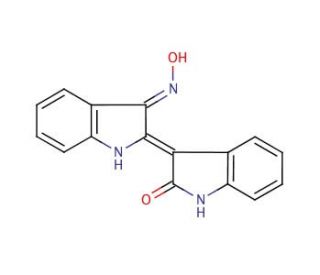

Indirubin-3′-monoxime (CAS 160807-49-8)
Vedere citazioni di prodotto (1)
LINK RAPIDI
L'indirubina-3'-monoxima, un composto chimico derivato dall'indirubina presente in natura, è diventata uno strumento prezioso nella ricerca scientifica, in particolare nel campo della biologia cellulare e della trasduzione del segnale. Il suo meccanismo d'azione consiste nell'inibire le chinasi ciclina-dipendenti (CDK), in particolare CDK1 e CDK5, competendo con il legame dell'ATP al sito catalitico. Questa inibizione determina l'arresto del ciclo cellulare e la modulazione di vari processi cellulari regolati dall'attività delle CDK, come la proliferazione, la differenziazione e l'apoptosi. Inoltre, è stato dimostrato che l'indirubina-3'-monoxima ha proprietà antinfiammatorie sopprimendo l'attività della glicogeno sintasi chinasi-3β (GSK-3β) e la via di segnalazione del fattore nucleare kappa-catena leggera-enhancer delle cellule B attivate (NF-κB). In ambito di ricerca, l'indirubina-3'-monoxima è stata ampiamente utilizzata per studiare le funzioni delle CDK e il loro coinvolgimento nei processi cellulari, tra cui la neurogenesi, la differenziazione neuronale e la plasticità sinaptica. Inoltre, la sua capacità di modulare l'attività delle CDK ha portato alla sua esplorazione come agente nei disturbi neurologici, come il morbo di Alzheimer e il morbo di Parkinson, e nella ricerca sul cancro. Nel complesso, l'indirubina-3'-monoxima è uno strumento versatile per svelare la complessità delle vie di segnalazione cellulare e promette di sviluppare nuovi interventi mirati alle CDK e alle vie associate in varie condizioni patologiche.
Indirubin-3′-monoxime (CAS 160807-49-8) Referenze
- Le indirubine inibiscono la glicogeno sintasi chinasi-3 beta e la CDK5/p25, due proteine chinasi coinvolte nella fosforilazione anomala della tau nella malattia di Alzheimer. Una proprietà comune alla maggior parte degli inibitori delle chinasi ciclino-dipendenti? | Leclerc, S., et al. 2001. J Biol Chem. 276: 251-60. PMID: 11013232
- Inibizione della chinasi 1 ciclina-dipendente (CDK1) da parte di derivati dell'indirubina in cellule tumorali umane. | Marko, D., et al. 2001. Br J Cancer. 84: 283-9. PMID: 11161389
- Applicazione di un test di potenziale di membrana omogeneo per valutare la funzione mitocondriale. | Sakamuru, S., et al. 2012. Physiol Genomics. 44: 495-503. PMID: 22433785
- Screening di inibitori di protein-chinasi umane mediante elettroforesi capillare utilizzando la diffusione trasversale di profili di flusso laminare per la miscelazione dei reagenti. | Nehmé, H., et al. 2013. J Chromatogr A. 1314: 298-305. PMID: 24075461
- Profilo degli inibitori della chinasi per nek1, nek6 e nek7 umani e analisi delle basi strutturali della specificità degli inibitori. | Moraes, EC., et al. 2015. Molecules. 20: 1176-91. PMID: 25591119
- La piccola molecola indirubina-3'-ossima inibisce la proteina chinasi R: effetto antiapoptotico e antiossidante nei miociti cardiaci di ratto. | Udumula, MP., et al. 2016. Pharmacology. 97: 25-30. PMID: 26571010
- Screening high-throughput e analisi bioinformatica per individuare i composti che prevengono l'apoptosi delle cellule β indotta dagli acidi grassi saturi. | Lee, SH., et al. 2017. Biochem Pharmacol. 138: 140-149. PMID: 28522407
- La morte cellulare simile all'oncosi è indotta dalla berberina attraverso la compromissione della respirazione aerobica mitocondriale mediata da ERK1/2 nei gliomi. | Sun, Y., et al. 2018. Biomed Pharmacother. 102: 699-710. PMID: 29604589
- Effetti inibitori dell'indirubina-3'-monoxima contro l'osteosarcoma umano. | Zhang, Y., et al. 2019. IUBMB Life. 71: 1465-1474. PMID: 31050877
- Identificazione di due inibitori di chinasi con tossicità sinergica con il perossido di idrogeno a basse dosi in cellule di cancro colorettale in vitro. | Freund, E., et al. 2020. Cancers (Basel). 12: PMID: 31906582
Informazioni ordini
| Nome del prodotto | Codice del prodotto | UNITÀ | Prezzo | Quantità | Preferiti | |
Indirubin-3′-monoxime, 1 mg | sc-202660 | 1 mg | $79.00 | |||
Indirubin-3′-monoxime, 5 mg | sc-202660A | 5 mg | $321.00 | |||
Indirubin-3′-monoxime, 50 mg | sc-202660B | 50 mg | $671.00 |