
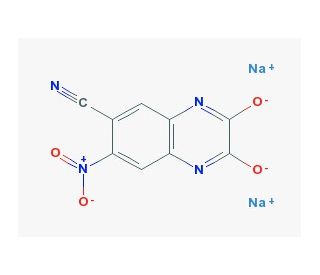

CNQX disodium salt 的分子结构, CAS编号: 479347-85-8
CNQX disodium salt (CAS 479347-85-8)
查看产品引用文献(5)
备用名:
6-Cyano-7-nitroquinoxaline-2,3-dione disodium
应用:
CNQX disodium salt 是一种竞争性 kainate/qualate 受体抑制剂
CAS号码:
479347-85-8
分子量:
276.12
分子式:
C9H2N4O4•2Na
仅供科研使用。不可用于诊断或治疗。
* 参考分析证明 大量特定数据 (包括水 含量).
快捷链接
订购信息
产品相关文献索引
描述
技术信息
安全信息
安全技术说明书和分析证明书
CNQX二钠盐是一种有效且具有竞争力的GluR(谷氨酸/天冬氨酸(非NMDA)受体)拮抗剂。它还显示出对NMDA受体甘氨酸调节位点的拮抗作用。它是CNQX的一种更易溶于水的形式。此外,它还是AMPA受体的非竞争性拮抗剂。它与该受体结合并阻断谷氨酸与AMPA受体的结合,从而防止AMPA受体的激活。这可以防止谷氨酸的释放,谷氨酸是一种兴奋性神经递质,导致神经元兴奋减少。在体外,CNQX二钠盐已被证明可以抑制cAMP依赖性蛋白激酶A的活性,以及蛋白激酶C的活性。
CNQX disodium salt (CAS 479347-85-8) 参考文献
- 6-氰基-7-硝基喹喔啉-2,3-二酮对腹角神经元突触电位的拮抗作用:大鼠脊髓离体研究。 | King, AE., et al. 1992. Br J Pharmacol. 107: 375-81. PMID: 1358390
- 注入下丘脑丘上核的谷氨酸受体拮抗剂可干扰血浆泌乳素和皮质酮水平的昼夜波动,而注入间脑背侧剑突核则可减轻哺乳刺激引起的大鼠泌乳素释放。 | Bodnár, I., et al. 2009. Brain Res Bull. 80: 9-16. PMID: 19539728
- 6-氰基-2,3-二羟基-7-硝基喹喔啉(CNQX)对体外大鼠运动神经元背根, NMDA, 凯因酸盐和喹喔啉酸盐介导的去极化的影响 | Long, SK., et al. 1990. Br J Pharmacol. 100: 850-4. PMID: 1976402
- 兴奋性氨基酸受体激动剂和竞争性拮抗剂开发过程中的结构-活性关系。 | Watkins, JC., et al. 1990. Trends Pharmacol Sci. 11: 25-33. PMID: 2155495
- 在急性癫痫模型中,大鼠Cornu Ammonis 1区一连串动作电位后的超极化电位受到抑制。 | Kernig, K., et al. 2012. Neuroscience. 201: 288-96. PMID: 22100272
- 比较萘法必利, CNQX 和氟哌啶醇对大鼠苯丙胺条件性位置偏好的获得和表现的影响。 | Banasikowski, TJ., et al. 2012. Behav Pharmacol. 23: 89-97. PMID: 22157177
- 视紫红质 P347L 转基因兔子的感光器和后感光器对光视 ERG a 波的贡献。 | Hirota, R., et al. 2012. Invest Ophthalmol Vis Sci. 53: 1467-72. PMID: 22273723
- 杏仁中央核内的 NMDA 或非 NMDA 受体拮抗剂可抑制大鼠疼痛的情感维度:半球协同作用的证据。 | Spuz, CA. and Borszcz, GS. 2012. J Pain. 13: 328-37. PMID: 22424916
- 刺激楔状核可抑制攀缘纤维的突触激活。 | Geborek, P., et al. 2012. Front Neural Circuits. 6: 120. PMID: 23335886
- 下丘脑室旁核的嘌呤能和谷氨酸能相互作用调节交感神经外流 | Ferreira-Neto, HC., et al. 2013. Purinergic Signal. 9: 337-49. PMID: 23400372
- 失神性癫痫 '镜像 '新遗传模型中的丘脑皮层关系和网络同步。 | Gigout, S., et al. 2013. Brain Res. 1525: 39-52. PMID: 23743261
- 在氧-葡萄糖剥夺模型中,MK-801, CNQX, 硝苯地平和 AP-3 对小脑颗粒细胞原代培养物的单一效应和组合效应。 | Zăgrean, AM., et al. 2014. Rom J Morphol Embryol. 55: 811-6. PMID: 25329107
- 大鼠内侧核的兴奋性矿氨酸能神经支配--对上升唤醒, 动机和进食控制的影响 | Blasiak, A., et al. 2015. Neuropharmacology. 99: 432-47. PMID: 26265304
- N-油酰多巴胺通过多种机制调节中脑多巴胺能神经元的活动。 | Sergeeva, OA., et al. 2017. Neuropharmacology. 119: 111-122. PMID: 28400256
- 喹喔啉二酮:强效竞争性非 NMDA 谷氨酸受体颉颃物。 | Honoré, T., et al. 1988. Science. 241: 701-3. PMID: 2899909
抑制剂:
GluR.订购信息
| 产品名称 | 产品编号 | 规格 | 价格 | 数量 | 收藏夹 | |
CNQX disodium salt, 1 mg | sc-203003B | 1 mg | $61.00 | |||
CNQX disodium salt, 5 mg | sc-203003 | 5 mg | $91.00 | |||
CNQX disodium salt, 10 mg | sc-203003A | 10 mg | $154.00 | |||
CNQX disodium salt, 25 mg | sc-203003C | 25 mg | $316.00 | |||
CNQX disodium salt, 50 mg | sc-203003D | 50 mg | $543.00 | |||
CNQX disodium salt, 100 mg | sc-203003E | 100 mg | $1138.00 |