
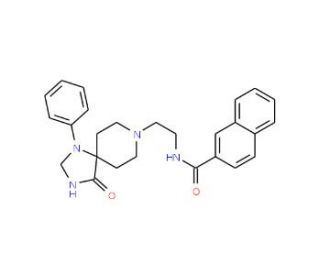

CAY10594 (CAS 1130067-34-3)
See product citations (8)
QUICK LINKS
CAY10594 is a Phospholipase D (PLD) inhibitor. PLD is an enzyme that cleaves the head group from phospholipids, producing the second messenger phosphatidic acid. Two mammalian isoforms of PLD (PLD1 and PLD2) have been identified, with multiple splice variants of each. Although the two isoforms share functional and structural features, they are regulated differently and apparently serve distinct biological roles. CAY10594 is a potent PC-PLD2 inhibitor in vitro (IC50 = 140 nM). It also inhibits PC-PLD1 at higher concentrations (IC50 = 5.1 muM). CAY10594 strongly inhibits the invasive migration of breast cancer cells in transwell assays, suggesting that PLD might be a useful target in blocking tumor cell invasion.
CAY10594 (CAS 1130067-34-3) References
- Design of isoform-selective phospholipase D inhibitors that modulate cancer cell invasiveness. | Scott, SA., et al. 2009. Nat Chem Biol. 5: 108-17. PMID: 19136975
- Stress peptide PACAP engages multiple signaling pathways within the carotid body to initiate excitatory responses in respiratory and sympathetic chemosensory afferents. | Roy, A., et al. 2013. Am J Physiol Regul Integr Comp Physiol. 304: R1070-84. PMID: 23594614
- CAY10593 inhibits the human P2X7 receptor independently of phospholipase D1 stimulation. | Pupovac, A., et al. 2013. Purinergic Signal. 9: 609-19. PMID: 23793974
- Activation of AMPK/TSC2/PLD by alcohol regulates mTORC1 and mTORC2 assembly in C2C12 myocytes. | Hong-Brown, LQ., et al. 2013. Alcohol Clin Exp Res. 37: 1849-61. PMID: 23895284
- Phospholipase D activity underlies very-low-density lipoprotein (VLDL)-induced aldosterone production in adrenal glomerulosa cells. | Tsai, YY., et al. 2014. Endocrinology. 155: 3550-60. PMID: 24956203
- Aquaporin-3 re-expression induces differentiation in a phospholipase D2-dependent manner in aquaporin-3-knockout mouse keratinocytes. | Choudhary, V., et al. 2015. J Invest Dermatol. 135: 499-507. PMID: 25233074
- Phospholipase D enzymes facilitate IL-17- and TNFα-induced expression of proinflammatory genes in rheumatoid arthritis synovial fibroblasts (RASF). | Friday, SC. and Fox, DA. 2016. Immunol Lett. 174: 9-18. PMID: 27058440
- Blockade of PLD2 Ameliorates Intestinal Mucosal Inflammation of Inflammatory Bowel Disease. | Zhou, G., et al. 2016. Mediators Inflamm. 2016: 2543070. PMID: 27721573
- Regulation of the Hippo Pathway by Phosphatidic Acid-Mediated Lipid-Protein Interaction. | Han, H., et al. 2018. Mol Cell. 72: 328-340.e8. PMID: 30293781
- Role of phospholipase D in migration and invasion induced by linoleic acid in breast cancer cells. | Diaz-Aragon, R., et al. 2019. Mol Cell Biochem. 457: 119-132. PMID: 30877512
- A phospholipase D2 inhibitor, CAY10594, ameliorates acetaminophen-induced acute liver injury by regulating the phosphorylated-GSK-3β/JNK axis. | Lee, SK., et al. 2019. Sci Rep. 9: 7242. PMID: 31076618
- Phosphatidic acid regulates subcellular distribution of RA-GEFs critical for chemokine-dependent migration. | Momoi, Y., et al. 2020. Biochem Biophys Res Commun. 524: 325-331. PMID: 31996307
- Cucurbitacin B-, E-, and I-Induced Browning of White Adipocytes Is Promoted by the Inhibition of Phospholipase D2. | Park, SY., et al. 2022. Int J Mol Sci. 23: PMID: 36499689
Ordering Information
| Product Name | Catalog # | UNIT | Price | Qty | FAVORITES | |
CAY10594, 1 mg | sc-223874 | 1 mg | $82.00 | |||
CAY10594, 5 mg | sc-223874A | 5 mg | $266.00 |