
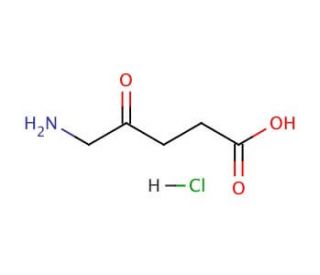

Struttura molecolare di 5-Aminolevulinic Acid Hydrochloride Salt, Numero CAS: 5451-09-2
5-Aminolevulinic Acid Hydrochloride Salt (CAS 5451-09-2)
Vedere citazioni di prodotto (2)
Nomi alternativi:
5-Aminolevulinic Acid Hydrochloride Salt is also known as 5-ALA.
Applicazione:
5-Aminolevulinic Acid Hydrochloride Salt è un aminoacido presente in natura e un precursore dei tetrapirroli.
Numero CAS:
5451-09-2
Purezza:
≥98%
Peso molecolare:
167.59
Formula molecolare:
C5H9NO3•HCl
Solo per uso in Ricerca. Non previsto per Uso Diagnostico o Terapeutico.
* Vedere Certificato di Analisi per informazioni sul lotto specifico (incluso il contenuto d'acqua).
LINK RAPIDI
Informazioni ordini
Citazioni prodotti
Descrizione
Informazione tecnica
Informazioni di sicurezza
SDS & Certificato d'analisi
L'acido 5-amminolevulinico sale cloridrato (5-ALA HCl) è un aminoacido presente in natura e un precursore dei tetrapirroli nella biosintesi della clorofilla e dell'eme. È considerato un fotosensibilizzatore antineoplastico. Il sale cloridrato di acido 5-amminolevulinico si converte in protoporfirine all'interno dei tessuti in seguito all'esposizione alla luce, producendo sottoprodotti sotto forma di specie reattive dell'ossigeno. È noto per le sue attività antinfiammatorie, antiossidanti e antitumorali. I ricercatori studiano gli effetti del sale cloridrato di acido 5-amminolevulinico su vari processi biologici, come infiammazione, proliferazione cellulare ed espressione genica.
5-Aminolevulinic Acid Hydrochloride Salt (CAS 5451-09-2) Referenze
- Biosintesi, produzione biotecnologica e applicazioni dell'acido 5-aminolevulinico. | Sasaki, K., et al. 2002. Appl Microbiol Biotechnol. 58: 23-9. PMID: 11831472
- L'acido 5-aminolevulinico allevia i cambiamenti indotti dalla salinità in Brassica napus, come rivelato dallo studio ultrastrutturale del cloroplasto. | Naeem, MS., et al. 2012. Plant Physiol Biochem. 57: 84-92. PMID: 22695221
- Effetti dell'acido 5-aminolevulinico esogeno sull'espressione dei geni dell'acquaporina PIP1 e NIP in piantine di cultivar di cetriolo sottoposte a stress da salinità. | Yan, F., et al. 2014. Genet Mol Res. 13: 2563-73. PMID: 24535911
- Effetti fisiologici e metabolici dell'acido 5-aminolevulinico per mitigare lo stress da salinità nella gramigna strisciante. | Yang, Z., et al. 2014. PLoS One. 9: e116283. PMID: 25551443
- Una nuova strategia per la produzione di acido 5-amminolevulinico in Corynebacterium glutamicum ricombinante ad alta resa. | Yang, P., et al. 2016. Appl Environ Microbiol. 82: 2709-2717. PMID: 26921424
- Strumenti tradizionali e nuovi per sondare il metabolismo mitocondriale in salute e malattia. | Zhang, Y. and Avalos, JL. 2017. Wiley Interdiscip Rev Syst Biol Med. 9: PMID: 28067471
- L'acido 5-aminolevulinico migliora la tolleranza al sale mediata dalla regolazione del metabolismo del tetrapirrolo e della prolina nelle piantine di Brassica napus L. sottoposte a stress da NaCl. | Xiong, JL., et al. 2018. Plant Physiol Biochem. 124: 88-99. PMID: 29353686
- L'acido 5-amminolevulinico (ALA) ha alleviato lo stress da salinità nelle piantine di cetriolo potenziando la via di sintesi della clorofilla. | Wu, Y., et al. 2018. Front Plant Sci. 9: 635. PMID: 29868088
- Effetti sinergici dell'acido 5-aminolevulinico e degli estratti di alga Ascophyllum nodosum sui fenoli dell'asparago e sui geni correlati allo stress in condizioni di irrigazione salina. | Al-Ghamdi, AA. and Elansary, HO. 2018. Plant Physiol Biochem. 129: 273-284. PMID: 29906777
- Il perossido di idrogeno come mediatore della ritenzione di Na+ indotta dall'acido 5-aminolevulinico nelle radici per migliorare la tolleranza al sale delle fragole. | Wu, WW., et al. 2019. Physiol Plant. 167: 5-20. PMID: 30891756
- Studi meccanici sulla porfobilinogeno sintasi (acido 5-aminolevulinico deidratasi) di Pyrobaculum calidifontis. | Azim, N., et al. 2019. Bioorg Chem. 91: 103117. PMID: 31377385
- L'acido 5-amminolevulinico migliora la morfogenesi e la distribuzione subcellulare del Na+ nelle cellule apicali di Cucumis sativus L. sotto stress da salinità. | Wu, Y., et al. 2021. Front Plant Sci. 12: 636121. PMID: 33815443
- L'esposizione delle radici all'acido 5-amminolevulinico (ALA) influisce sull'accumulo di elementi fogliari, sull'emissione di isoprene, sull'equilibrio fitormonale e sulla fotosintesi di Arundo donax stressata dal sale. | Brilli, F., et al. 2022. Int J Mol Sci. 23: PMID: 35457125
- Produzione di acido 5-aminolevulinico da idrolizzati di residui di manioca e scarti di pesce da parte di Bacillus cereus PT1 ingegnerizzato. | Luo, Y., et al. 2023. Microb Biotechnol. 16: 381-391. PMID: 35920136
- Effetto dell'età e di varie sostanze chimiche sulla fase di ritardo della sintesi clorofilliana in piantine di fagiolo cresciute al buio | Edward C. Sisler and William H. Klein. 1963. Physiologia Plantarum. 16: 315.
Inibitore di:
INSIG-1.Attivatore di:
ACAT-2, AKR1B7, ALAS-E, ASA, C20orf3, COX10, CYP4V3, Fdx1, ISCA1, Mitochondrial Topo I, MMAB, MRM1, MRP-L41, OTTMUSG00000016453, p20-ARC, PCCA, PECI, PMPCB, TMEM14A, Tom40, Tom40B, Transcobalamin I, e UROD.Informazioni ordini
| Nome del prodotto | Codice del prodotto | UNITÀ | Prezzo | Quantità | Preferiti | |
5-Aminolevulinic Acid Hydrochloride Salt, 1 g | sc-262399 | 1 g | $41.00 | |||
5-Aminolevulinic Acid Hydrochloride Salt, 5 g | sc-262399A | 5 g | $110.00 | |||
5-Aminolevulinic Acid Hydrochloride Salt, 25 g | sc-262399B | 25 g | $320.00 | |||
5-Aminolevulinic Acid Hydrochloride Salt, 100 g | sc-262399C | 100 g | $1400.00 |