
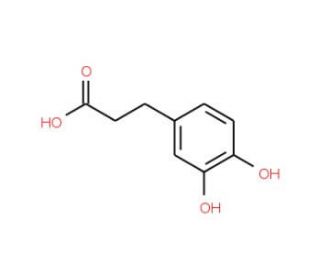

3,4-Dihydroxyhydrocinnamic acid (CAS 1078-61-1)
See product citations (3)
QUICK LINKS
3,4-Dihydroxyhydrocinnamic acid is a compound studied for its role in plant metabolism and as a potential intermediate in the biosynthesis of various phenolic compounds. In plant science research, it is often examined for its part in the phenylpropanoid pathway, a key route for the production of lignin, flavonoids, and other important plant compounds. Researchers investigate the enzymatic reactions 3,4-Dihydroxyhydrocinnamic acid undergoes and how it contributes to the defense mechanisms of plants against pathogens. In addition, this compound is used to study the antioxidant properties of phenolic substances, which is relevant in the context of stress response in plants. The research on 3,4-Dihydroxyhydrocinnamic acid also extends to its potential use as a natural antioxidant in food and cosmetic applications, where it may contribute to the stability and shelf-life of products.
3,4-Dihydroxyhydrocinnamic acid (CAS 1078-61-1) References
- Naphthalenemethyl ester derivative of dihydroxyhydrocinnamic acid, a component of cinnamon, increases glucose disposal by enhancing translocation of glucose transporter 4. | Kim, W., et al. 2006. Diabetologia. 49: 2437-48. PMID: 16896937
- Ferric-reducing ability power of selected plant polyphenols and their metabolites: implications for clinical studies on the antioxidant effects of fruits and vegetable consumption. | deGraft-Johnson, J., et al. 2007. Basic Clin Pharmacol Toxicol. 100: 345-52. PMID: 17448122
- Potentiometric studies on the complexation of copper(II) by phenolic acids as discrete ligand models of humic substances. | Borges, F., et al. 2005. Talanta. 66: 670-3. PMID: 18970037
- Facile surface functionalization of hydrophobic magnetic nanoparticles. | Liu, Y., et al. 2014. J Am Chem Soc. 136: 12552-5. PMID: 25140614
- Identification and Quantification of Potential Anti-inflammatory Hydroxycinnamic Acid Amides from Wolfberry. | Wang, S., et al. 2017. J Agric Food Chem. 65: 364-372. PMID: 28008757
- Bio-inspired catechol conjugation converts water-insoluble chitosan into a highly water-soluble, adhesive chitosan derivative for hydrogels and LbL assembly. | Kim, K., et al. 2013. Biomater Sci. 1: 783-790. PMID: 32481831
- Structural basis of antiviral activity of caffeic acid against severe fever with thrombocytopenia syndrome virus. | Ogawa, M., et al. 2021. J Infect Chemother. 27: 397-400. PMID: 33109438
- Evaluation of fermentation assisted by Lactobacillus brevis POM, and Lactobacillus plantarum (TR-7, TR-71, TR-14) on antioxidant compounds and organic acids of an orange juice-milk based beverage. | de la Fuente, B., et al. 2021. Food Chem. 343: 128414. PMID: 33131951
- Bio-Based Hotmelt Adhesives with Well-Adhesion in Water. | Yu, X., et al. 2021. Polymers (Basel). 13: PMID: 33672307
- Eriocitrin: A review of pharmacological effects. | Yao, L., et al. 2022. Biomed Pharmacother. 154: 113563. PMID: 35987162
- Fabrication of two-dimensional structures of metal oxide nanocrystals using Si substrate modified with 3, 4-Dihydroxyhydrocinnamic acid | Hojo, D., Togashi, T., Iwasa, D., Arita, T., Minami, K., Takami, S., & Adschiri, T. 2010. Chemistry of Materials. 22(5): 1862-1869.
- Continuous hydrothermal synthesis of 3, 4-dihydroxyhydrocinnamic acid-modified magnetite nanoparticles with stealth-functionality against immunological response | Togashi, T., Takami, S., Kawakami, K., Yamamoto, H., Naka, T., Sato, K.,.. & Adschiri, T. 2012. Journal of Materials Chemistry. 22(18): 9041-9045.
- Surface Chemistry Directs the Tunable Assembly of TiO2 Anatase Nanocubes into Three‐Dimensional Mesocrystals | Huesmann, H., Schechtel, E., Lieberwirth, I., Panthöfer, M., & Tremel, W. 2019. European Journal of Inorganic Chemistry. 2019(27): 3165-3170.
Ordering Information
| Product Name | Catalog # | UNIT | Price | Qty | FAVORITES | |
3,4-Dihydroxyhydrocinnamic acid, 5 g | sc-254533 | 5 g | $71.00 | |||
3,4-Dihydroxyhydrocinnamic acid, 25 g | sc-254533A | 25 g | $257.00 |