
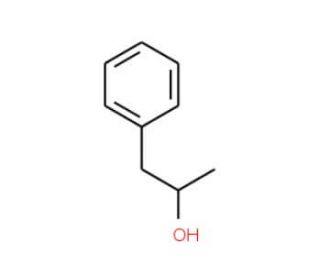

1-Phenyl-2-propanol (CAS 698-87-3)
Direktverknüpfungen
1-Phenyl-2-propanol ist ein Alkohol, der natürlich in verschiedenen Pflanzen und Blumen vorkommt. Diese aromatische Verbindung hat ein farbloses Aussehen und verströmt einen angenehmen Blumenduft. Seine Anwendungen gehen über sein natürliches Vorkommen hinaus, da er als Schlüsselkomponente bei der Synthese anderer Verbindungen dient und als Aromastoff in Lebensmitteln und Getränken Verwendung findet. Die wissenschaftliche Forschung profitiert in hohem Maße von den vielfältigen Einsatzmöglichkeiten von 1-Phenyl-2-propanol. Es dient als Substrat für die Untersuchung von Enzymen wie Alkoholdehydrogenase, Xanthinoxidase, Cytochrom P450, Glutathion-S-Transferase, Aldehyddehydrogenase und Cytochrom b5. Diese Enzymstudien tragen zum Verständnis der komplizierten Mechanismen und Interaktionen bei, die an biochemischen Prozessen beteiligt sind.
1-Phenyl-2-propanol (CAS 698-87-3) Literaturhinweise
- Chemisches Profiling von beschlagnahmtem Methamphetamin, das vermutlich aus Phenylessigsäurederivaten synthetisiert wurde. | Tsujikawa, K., et al. 2013. Forensic Sci Int. 227: 42-4. PMID: 22989601
- Nano-amilosio-2,3-bis(3,5-dimetilfenilcarbammato)-silice ibrida immobilizzata su colonna capillare tubolare aperta per l'enantioseparazione in elettrocromatografia capillare. | Sun, Y., et al. 2018. Electrophoresis. 39: 1086-1095. PMID: 29383728
- Miglioramento del riciclo dei cofattori nella bioconversione di alcoli racemici in ammine chirali con l'alcol deidrogenasi e l'ammina deidrogenasi mediante l'accoppiamento di cellule e sistema cell-free. | Liu, J. and Li, Z. 2019. Biotechnol Bioeng. 116: 536-542. PMID: 30536736
- Kinetische Analyse als Optimierungsinstrument für die katalytische Veresterung mit einem feuchtigkeitstoleranten Zirkoniumkomplex. | Villo, P., et al. 2020. J Org Chem. 85: 6959-6969. PMID: 32352291
- Strukturelle Aufklärung des Mechanismus der molekularen Erkennung in chiralen kristallinen Schwämmen. | Zhang, SY., et al. 2020. Angew Chem Int Ed Engl. 59: 17600-17606. PMID: 32589318
- Py-FTIR-GC/MS-Analyse flüchtiger Produkte aus der Pyrolyse von Autoschredderrückständen. | Yang, B. and Chen, M. 2020. Polymers (Basel). 12: PMID: 33217995
- Ortsselektive Reaktionen, die durch molekulare Container vermittelt werden. | Wang, R. and Yu, Y. 2022. Beilstein J Org Chem. 18: 309-324. PMID: 35368585
- Graphenoxid-Iridium-Nanokatalysator für die Umwandlung von Benzylalkoholen in Carbonylverbindungen. | Chen, TR., et al. 2020. RSC Adv. 10: 4436-4445. PMID: 35495275
- Mit Silica-Nanolagen beschichtete Kapillare durch hydrothermales Sol-Gel-Verfahren zur Trennung von Aminen und zum Nachweis von Tyramin in Lebensmitteln. | Obma, A., et al. 2022. Sci Rep. 12: 7460. PMID: 35523909
- Poröses organisches, in Käfige eingebettetes C10-modifiziertes Siliciumdioxid als stationäre HPLC-Phase und seine vielfältigen Trennfunktionen. | Wang, L., et al. 2022. Molecules. 27: PMID: 36558026
- Wasserlösliche Pd-Nanopartikel für die Anti-Markovnikov-Oxidation von Allylbenzol in Wasser. | Avila, E., et al. 2023. Nanomaterials (Basel). 13: PMID: 36678101
- Liganden-Leerstellen-Kanäle in säulenförmigen anorganisch-organischen Hybriden für elektrokatalytische organische Oxidation mit enzymähnlichen Aktivitäten. | Chen, Z., et al. 2023. Nat Commun. 14: 1184. PMID: 36864050
- Kovalente organische Gerüste: Von Strukturen zu Anwendungen. | Tran, QN., et al. 2023. Polymers (Basel). 15: PMID: 36904520
Bestellinformation
| Produkt | Katalog # | EINHEIT | Preis | ANZAHL | Favoriten | |
1-Phenyl-2-propanol, 5 g | sc-237615 | 5 g | $95.00 | |||
1-Phenyl-2-propanol, 25 g | sc-237615A | 25 g | $325.00 |