
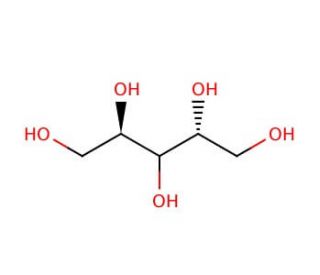

D-(+)-Arabitol (CAS 488-82-4)
QUICK LINKS
D-(+)-Arabitol, a naturally occurring sugar alcohol, has gained attention in scientific research for its diverse applications across various fields. One of its primary mechanisms of action lies in its role as a potential carbon source for microorganisms, particularly in biotechnological processes such as fermentation and bioremediation. Researchers have explored its utilization in microbial fermentation to produce value-added compounds like organic acids, enzymes, and biofuels. Moreover, D-(+)-arabitol exhibits promising properties as a cryoprotectant and osmoprotectant, making it valuable in cryopreservation techniques for cells and tissues and in enhancing the stress tolerance of microorganisms and plants. In agricultural research, D-(+)-arabitol has been investigated for its potential in improving crop yield and stress resistance, particularly under adverse environmental conditions such as drought and salinity. Furthermore, its compatibility with various microorganisms and plants makes it an attractive candidate for biotechnological applications, including the production of bio-based materials and pharmaceutical intermediates. Overall, D-(+)-arabitol′s multifaceted properties make it a valuable chemical for advancing research in biotechnology, agriculture, and environmental science.
D-(+)-Arabitol (CAS 488-82-4) References
- Analysis of sugars in environmental samples by gas chromatography-mass spectrometry. | Medeiros, PM. and Simoneit, BR. 2007. J Chromatogr A. 1141: 271-8. PMID: 17207493
- Slow molecular mobility in the crystalline and amorphous solid states of pentitols: a study by thermally stimulated depolarisation currents and by differential scanning calorimetry. | Diogo, HP., et al. 2007. Carbohydr Res. 342: 961-9. PMID: 17303096
- High-level production of d-arabitol by Zygosaccharomyces rouxii from glucose: Metabolic engineering and process optimization. | Li, X., et al. 2023. Bioresour Technol. 367: 128251. PMID: 36334865
- Metabolome and Microbiome Analysis to Study the Flavor of Summer Black Tea Improved by Stuck Fermentation. | Wen, L., et al. 2023. Foods. 12: PMID: 37761123
- New sugar alcohols mixtures for long-term thermal energy storage applications at temperatures between 70 C and 100 C | Del Barrio, E. P., Cadoret, R., Daranlot, J., & Achchaq, F. 2016. Solar Energy Materials and Solar Cells. 155: 454-468.
- Heat capacities of some sugar alcohols as phase change materials for thermal energy storage applications | Jia, R., Sun, K., Li, R., Zhang, Y., Wang, W., Yin, H.,.. & Tan, Z. 2017. The Journal of Chemical Thermodynamics,. 115: 233-248.
- Screening of sugar alcohols and their binary eutectic mixtures as phase change materials for low-to-medium temperature latent heat storage.(Ⅰ): Non-isothermal melting and crystallization behaviors | Shao, X. F., Wang, C., Yang, Y. J., Feng, B., Zhu, Z. Q., Wang, W. J.,.. & Fan, L. W. 2018. Energy. 160: 1078-1090.
- Experimental study of screening polyols and their binary eutectic phase change materials for long-term thermal energy storage | Lv, L., Huang, S., Cen, K., & Zhou, H. 2023. Journal of Cleaner Production. 399: 136636.
- Qualitative and quantitative analysis of characteristic sugars in three colored quinoas based on untargeted and targeted metabolomics | Song, J., & Peng, J. 2024. Journal of Food Composition and Analysis. 126: 105880.
Ordering Information
| Product Name | Catalog # | UNIT | Price | Qty | FAVORITES | |
D-(+)-Arabitol, 25 g | sc-221460 | 25 g | $204.00 | |||
D-(+)-Arabitol, 100 g | sc-221460A | 100 g | $683.00 |