
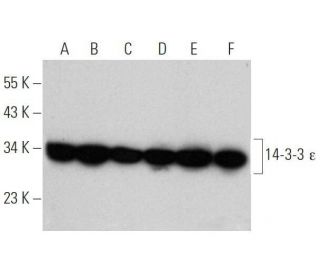
14-3-3 ε Antibody (8C3): sc-23957
- 14-3-3 ε Antibody (8C3) is a mouse monoclonal IgG2a κ 14-3-3 ε antibody, cited in 52 publications, provided at 200 µg/ml
- raised against partially purified proteins of ovine pineal gland
- 14-3-3 epsilon Antibody (8C3) is recommended for detection of 14-3-3 ε of mouse, rat, human and ovine origin by WB, IP, IF and IHC(P)
- Anti-14-3-3 epsilon Antibody (8C3) is available conjugated to agarose for IP; HRP for WB, IHC(P) and ELISA; and to either phycoerythrin or FITC for IF, IHC(P) and FCM
- also available conjugated to Alexa Fluor® 488, Alexa Fluor® 546, Alexa Fluor® 594 or Alexa Fluor® 647 for WB (RGB), IF, IHC(P) and FCM, and for use with RGB fluorescent imaging systems, such as iBright™ FL1000, FluorChem™, Typhoon, Azure and other comparable systems
- also available conjugated to Alexa Fluor® 680 or Alexa Fluor® 790 for WB (NIR), IF and FCM; for use with Near-Infrared (NIR) detection systems, such as LI-COR®Odyssey®, iBright™ FL1000, FluorChem™, Typhoon, Azure and other comparable systems
- m-IgG Fc BP-HRP and m-IgGκ BP-HRP are the preferred secondary detection reagents for 14-3-3 ε Antibody (8C3) for WB and IHC(P) applications. These reagents are now offered in bundles with 14-3-3 ε Antibody (8C3) (see ordering information below).

QUICK LINKS
SEE ALSO...
14-3-3 ε Antibody (8C3) is a mouse monoclonal IgG2a kappa light chain antibody that detects 14-3-3 epsilon protein of mouse, rat, human, and ovine origin by western blotting (WB), immunoprecipitation (IP), immunofluorescence (IF), and immunohistochemistry. 14-3-3 ε monoclonal antibody (8C3) is available in both non-conjugated and various conjugated forms, including agarose, horseradish peroxidase (HRP), phycoerythrin (PE), fluorescein isothiocyanate (FITC), and multiple Alexa Fluor® conjugates. 14-3-3 epsilon protein plays a crucial role in regulating cellular processes such as apoptosis, mitogenic signaling, and cell-cycle checkpoints, making 14-3-3 epsilon significant in cancer biology. 14-3-3 epsilon protein is primarily located in the cytoplasm, where 14-3-3 epsilon interacts with a variety of target proteins, facilitating proper function and localization. Cytoplasmic presence of 14-3-3 proteins is essential for sequestering and regulating ligands, which often contain a 14-3-3 consensus binding motif and are typically phosphorylated on serine or threonine residues. By binding to these phosphorylated proteins, 14-3-3 epsilon can modulate activity, stability, and interactions, thereby influencing critical signaling pathways. Dysregulation of 14-3-3 epsilon expression or function can lead to a range of pathological conditions, including cancer, underscoring 14-3-3 epsilon′s importance in maintaining cellular homeostasis.
Alexa Fluor® is a trademark of Molecular Probes Inc., OR., USA
LI-COR® and Odyssey® are registered trademarks of LI-COR Biosciences
14-3-3 ε Antibody (8C3) References:
- The 4.1/ezrin/radixin/moesin domain of the DAL-1/Protein 4.1B tumour suppressor interacts with 14-3-3 proteins. | Yu, T., et al. 2002. Biochem J. 365: 783-9. PMID: 11996670
- MADM, a novel adaptor protein that mediates phosphorylation of the 14-3-3 binding site of myeloid leukemia factor 1. | Lim, R., et al. 2002. J Biol Chem. 277: 40997-1008. PMID: 12176995
- The 14-3-3 cancer connection. | Hermeking, H. 2003. Nat Rev Cancer. 3: 931-43. PMID: 14737123
- Isoform-specific subcellular localization among 14-3-3 proteins in Arabidopsis seems to be driven by client interactions. | Paul, AL., et al. 2005. Mol Biol Cell. 16: 1735-43. PMID: 15659648
- The protein YWHAE (14-3-3 epsilon) in spermatozoa is essential for male fertility. | Eisa, A., et al. 2021. Andrology. 9: 312-328. PMID: 32657535
- 14-3-3 epsilon is an intracellular component of TNFR2 receptor complex and its activation protects against osteoarthritis. | Fu, W., et al. 2021. Ann Rheum Dis. 80: 1615-1627. PMID: 34226187
- Targeting macrophage TFEB-14-3-3 epsilon Interface by naringenin inhibits abdominal aortic aneurysm. | Jia, Y., et al. 2022. Cell Discov. 8: 21. PMID: 35228523
- Nucleo-cytoplasmic shuttling of 14-3-3 epsilon carrying hnRNP C promotes autophagy. | Guo, M., et al. 2023. Cancer Biol Ther. 24: 2246203. PMID: 37599448
- 14-3-3: modulators of signaling proteins? | Morrison, D. 1994. Science. 266: 56-7. PMID: 7939645
- Structural organization and chromosomal assignment of the human 14-3-3 eta chain gene (YWHAH). | Muratake, T., et al. 1996. Genomics. 36: 63-9. PMID: 8812417
- The structural basis for 14-3-3:phosphopeptide binding specificity. | Yaffe, MB., et al. 1997. Cell. 91: 961-71. PMID: 9428519
- A novel sphingosine-dependent protein kinase (SDK1) specifically phosphorylates certain isoforms of 14-3-3 protein. | Megidish, T., et al. 1998. J Biol Chem. 273: 21834-45. PMID: 9705322
Ordering Information
| Product Name | Catalog # | UNIT | Price | Qty | FAVORITES | |
14-3-3 ε Antibody (8C3) | sc-23957 | 200 µg/ml | $322.00 | |||
14-3-3 ε Antibody (8C3): m-IgG Fc BP-HRP Bundle | sc-528385 | 200 µg Ab; 10 µg BP | $361.00 | |||
14-3-3 ε Antibody (8C3): m-IgGκ BP-HRP Bundle | sc-520751 | 200 µg Ab, 40 µg BP | $361.00 | |||
14-3-3 ε Antibody (8C3) AC | sc-23957 AC | 500 µg/ml, 25% agarose | $424.00 | |||
14-3-3 ε Antibody (8C3) HRP | sc-23957 HRP | 200 µg/ml | $322.00 | |||
14-3-3 ε Antibody (8C3) FITC | sc-23957 FITC | 200 µg/ml | $336.00 | |||
14-3-3 ε Antibody (8C3) PE | sc-23957 PE | 200 µg/ml | $349.00 | |||
14-3-3 ε Antibody (8C3) Alexa Fluor® 488 | sc-23957 AF488 | 200 µg/ml | $364.00 | |||
14-3-3 ε Antibody (8C3) Alexa Fluor® 546 | sc-23957 AF546 | 200 µg/ml | $364.00 | |||
14-3-3 ε Antibody (8C3) Alexa Fluor® 594 | sc-23957 AF594 | 200 µg/ml | $364.00 | |||
14-3-3 ε Antibody (8C3) Alexa Fluor® 647 | sc-23957 AF647 | 200 µg/ml | $364.00 | |||
14-3-3 ε Antibody (8C3) Alexa Fluor® 680 | sc-23957 AF680 | 200 µg/ml | $364.00 | |||
14-3-3 ε Antibody (8C3) Alexa Fluor® 790 | sc-23957 AF790 | 200 µg/ml | $364.00 |