
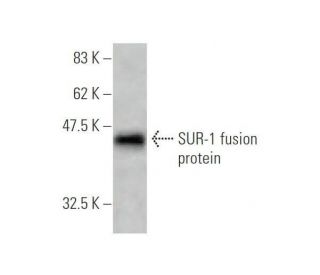
epitope corresponding to amino acids 611-690 mapping within an internal region of SUR-1 of human origin
recommended for detection of SUR-1 of mouse, rat and human origin by WB, IP, IF and ELISA; also reactive with additional species, including equine, bovine and porcine
SUR-1 Background Information Both suphonylurea receptor-1 (SUR-1) and sulphonylurea receptor-2 (SUR-2) belong to the ATP-binding cassette superfamily associated with KIR6.x. SUR-1 and KIR6.x proteins are required for the regulation of glucose-induced Insulin secretion by controlling K-ATP channel activity of the pancreatic ∫-cell membrane while SUR-2 and KIR6.x proteins reconstitute the cardiac and the vascular-smooth-muscle-type K-ATP channels. Loss-of-function mutations in the SUR-1 gene causes the disease persistent hyperinsulinemic hypoglycemia of infancy (PHHI). PHHI is characterized by increased irregular Insulin secretion, which causes disorganized formation of new islets and leads to hypoglycemia, coma and severe brain damage. The K-ATP channels controlled by SUR-2 are activated during myocardial ischemia, which suggests that mutations in the SUR-2 gene may cause channel malfunction and ischemic injury to the heart. No disease has yet been found to be associated with the SUR-2 gene.
SUR-1 (H-80) Produkt Citat
Se hur andra har använt SUR-1 (H-80): sc-25683 antikropp och SUR-1 (H-80) konjugerade antikroppar.
6 total citations
Loading citations.
SUR-1 (H-80)
Klicka på bilden för att förstora
SUR-1 (H-80): sc-25683. Western blot analysis of SUR-1 expression in MIA PaCa-2 (A) and JAR (B) whole cell lysates and rat brain tissue extract (C).
SUR-1 (H-80): sc-25683. Immunofluorescence staining of methanol-fixed MIA Paca-2 cells showing cytoplasmic localization.
SUR-1 (H-80): sc-25683. Immunofluorescence staining of methanol-fixed HeLa cells showing cytoplasmic localization.
