
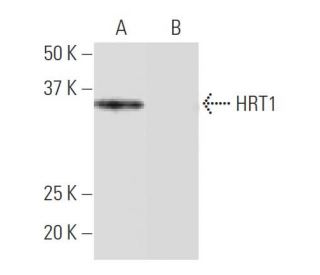
epitope mapping near the C-terminus of HRT1 of human origin
recommended for detection of HRT1 of human and, to a lesser extent, mouse and rat origin by WB, IF and ELISA; also reactive with additional species, including equine, canine, bovine, porcine and avian
blocking peptide, sc-16424 P
TransCruz reagent for Gel Supershift and ChIP applications, sc-16424 X, 200 µg/0.1 ml
HRT1 Background Information The LIN-12/Notch family of transmembrane receptors plays a central role in development by regulating cell fate and establishing boundaries of gene expression. Notch signaling activates the Hairy/Enhancer of split (HES) genes, which encode basic helix-loop-helix (bHLH) transcriptional repressors that are critical for directing embryonic patterning and development. The Hairy-related transcription factors (HRTs) comprise a subclass of bHLH proteins that exhibit structural similarity with the HES proteins and include HRT1, HRT2 and HRT3. The HRT family (also designated Hesr, Hey, CHF and Gridlock) contain a bHLH domain, an Orange domain and a novel YRPW domain, which is absent in HRT3. The Hairy-related genes are downstream targets for Notch signaling. HRT1 is expressed in the somitic mesoderm, central nervous system, kidney, heart, nasal epithelium and limb buds in murine embryos as well as in adult tissues. It has altered expression in many breast, lung and kidney tumors. Like HRT1, HRT2 and HRT3 are also expressed in developing somites, heart and nervous system.
HRT1 (C-20) Citacoes dos Produtos
Veja como outros autores utilizaram o anticorpo e/ou o anticorpo cojugado
