
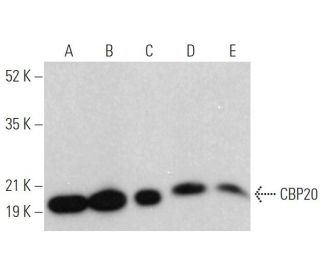
CBP20 Anticorpo (B-1): sc-137123
- CBP20 Anticorpo B-1é um anticorpo monoclonal produzido em camundongo IgG2b κ CBP20 anticorpo, citado em 2 publicações, fornecido em 200 µg/ml
- Produzido contra aminoácidos 1-156 que representam a completa extensão CBP20 de human origem
- CBP20 Anticorpo (B-1) é recomendado para a detecção de CBP20 de mouse, rat e human origem em WB, IP, IF e ELISA; Reage também com outras espécies, incluindo and equine, canine and bovine
- Anticorpo anti-CBP20 O anticorpo anti-CBP20 (B-1) está disponível conjugado com agarose para IP; HRP para WB, IHC(P) e ELISA; e com fioeritrina ou FITC para IF, IHC(P) e FCM
- também disponível conjugado com Alexa Fluor® 488, Alexa Fluor® 546, Alexa Fluor® 594 ou Alexa Fluor® 647 para WB (RGB), IF, IHC(P) e FCM, e para utilização com sistemas de imagiologia fluorescente RGB, tais como iBright™ FL1000, FluorChem™, Typhoon, Azure e outros sistemas comparáveis
- também disponível conjugado com Alexa Fluor® 680 ou Alexa Fluor® 790 para WB (NIR), IF e FCM; para utilização com sistemas de deteção de infravermelhos próximos (NIR), tais como LI-COR®Odyssey®, iBright™ FL1000, FluorChem™, Typhoon, Azure e outros sistemas comparáveis
- dispnonível como reagente TransCruz para o uso em ChIP (sc-137123 X, 200 µg/0.1 ml)
- 2b BP-HRP">m-IgG2b BP-HRP e m-IgGκ BP-HRP são os reagentes de deteção secundários preferidos para CBP20 Antibody (B-1) para aplicações WB. Estes reagentes são agora oferecidos em conjuntos com CBP20 Antibody (B-1)(ver informações de encomenda abaixo).

LINKS RÁPIDOS
VEJA TAMBÉM
O Anticorpo CBP20 (B-1) é um anticorpo monoclonal CBP20 IgG2b κ de camundongo (também designado anticorpo CBP20) que detecta a proteína CBP20 de origem de camundongo, rato e humana por WB, IP, IF e ELISA. O anticorpo CBP20 (B-1) está disponível na forma de anticorpo anti-CBP20 não conjugado, bem como em várias formas conjugadas de anticorpo anti-CBP20, incluindo agarose, HRP, PE, FITC e vários conjugados Alexa Fluor®. Nos eucariotas, a maioria dos mRNAs tem uma capa m(7)G, que é adicionada cotranscricionalmente e desempenha um papel crítico em muitos aspectos do metabolismo do mRNA. O efeito da capa na tradução é mediado pelo fator de iniciação eIF-4F, enquanto o efeito no splicing do pré-mRNA envolve um complexo nuclear (CBC). O CBC é constituído por duas proteínas de ligação à capa, CBP20 e CBP80, que medeiam as funções estimuladoras da capa no splicing do pré-RNAm, na formação da extremidade 3' e na exportação do snRNA U. Os genes CBC1 e CBC2 codificam a CBP80 e a CBP20, respetivamente. A CBP80 compreende três domínios, cada um contendo um domínio MIF4G. A CBP20 tem uma dobra RNAP e associa-se ao segundo e terceiro domínios da CBP80. A CBP também desempenha um papel no decaimento mediado por nonsense (NMD), que elimina os ARNm que terminam prematuramente a tradução. O ARNm ligado ao CBP80 passa por uma ronda de tradução "pioneira" antes de o CBP80-CBP20 ser substituído pelo eIF4E e pelas proteínas Upf2 e Upf3.
Alexa Fluor® é uma marca comercial da Molecular Probes Inc., OR., EUA
LI-COR® e Odyssey® são marcas registadas da LI-COR Biosciences
Referencias do CBP20 Anticorpo (B-1):
- O papel da proteína de ligação à capa nuclear Cbc1p da levedura na terminação e degradação do mRNA. | Das, B., et al. 2000. Mol Cell Biol. 20: 2827-38. PMID: 10733586
- A interação do fator de iniciação da tradução eucariótica 4G com o complexo nuclear de ligação da capa fornece uma ligação entre as funções nucleares e citoplasmáticas da capa de guanosina m(7). | McKendrick, L., et al. 2001. Mol Cell Biol. 21: 3632-41. PMID: 11340157
- Estrutura cristalina do complexo de ligação da tampa nuclear humana. | Mazza, C., et al. 2001. Mol Cell. 8: 383-96. PMID: 11545740
- Evidência de uma ronda pioneira de tradução de mRNA: os mRNAs sujeitos a decaimento mediado por nonsense em células de mamíferos são ligados por CBP80 e CBP20. | Ishigaki, Y., et al. 2001. Cell. 106: 607-17. PMID: 11551508
- Duas proteínas de ligação à capa, CBP20 e CBP80, estão envolvidas no processamento de microRNAs primários. | Kim, S., et al. 2008. Plant Cell Physiol. 49: 1634-44. PMID: 18829588
- O que é que tu queres dizer com isso? | Jäger, K., et al. 2011. Plant Biol (Stuttg). 13: 78-84. PMID: 21143728
- Propriedades de ligação e localização dinâmica de uma isoforma alternativa da subunidade CBP20 do complexo de ligação à tampa. | Pabis, M., et al. 2010. Nucleus. 1: 412-21. PMID: 21326824
- A análise proteómica quantitativa revela que as proteínas CBP20 e CBP80 do complexo nuclear de arabidopsis modulam a resposta ao stress salino. | Kong, X., et al. 2014. J Proteome Res. 13: 2495-510. PMID: 24689873
- Fosforilação do CBP20 liga o microRNA ao crescimento da raiz na resposta ao etileno. | Zhang, F., et al. 2016. PLoS Genet. 12: e1006437. PMID: 27870849
- Ceras cuticulares - Um escudo de cevada mutante no gene CBP20 (Cap-Binding Protein 20) quando luta contra o stress da seca. | Daszkowska-Golec, A., et al. 2020. Plant Sci. 300: 110593. PMID: 33180718
- Um complexo de proteínas de ligação à capa que medeia a exportação de U snRNA. | Izaurralde, E., et al. 1995. Nature. 376: 709-12. PMID: 7651522
- Um complexo de proteínas de ligação à capa nuclear envolvido no splicing de pré-mRNA. | Izaurralde, E., et al. 1994. Cell. 78: 657-68. PMID: 8069914
Informacoes sobre ordens
| Nome do Produto | Numero de Catalogo | UNID | Preco | Qde | FAVORITOS | |
CBP20 Anticorpo (B-1) | sc-137123 | 200 µg/ml | $322.00 | |||
Pacote do CBP20 (B-1): m-IgGκ BP-HRP | sc-521430 | 200 µg Ab, 40 µg BP | $361.00 | |||
Pacote do CBP20 (B-1): m-IgG2b BP-HRP | sc-548896 | 200 µg Ab; 10 µg BP | $361.00 | |||
CBP20 Anticorpo (B-1) X | sc-137123 X | 200 µg/0.1 ml | $322.00 | |||
CBP20 Anticorpo (B-1) AC | sc-137123 AC | 500 µg/ml, 25% agarose | $424.00 | |||
CBP20 Anticorpo (B-1) HRP | sc-137123 HRP | 200 µg/ml | $322.00 | |||
CBP20 Anticorpo (B-1) FITC | sc-137123 FITC | 200 µg/ml | $336.00 | |||
CBP20 Anticorpo (B-1) PE | sc-137123 PE | 200 µg/ml | $349.00 | |||
CBP20 Anticorpo (B-1) Alexa Fluor® 488 | sc-137123 AF488 | 200 µg/ml | $364.00 | |||
CBP20 Anticorpo (B-1) Alexa Fluor® 546 | sc-137123 AF546 | 200 µg/ml | $364.00 | |||
CBP20 Anticorpo (B-1) Alexa Fluor® 594 | sc-137123 AF594 | 200 µg/ml | $364.00 | |||
CBP20 Anticorpo (B-1) Alexa Fluor® 647 | sc-137123 AF647 | 200 µg/ml | $364.00 | |||
CBP20 Anticorpo (B-1) Alexa Fluor® 680 | sc-137123 AF680 | 200 µg/ml | $364.00 | |||
CBP20 Anticorpo (B-1) Alexa Fluor® 790 | sc-137123 AF790 | 200 µg/ml | $364.00 |