
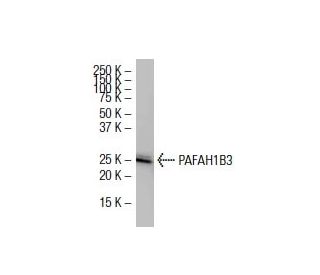


PAFAH1B3 Anticuerpo (37-K): sc-81950
- PAFAH1B3 Anticuerpo (37-K) es un monoclonal de ratón IgG1 κ, ver las 1 publicaciones, proporcionado como 100 µg/ml
- producido contra una proteina recombinante PAFAH1B3 de origen human
- recomendado para detectarPAFAH1B3 de mouse, rat y human origen, mediante WB, IP, IF y ELISA
- Actualmente, aún no hemos completado la identificación de los reactivos de detección secundaria preferidos para PAFAH1B3 Anticuerpo (37-K). Este trabajo está en progreso.

ENLACES RÁPIDOS
El factor activador de plaquetas (PAF) acetilhidrolasas catalizan la hidrólisis del enlace éster sn-2 del PAF y fosfolípidos proinflamatorios relacionados, atenuando así su bioactividad. La familia de acetilhidrolasas de PAF incluye una isoenzima plasmática secretada y dos isoenzimas intracelulares. Las isoenzimas intracelulares se distinguen por diferencias en su secuencia primaria, localización tisular, composición de subunidades y preferencias de sustrato. La isoforma intracelular más caracterizada, PAFAH1B, es una proteína heterotrimérica expresada en tejido cerebral y juega un papel importante en el desarrollo y función cerebral. PAFAH1B está compuesta por una subunidad reguladora (LIS1) y dos subunidades catalíticas homólogas (PAFAH1B2 y PAFAH1B3), que albergan toda la actividad de la enzima. Las subunidades PAFAH1B2 y PAFAH1B3 se asocian fácilmente con alta afinidad para formar heterodímeros, y esta dimerización es esencial tanto para la estabilidad como para la actividad catalítica. PAFAH1B3 también es conocida comúnmente como subunidad de 29 kDa de PAFAH1B, subunidad γ de PAFAH1B o subunidad α1 de PAFAH1B.
Información sobre pedidos
| Nombre del producto | Número de catálogo | UNIDAD | Precio | CANTIDAD | Favoritos | |
PAFAH1B3 Anticuerpo (37-K) | sc-81950 | 100 µg/ml | $339.00 |