
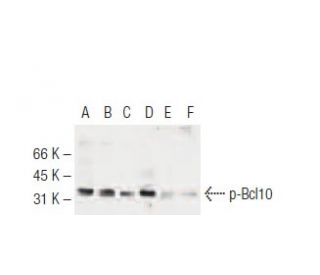


Anticorps p-Bcl10 (6D3): sc-81484
- L'anticorps p-Bcl10 6D3 est un monoclonal IgG1 de souris, cité dans 3 publications, fourni en 50 µg/0.5 ml
- soulevée contre le phosphopeptide synthétique entourant la sérine 138 de Bcl10 d'origine human.
- recommandé pour la détection de Ser 138 phosphorylated Bcl10 d'origine mouse, rat et, dans une moindre mesure, human par WB et IP
- Nous testons actuellement encore nos anticorps secondaires pour trouver la meilleure protéine de liaison pour cet anticorps primaire p-Bcl10 (6D3). Veuillez nous contacter si vous avez des questions concernant les réactifs de détection secondaire appropriés.

ACCÈS RAPIDE AUX LIENS
VOIR ÉGALEMENT...
L'anticorps p-Bcl10 (6D3) est un anticorps monoclonal IgG1 de souris qui détecte le Bcl10 phosphorylé Ser 138 d'origine murine par western blotting (WB) et immunoprécipitation (IP). L'anticorps anti-p-Bcl10 (6D3) est disponible sous forme non conjuguée. Bcl10, également connu sous le nom de CIPER, c-CARMEN et mE10, joue un rôle crucial dans la régulation de l'apoptose et des réponses immunitaires, ce qui fait de Bcl10 une protéine importante dans l'étude de divers lymphomes et autres types de tumeurs. Bcl10 est principalement localisé dans le cytoplasme, où il interagit avec d'autres molécules de signalisation pour activer la voie NFκB, un régulateur clé des réponses immunitaires et inflammatoires. La localisation cytoplasmique de Bcl10 permet une signalisation rapide en réponse à des stimuli cellulaires, facilitant la transduction de signaux qui conduisent à la survie ou à l'apoptose des cellules. Bcl10 contient notamment un domaine de recrutement des caspases (CARD) à l'extrémité N-terminale, qui est essentiel pour l'activation de NFκB et l'induction de l'apoptose. Alors que Bcl10 a été impliqué dans la pathogenèse des lymphomes à cellules B MALT, des études ont montré que Bcl10 n'est pas muté dans de nombreuses tumeurs humaines, mettant en évidence un rôle complexe dans la biologie du cancer. La détection spécifique de Bcl10 phosphorylé par l'anticorps monoclonal p-Bcl10 (6D3) fait de cet anticorps un outil précieux pour les chercheurs qui étudient les mécanismes moléculaires sous-jacents à la fonction de Bcl10 et ses implications dans la maladie.
Alexa Fluor® est une marque déposée de Molecular Probes Inc., OR., USA
LI-COR® et Odyssey® sont marques déposées de LI-COR Biosciences
Anticorps p-Bcl10 (6D3) Références:
- Expression de BCL10 dans les tissus lymphoïdes normaux et néoplasiques. Localisation nucléaire dans le lymphome du MALT. | Ye, H., et al. 2000. Am J Pathol. 157: 1147-54. PMID: 11021819
- Bcl10 est un régulateur positif de l'activation de NF-kappaB induite par les récepteurs d'antigènes et de la fermeture du tube neural. | Ruland, J., et al. 2001. Cell. 104: 33-42. PMID: 11163238
- Bcl10 et MALT1, cibles indépendantes de la translocation chromosomique dans le lymphome malt, coopèrent dans une nouvelle voie de signalisation NF-kappa B. | Lucas, PC., et al. 2001. J Biol Chem. 276: 19012-9. PMID: 11262391
- La liaison interchangeable de Bcl10 à TRAF2 et cIAPs régule la signalisation de l'apoptose. | Yui, D., et al. 2001. Oncogene. 20: 4317-23. PMID: 11466612
- Bcl10. | Thome, M. and Tschopp, J. 2002. Curr Biol. 12: R45. PMID: 11818074
- Bcl10 active la voie NF-kappaB par ubiquitination de NEMO. | Zhou, H., et al. 2004. Nature. 427: 167-71. PMID: 14695475
- Nouveaux rôles pour Bcl10 dans le développement des cellules B et la réponse aux LPS. | Fischer, KD., et al. 2004. Trends Immunol. 25: 113-6. PMID: 15049289
- La dégradation de Bcl10 induite par l'activation des cellules T régule négativement la signalisation de NF-kappa B. | Scharschmidt, E., et al. 2004. Mol Cell Biol. 24: 3860-73. PMID: 15082780
- La BCL10 agit comme médiateur de la signalisation du récepteur 4 du lipopolysaccharide/toll-like par le biais d'une interaction avec Pellino2. | Liu, Y., et al. 2004. J Biol Chem. 279: 37436-44. PMID: 15213237
- Le lymphome MALT avec t(14;18)(q32;q21)/IGH-MALT1 se caractérise par une forte expression cytoplasmique de MALT1 et de BCL10. | Ye, H., et al. 2005. J Pathol. 205: 293-301. PMID: 15682443
- Bcl10 peut favoriser la survie des lymphocytes B stimulés par l'antigène. | Tian, MT., et al. 2005. Blood. 106: 2105-12. PMID: 15878976
- Bcl10 joue un rôle divergent dans la cytotoxicité médiée par les cellules NK et la génération de cytokines. | Malarkannan, S., et al. 2007. J Immunol. 179: 3752-62. PMID: 17785812
Informations pour la commande
| Nom du produit | Ref. Catalogue | COND. | Prix HT | QTÉ | Favoris | |
Anticorps p-Bcl10 (6D3) | sc-81484 | 50 µg/0.5 ml | $322.00 |