
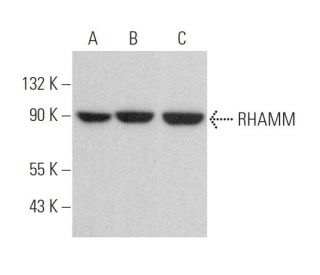

Este anticuerpo policlonal ha dejado de fabricarse. Consulta nuestro anticuerpo monoclonal recomendado RHAMM (H-8) (se muestran datos de muestra).
RHAMM Anticuerpo (E-19): sc-16170
- RHAMM Anticuerpo E-19 es un policlonal de cabra IgG proporcionado como 200 µg/ml
- epítopo localizado cerca de C-terminus de RHAMM de origen human
- Anticuerpo policlonal discontinuado

VER TAMBIÉN ....
Información sobre pedidos
RHAMM (H-8): sc-515221 [ Monoclonal recomendado como alternativa a RHAMM (E-19) ]
| Nombre del producto | Número de catálogo | UNIDAD | Precio | CANTIDAD | Favoritos | |
RHAMM Anticuerpo (H-8) | sc-515221 | 200 µg/ml | $322.00 | |||
Paquete de RHAMM (H-8): m-IgG Fc BP-HRP | sc-531316 | 200 µg Ab; 10 µg BP | $361.00 | |||
Paquete de RHAMM (H-8): m-IgGκ BP-HRP | sc-524978 | 200 µg Ab, 40 µg BP | $361.00 | |||
RHAMM Anticuerpo (H-8) AC | sc-515221 AC | 500 µg/ml, 25% agarose | $424.00 | |||
RHAMM Anticuerpo (H-8) HRP | sc-515221 HRP | 200 µg/ml | $322.00 | |||
RHAMM Anticuerpo (H-8) FITC | sc-515221 FITC | 200 µg/ml | $336.00 | |||
RHAMM Anticuerpo (H-8) PE | sc-515221 PE | 200 µg/ml | $349.00 | |||
RHAMM Anticuerpo (H-8) Alexa Fluor® 488 | sc-515221 AF488 | 200 µg/ml | $364.00 | |||
RHAMM Anticuerpo (H-8) Alexa Fluor® 546 | sc-515221 AF546 | 200 µg/ml | $364.00 | |||
RHAMM Anticuerpo (H-8) Alexa Fluor® 594 | sc-515221 AF594 | 200 µg/ml | $364.00 | |||
RHAMM Anticuerpo (H-8) Alexa Fluor® 647 | sc-515221 AF647 | 200 µg/ml | $364.00 | |||
RHAMM Anticuerpo (H-8) Alexa Fluor® 680 | sc-515221 AF680 | 200 µg/ml | $364.00 | |||
RHAMM Anticuerpo (H-8) Alexa Fluor® 790 | sc-515221 AF790 | 200 µg/ml | $364.00 |