
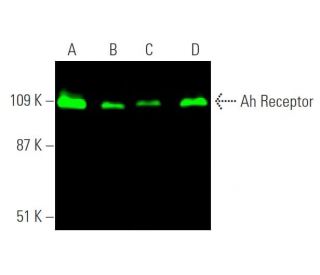
Ah Receptor Antibody (A-3): sc-133088
- Ah Receptor Antibody (A-3) is a mouse monoclonal IgG2b κ Ah Receptor antibody, cited in 109 publications, provided at 200 µg/ml
- raised against amino acids 637-848 of Ah Receptor of human origin
- Ah Receptor Antibody (A-3) is recommended for detection of Ah Receptor of mouse, rat and human origin by WB, IP, IF, IHC(P) and ELISA
- Anti-Ah Receptor Antibody (A-3) is available conjugated to agarose for IP; HRP for WB, IHC(P) and ELISA; and to either phycoerythrin or FITC for IF, IHC(P) and FCM
- also available conjugated to Alexa Fluor® 488, Alexa Fluor® 546, Alexa Fluor® 594 or Alexa Fluor® 647 for WB (RGB), IF, IHC(P) and FCM, and for use with RGB fluorescent imaging systems, such as iBright™ FL1000, FluorChem™, Typhoon, Azure and other comparable systems
- also available conjugated to Alexa Fluor® 680 or Alexa Fluor® 790 for WB (NIR), IF and FCM; for use with Near-Infrared (NIR) detection systems, such as LI-COR®Odyssey®, iBright™ FL1000, FluorChem™, Typhoon, Azure and other comparable systems
- TransCruz reagent for Gel Supershift and ChIP applications (sc-133088 X, 200 µg/0.1 ml)
- m-IgG2b BP-HRP and m-IgGκ BP-HRP are the preferred secondary detection reagents for Ah Receptor Antibody (A-3) for WB and IHC(P) applications. These reagents are now offered in bundles with Ah Receptor Antibody (A-3) (see ordering information below).

QUICK LINKS
SEE ALSO...
Ah Receptor Antibody (A-3) is a mouse monoclonal IgG2b kappa light chain antibody that detects aryl hydrocarbon receptor protein of mouse, rat, and human origin by western blotting (WB), immunoprecipitation (IP), immunofluorescence (IF), immunohistochemistry, and enzyme-linked immunosorbent assay (ELISA). Aryl hydrocarbon receptor antibody (A-3) is available in both non-conjugated and various conjugated forms, including agarose, horseradish peroxidase (HRP), phycoerythrin (PE), fluorescein isothiocyanate (FITC), and multiple Alexa Fluor® conjugates. The aryl hydrocarbon receptor (AhR) plays a crucial role in mediating the biological effects of environmental toxins, such as 2,3,7,8-tetrachlorodibenzo-p-dioxin (TCDD), which is known to induce adverse reproductive, immunologic, and metabolic effects. As a ligand-dependent transcription factor, AhR is essential for regulating the expression of genes involved in xenobiotic metabolism. Upon binding to TCDD or other ligands, AhR forms a complex with the Ah Receptor nuclear translocator (Arnt), facilitating its translocation to the nucleus where it binds to specific DNA sequences known as xenobiotic responsive elements (XREs). This interaction is vital for the transcriptional activation of genes that help detoxify harmful compounds, underscoring the importance of AhR in maintaining cellular homeostasis and responding to environmental stressors.
Alexa Fluor® is a trademark of Molecular Probes Inc., OR., USA
LI-COR® and Odyssey® are registered trademarks of LI-COR Biosciences
Ah Receptor Antibody (A-3) References:
- Identification of the Ah receptor nuclear translocator protein (Arnt) as a component of the DNA binding form of the Ah receptor. | Reyes, H., et al. 1992. Science. 256: 1193-5. PMID: 1317062
- Ah receptor-mediated suppression of liver regeneration through NC-XRE-driven p21Cip1 expression. | Jackson, DP., et al. 2014. Mol Pharmacol. 85: 533-41. PMID: 24431146
- Suppression of Ah Receptor (AhR) increases the aggressiveness of TNBC cells and 11-Cl-BBQ-activated AhR inhibits their growth. | Elson, DJ., et al. 2023. Biochem Pharmacol. 215: 115706. PMID: 37506922
- Immune cell-intrinsic Ah receptor facilitates the expression of antimicrobial REG3G in the small intestine. | Chakraborty, D., et al. 2024. FASEB J. 38: e23471. PMID: 38358358
- The Ah receptor: mediator of the toxicity of 2,3,7,8-tetrachlorodibenzo-p-dioxin (TCDD) and related compounds. | Okey, AB., et al. 1994. Toxicol Lett. 70: 1-22. PMID: 8310450
- Functional characterization of DNA-binding domains of the subunits of the heterodimeric aryl hydrocarbon receptor complex imputing novel and canonical basic helix-loop-helix protein-DNA interactions. | Bacsi, SG. and Hankinson, O. 1996. J Biol Chem. 271: 8843-50. PMID: 8621524
- cDNA cloning and tissue-specific expression of a novel basic helix-loop-helix/PAS factor (Arnt2) with close sequence similarity to the aryl hydrocarbon receptor nuclear translocator (Arnt). | Hirose, K., et al. 1996. Mol Cell Biol. 16: 1706-13. PMID: 8657146
- A nuclear localization signal of human aryl hydrocarbon receptor nuclear translocator/hypoxia-inducible factor 1beta is a novel bipartite type recognized by the two components of nuclear pore-targeting complex. | Eguchi, H., et al. 1997. J Biol Chem. 272: 17640-7. PMID: 9211913
- Ah receptor-dependent CYP1A induction by two carotenoids, canthaxanthin and beta-apo-8'-carotenal, with no affinity for the TCDD binding site. | Gradelet, S., et al. 1997. Biochem Pharmacol. 54: 307-15. PMID: 9271336
- Molecular evolution of two vertebrate aryl hydrocarbon (dioxin) receptors (AHR1 and AHR2) and the PAS family. | Hahn, ME., et al. 1997. Proc Natl Acad Sci U S A. 94: 13743-8. PMID: 9391097
- A mutation in the aryl hydrocarbon receptor (AHR) in a cultured mammalian cell line identifies a novel region of AHR that affects DNA binding. | Sun, W., et al. 1997. J Biol Chem. 272: 31845-54. PMID: 9395531
- Animal models of human response to dioxins. | Grassman, JA., et al. 1998. Environ Health Perspect. 106 Suppl 2: 761-75. PMID: 9599728
Ordering Information
| Product Name | Catalog # | UNIT | Price | Qty | FAVORITES | |
Ah Receptor Antibody (A-3) | sc-133088 | 200 µg/ml | $322.00 | |||
Ah Receptor Antibody (A-3): m-IgGκ BP-HRP Bundle | sc-521229 | 200 µg Ab, 40 µg BP | $361.00 | |||
Ah Receptor Antibody (A-3): m-IgG2b BP-HRP Bundle | sc-548874 | 200 µg Ab; 10 µg BP | $361.00 | |||
Ah Receptor Antibody (A-3) X | sc-133088 X | 200 µg/0.1 ml | $322.00 | |||
Ah Receptor Antibody (A-3) AC | sc-133088 AC | 500 µg/ml, 25% agarose | $424.00 | |||
Ah Receptor Antibody (A-3) HRP | sc-133088 HRP | 200 µg/ml | $322.00 | |||
Ah Receptor Antibody (A-3) FITC | sc-133088 FITC | 200 µg/ml | $336.00 | |||
Ah Receptor Antibody (A-3) PE | sc-133088 PE | 200 µg/ml | $349.00 | |||
Ah Receptor Antibody (A-3) Alexa Fluor® 488 | sc-133088 AF488 | 200 µg/ml | $364.00 | |||
Ah Receptor Antibody (A-3) Alexa Fluor® 546 | sc-133088 AF546 | 200 µg/ml | $364.00 | |||
Ah Receptor Antibody (A-3) Alexa Fluor® 594 | sc-133088 AF594 | 200 µg/ml | $364.00 | |||
Ah Receptor Antibody (A-3) Alexa Fluor® 647 | sc-133088 AF647 | 200 µg/ml | $364.00 | |||
Ah Receptor Antibody (A-3) Alexa Fluor® 680 | sc-133088 AF680 | 200 µg/ml | $364.00 | |||
Ah Receptor Antibody (A-3) Alexa Fluor® 790 | sc-133088 AF790 | 200 µg/ml | $364.00 |