
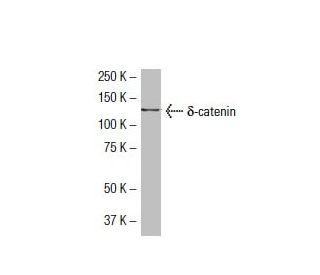


δ-catenin Antibody (40.1): sc-81793
- δ-catenin Antibody (40.1) is a mouse monoclonal IgG1 κ δ-catenin antibody, cited in 12 publications, provided at 100 µg/ml
- raised against a partial recombinant protein mapping within amino acids 1081-1191 of δ-catenin of human origin
- recommended for detection of δ-catenin of mouse, rat and human origin by WB, IP, IF, IHC(P) and ELISA
- m-IgG Fc BP-HRP and m-IgG1 BP-HRP are the preferred secondary detection reagents for δ-catenin Antibody (40.1) for WB and IHC(P) applications. These reagents are now offered in bundles with δ-catenin Antibody (40.1) (see ordering information below).

QUICK LINKS
SEE ALSO...
δ-catenin Antibody (40.1) is a mouse monoclonal IgG1 kappa light chain antibody that detects delta-catenin protein of mouse, rat, and human origin by western blotting (WB), immunoprecipitation (IP), immunofluorescence (IF), immunohistochemistry with paraffin-embedded sections (IHCP), and enzyme-linked immunosorbent assay (ELISA). Anti-delta-catenin antibody (40.1) is available as a non-conjugated format. Delta-catenin, a member of the catenin family, plays a crucial role in regulating cell adhesion and signaling pathways, particularly in the brain where delta-catenin interacts with presenilin 1, a protein implicated in Alzheimer′s disease. Delta-catenin presence in the central nervous system highlights delta-catenin′s importance in neuronal development and synaptic function. Notably, the gene encoding delta-catenin is located on human chromosome 5p15.2, and a hemizygous loss of this gene is associated with Cri-du-Chat syndrome, a genetic disorder characterized by developmental delays and intellectual disability. Delta-catenin interaction with other catenins, such as α-catenin and β-catenin, further emphasizes delta-catenin′s role in maintaining cellular integrity and communication. Additionally, the transmembrane phosphatase PTPm, which associates with catenin/cadherin complexes, may modulate signaling pathways critical for cellular responses.
Alexa Fluor® is a trademark of Molecular Probes Inc., OR., USA
LI-COR® and Odyssey® are registered trademarks of LI-COR Biosciences
δ-catenin Antibody (40.1) References:
- Hemizygosity of delta-catenin (CTNND2) is associated with severe mental retardation in cri-du-chat syndrome. | Medina, M., et al. 2000. Genomics. 63: 157-64. PMID: 10673328
- Circular RNA EIF4G3 suppresses gastric cancer progression through inhibition of β-catenin by promoting δ-catenin ubiquitin degradation and upregulating SIK1. | Zang, X., et al. 2022. Mol Cancer. 21: 141. PMID: 35780119
- δ-Catenin controls astrocyte morphogenesis via layer-specific astrocyte-neuron cadherin interactions. | Tan, CX., et al. 2023. J Cell Biol. 222: PMID: 37707499
- Frequent alterations in E-cadherin and alpha- and beta-catenin expression in human breast cancer cell lines. | Pierceall, WE., et al. 1995. Oncogene. 11: 1319-26. PMID: 7478552
- Role of the E-cadherin/alpha-catenin complex in modulating cell-cell and cell-matrix adhesive properties of invasive colon carcinoma cells. | Breen, E., et al. 1995. Ann Surg Oncol. 2: 378-85. PMID: 7496831
- Receptor protein tyrosine phosphatase PTPmu associates with cadherins and catenins in vivo. | Brady-Kalnay, SM., et al. 1995. J Cell Biol. 130: 977-86. PMID: 7642713
- Identification of plakoglobin domains required for association with N-cadherin and alpha-catenin. | Sacco, PA., et al. 1995. J Biol Chem. 270: 20201-6. PMID: 7650039
- Interaction of alpha-actinin with the cadherin/catenin cell-cell adhesion complex via alpha-catenin. | Knudsen, KA., et al. 1995. J Cell Biol. 130: 67-77. PMID: 7790378
- Beta-catenin expression in human cancers. | Takayama, T., et al. 1996. Am J Pathol. 148: 39-46. PMID: 8546224
- Cloning of an alternative form of plakoglobin (gamma-catenin) lacking the fourth armadillo repeat. | Ozawa, M., et al. 1995. J Biochem. 118: 836-40. PMID: 8576101
- Presenilin 1 interaction in the brain with a novel member of the Armadillo family. | Zhou, J., et al. 1997. Neuroreport. 8: 2085-90. PMID: 9223106
- delta-catenin, an adhesive junction-associated protein which promotes cell scattering. | Lu, Q., et al. 1999. J Cell Biol. 144: 519-32. PMID: 9971746
Ordering Information
| Product Name | Catalog # | UNIT | Price | Qty | FAVORITES | |
δ-catenin Antibody (40.1) | sc-81793 | 100 µg/ml | $339.00 | |||
δ-catenin Antibody (40.1): m-IgG Fc BP-HRP Bundle | sc-539664 | 100 µg Ab; 10 µg BP | $361.00 | |||
δ-catenin Antibody (40.1): m-IgG1 BP-HRP Bundle | sc-541644 | 100 µg Ab; 20 µg BP | $361.00 |