
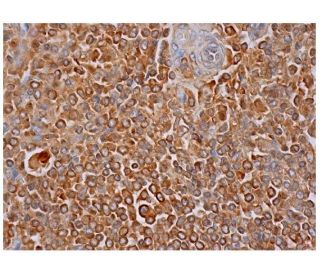


p-PKC theta Anticuerpo (A-11): sc-271922
- p-PKC theta Anticuerpo (A-11) es un monoclonal de ratón IgM κ, ver las 4 publicaciones, proporcionado como 200 µg/ml
- recomendado para detectarThr 538 phosphorylated p-PKC θ de mouse, rat y human origen, mediante WB, IP, IF, IHC(P) y ELISA
- m-IgGκ BP-HRP es el reactivo de detección secundario preferido para p-PKC theta Anticuerpo (A-11) para aplicaciones WB e IHC(P). Este reactivo se ofrece ahora en un paquete con p-PKC theta Anticuerpo (A-11)(ver información de pedido más abajo). Para otros conjugados m-IgGκ BP, consulte nuestra lista completa de proteínas de unión a IgG de ratón.

El anticuerpo p-PKC θ (A-11) es un anticuerpo monoclonal de ratón IgM κ que detecta la p-PKC θ fosforilada en la posición Thr 538 de origen humano, de ratón y de rata mediante WB, IP, IF, IHC(P) y ELISA. Este anticuerpo está disponible en forma no conjugada. Los miembros de la familia de la proteína quinasa C (PKC) desempeñan un papel regulador clave en diversas funciones celulares, incluyendo el crecimiento y diferenciación celular, la expresión génica, la secreción hormonal y la función de la membrana. Las PKC pueden subdividirse en al menos dos clases principales, incluyendo isoformas convencionales (c) PKC (α, βI, βII y γ) e isoformas novedosas (n) PKC (δ, ε, ζ, η y θ). Las isoformas de PKC pueden ser activadas a través de la fosforilación de tirosina y activadas catalíticamente mediante tratamiento con H2O2. Los residuos Tyr 155, 525, 523 y 565 en el dominio catalítico son cruciales para la activación de estas enzimas. El residuo Ser 643 parece ser un sitio de autofosforilación. La PKC θ puede sufrir autofosforilación en la Serina 676 (Ser 676) en el bucle de giro y en la Serina 695 (Ser 695) en el bucle hidrofóbico. La fosforilación de la Serina 676 puede regular negativamente la activación de NFκB. La Serina 695 es crucial para activar la fosforilación de treonina 692 (Thr 692) y los residuos de treonina 703 (Thr 703), ambos necesarios para el cambio de movilidad.
Alexa Fluor® es una marca registrada de Molecular Probes Inc., OR., USA
REIVEW LI-COR® y Odyssey® son marcas registradas de LI-COR Biosciences.
p-PKC theta Anticuerpo (A-11) Referencias:
- El TOR de mamíferos controla una de las dos vías cinasas que actúan sobre nPKCdelta y nPKCepsilon. | Parekh, D., et al. 1999. J Biol Chem. 274: 34758-64. PMID: 10574945
- Sitios de fosforilación de la proteína quinasa C delta en células tratadas con H2O2 y su activación por tirosina quinasa in vitro. | Konishi, H., et al. 2001. Proc Natl Acad Sci U S A. 98: 6587-92. PMID: 11381116
- Caracterización de la fosforilación de PKCtheta inducida por TCR en linfocitos murinos primarios. | Thebault, S. and Ochoa-Garay, J. 2004. Mol Immunol. 40: 931-42. PMID: 14725789
- Un nuevo miembro de la familia de la proteína cinasa C, nPKC theta, expresado predominantemente en el músculo esquelético. | Osada, S., et al. 1992. Mol Cell Biol. 12: 3930-8. PMID: 1508194
- Activación dependiente del calcio de una proteína cinasa multifuncional por fosfolípidos de membrana. | Takai, Y., et al. 1979. J Biol Chem. 254: 3692-5. PMID: 438153
- Rotación de fosfolípidos de inositol y transducción de señales. | Nishizuka, Y. 1984. Science. 225: 1365-70. PMID: 6147898
- Papel de la proteína cinasa C en la transducción de señales en la superficie celular y en la promoción de tumores. | Nishizuka, Y. Nature. 308: 693-8. PMID: 6232463
- La proteína cinasa C como posible proteína receptora de los ésteres de forbol promotores de tumores. | Kikkawa, U., et al. 1983. J Biol Chem. 258: 11442-5. PMID: 6311812
- Activación directa de la proteína cinasa activada por calcio y dependiente de fosfolípidos por ésteres de forbol promotores de tumores. | Castagna, M., et al. 1982. J Biol Chem. 257: 7847-51. PMID: 7085651
- Activación de la proteína cinasa C por fosforilación de tirosina en respuesta al H2O2. | Konishi, H., et al. 1997. Proc Natl Acad Sci U S A. 94: 11233-7. PMID: 9326592
Información sobre pedidos
| Nombre del producto | Número de catálogo | UNIDAD | Precio | CANTIDAD | Favoritos | |
p-PKC theta Anticuerpo (A-11) | sc-271922 | 200 µg/ml | $322.00 | |||
Paquete de p-PKC theta (A-11): m-IgGκ BP-HRP | sc-552320 | 200 µg Ab; 40 µg BP | $361.00 | |||
p-PKC theta (A-11) péptido neutralizante | sc-271922 P | 100 µg/0.5 ml | $69.00 |