
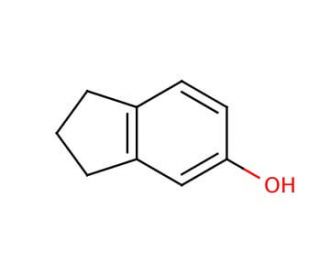

5-Indanol (CAS 1470-94-6)
QUICK LINKS
5-Indanol is a chemical compound characterized by a hydroxyl group attached to the fifth position of an indane ring. This structural feature enhances the molecule′s chemical reactivity, particularly in oxidation and reduction reactions, making it useful in various synthetic chemistry applications. The presence of the hydroxyl group on the indane skeleton allows 5-Indanol to serve as an intermediate in the synthesis of more complex organic compounds. 5-Indanol′s ability to undergo transformations such as hydroxylation and acylation is critical for modifying its properties and behavior in biological applications. These modifications can significantly alter the pharmacokinetic and pharmacodynamic profiles of the derivatives. 5-Indanol may be useful in research applications where its transformation into various analogs and derivatives helps explore the structure-activity relationships essential for compound exploration and enhancement.
5-Indanol (CAS 1470-94-6) References
- Alkylphenol biotransformations catalyzed by 4-ethylphenol methylenehydroxylase. | Hopper, DJ. and Cottrell, L. 2003. Appl Environ Microbiol. 69: 3650-2. PMID: 12788775
- Aromatic hydroxylation of indan by o-xylene-degrading Rhodococcus sp. strain DK17. | Kim, D., et al. 2010. Appl Environ Microbiol. 76: 375-7. PMID: 19880642
- Silanol: a traceless directing group for Pd-catalyzed o-alkenylation of phenols. | Huang, C., et al. 2011. J Am Chem Soc. 133: 12406-9. PMID: 21766826
- Metabolism and nephrotoxicity of indan in male Fischer 344 rats. | Servé, MP., et al. 1990. J Toxicol Environ Health. 29: 409-16. PMID: 2325154
- Structure-activity relationship studies of QS11, a small molecule Wnt synergistic agonist. | Singh, MK., et al. 2015. Bioorg Med Chem Lett. 25: 4838-4842. PMID: 26152429
- Evolution and diversity of floral scent chemistry in the euglossine bee-pollinated orchid genus Gongora. | Hetherington-Rauth, MC. and Ramírez, SR. 2016. Ann Bot. 118: 135-48. PMID: 27240855
- A Xylenol Orange-Based Screening Assay for the Substrate Specificity of Flavin-Dependent para-Phenol Oxidases. | Ewing, TA., et al. 2018. Molecules. 23: PMID: 29342886
- Computer-Assisted Discovery and Structural Optimization of a Novel Retinoid X Receptor Agonist Chemotype. | Heitel, P., et al. 2019. ACS Med Chem Lett. 10: 203-208. PMID: 30783504
- Direct conversion of phenols into primary anilines with hydrazine catalyzed by palladium. | Qiu, Z., et al. 2019. Chem Sci. 10: 4775-4781. PMID: 31160954
- Discovery, Biocatalytic Exploration and Structural Analysis of a 4-Ethylphenol Oxidase from Gulosibacter chungangensis. | Alvigini, L., et al. 2021. Chembiochem. 22: 3225-3233. PMID: 34523783
- Comprehensive Flavor Analysis of Volatile Components During the Vase Period of Cut Lily (Lilium spp. 'Manissa') Flowers by HS-SPME/GC-MS Combined With E-Nose Technology. | Wei, L., et al. 2022. Front Plant Sci. 13: 822956. PMID: 35783924
- Volatile Metabolome and Aroma Differences of Six Cultivars of Prunus mume Blossoms. | Li, T., et al. 2023. Plants (Basel). 12: PMID: 36679020
- Regio- and stereospecific conversion of 4-alkylphenols by the covalent flavoprotein vanillyl-alcohol oxidase. | van den Heuvel, RH., et al. 1998. J Bacteriol. 180: 5646-51. PMID: 9791114
Ordering Information
| Product Name | Catalog # | UNIT | Price | Qty | FAVORITES | |
5-Indanol, 25 g | sc-239049 | 25 g | $145.00 |