
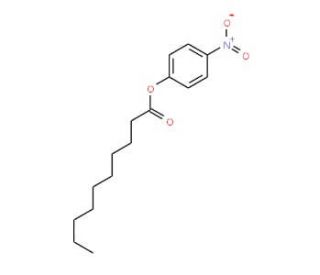

4-Nitrophenyl decanoate (CAS 1956-09-8)
QUICK LINKS
4-Nitrophenyl decanoate (4-NPD) is a member of the nitrophenyl esters family, serving as an essential component in various scientific research applications and experiments, including biochemical and physiological studies. Notably, 4-Nitrophenyl decanoate demonstrates stability and presents a low toxicity profile. Within the realm of scientific research, 4-Nitrophenyl decanoate finds widespread utility and application. It acts as a substrate for enzyme kinetic studies, a probe for measuring lipase activity, and a ligand employed in affinity chromatography. Moreover, it contributes to investigations on protein structure, function, and enzyme mechanisms. Although the precise mechanism of action for 4-Nitrophenyl decanoate remains incompletely understood, it is believed to function as an inhibitor of enzymes featuring an active site containing a nitrophenyl group. By binding to the active site, 4-Nitrophenyl decanoate impedes the catalytic activity of the enzyme. While the biochemical and physiological effects of 4-Nitrophenyl decanoate warrant further investigation, it is hypothesized that this compound influences the activity of enzymes involved in diverse metabolic processes. Notably, these include the metabolism of fatty acids and lipids.
4-Nitrophenyl decanoate (CAS 1956-09-8) References
- Extraction of inorganic acids with neutral phosphorus extractants based on a reverse micelle/microemulsion mechanism. | Jiang, J., et al. 2003. J Colloid Interface Sci. 268: 208-14. PMID: 14611790
- Molecular and biochemical diversity of Oenococcus oeni strains isolated during spontaneous malolactic fermentation of Malvasia Nera wine. | Cappello, MS., et al. 2010. Syst Appl Microbiol. 33: 461-7. PMID: 21095085
- Production and characteristics of the whole-cell lipase from organic solvent tolerant Burkholderia sp. ZYB002. | Shu, ZY., et al. 2012. Appl Biochem Biotechnol. 166: 536-48. PMID: 22081330
- Isolation and characterization of an enzyme from the Greenshell™ mussel Perna canaliculus that hydrolyses pectenotoxins and esters of okadaic acid. | MacKenzie, LA., et al. 2012. Toxicon. 60: 406-19. PMID: 22613166
- [Isolation and functional characterization of lipase from the thermophilic alkali-tolerant bacterium Thermosyntropha lipolytica]. | Gumerov, VM., et al. 2012. Prikl Biokhim Mikrobiol. 48: 376-82. PMID: 23035569
- Peptide-nanoparticle ligation mediated by cutinase fusion for the development of cancer cell-targeted nanoconjugates. | Galbiati, E., et al. 2015. Bioconjug Chem. 26: 680-9. PMID: 25741889
- Ligand binding to the FA3-FA4 cleft inhibits the esterase-like activity of human serum albumin. | Ascenzi, P., et al. 2015. PLoS One. 10: e0120603. PMID: 25790235
- Design and synthesis of a novel glycosphingolipid derived from polyhydroxy 2-pyrrolidinone and phytoceramide appended by a 1,2,3-triazole linker. | Gorantla, JN., et al. 2016. Chem Phys Lipids. 194: 158-64. PMID: 26254857
- Isolation and Characterization of a New Thermoalkalophilic Lipase from Soil Bacteria. | Rabbani, M., et al. 2015. Iran J Pharm Res. 14: 901-6. PMID: 26330879
- Efficient Media for High Lipase Production: One Variable at a Time Approach. | Soleymani, S., et al. 2017. Avicenna J Med Biotechnol. 9: 82-86. PMID: 28496947
- Synergistic effect of acetyl xylan esterase from Talaromyces leycettanus JCM12802 and xylanase from Neocallimastix patriciarum achieved by introducing carbohydrate-binding module-1. | Zhang, Y., et al. 2019. AMB Express. 9: 13. PMID: 30694400
- Covalent immobilization of a halophilic, alkalithermostable lipase LipR2 on Florisil® nanoparticles for production of alkyl levulinates. | Mesbah, NM. 2019. Arch Biochem Biophys. 667: 22-29. PMID: 31022380
- Engineering of an oleaginous bacterium for the production of fatty acids and fuels. | Kim, HM., et al. 2019. Nat Chem Biol. 15: 721-729. PMID: 31209347
- Characterisation of a Novel Acetyl Xylan Esterase (BaAXE) Screened from the Gut Microbiota of the Common Black Slug (Arion ater). | Madubuike, H. and Ferry, N. 2022. Molecules. 27: PMID: 35566348
- Esterase acyl binding site of human milk lipase. | O'Connor, CJ. and Wallace, RG. 1985. J Pediatr Gastroenterol Nutr. 4: 240-4. PMID: 3989623
Ordering Information
| Product Name | Catalog # | UNIT | Price | Qty | FAVORITES | |
4-Nitrophenyl decanoate, 100 mg | sc-214266 | 100 mg | $78.00 | |||
4-Nitrophenyl decanoate, 1 g | sc-214266A | 1 g | $364.00 |