
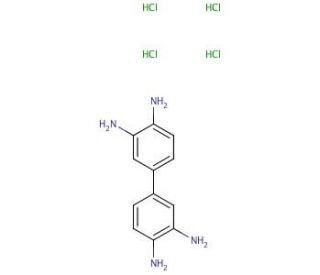

3,3′-Diaminobenzidine tetrahydrochloride (CAS 868272-85-9)
See product citations (35)
QUICK LINKS
3,3′-Diaminobenzidine tetrahydrochloride (DAB), with the CAS number 868272-85-9, is a derivative of benzidine and a reagent extensively used in biochemical research, particularly in the field of histochemistry. This substance is a solid at room temperature and is highly valued for its role as a chromogenic substrate in various enzymatic assays. DAB undergoes a color change in the presence of certain enzymes, such as horseradish peroxidase (HRP), making it indispensable in enzyme-linked immunosorbent assays (ELISA) and similar techniques that require visual detection. In such applications, DAB produces a brown end product when it reacts with HRP in the presence of hydrogen peroxide. This reaction is pivotal for the visualization of antigens in fixed tissue preparations, as the brown precipitate that forms is insoluble in alcohol and xylene, allowing for clear, long-lasting staining patterns under a microscope. This characteristic makes DAB particularly useful in the detailed study of cellular and tissue architecture and the localization of specific proteins within biological specimens. Importantly, due to its use in producing visual markers in research, DAB helps in elucidating molecular pathways and biological mechanisms in non-clinical experimental settings, providing researchers with a powerful tool for the investigation of complex biological systems.
3,3′-Diaminobenzidine tetrahydrochloride (CAS 868272-85-9) References
- Morphologic characterization of rat taste receptor cells that express components of the phospholipase C signaling pathway. | Clapp, TR., et al. 2004. J Comp Neurol. 468: 311-21. PMID: 14681927
- A protocol for cryoembedding the adult guinea pig cochlea for fluorescence immunohistology. | Coleman, B., et al. 2009. J Neurosci Methods. 176: 144-51. PMID: 18835298
- Effects of catalase on the accumulation of H(2)O(2) in rice cells inoculated with rice blast fungus, Magnaporthe oryzae. | Tanabe, S., et al. 2009. Physiol Plant. 137: 148-54. PMID: 19719483
- Resolution of diaminobenzidine for the detection of horseradish peroxidase on surfaces of cultured cells. | Messing, A., et al. 1985. J Histochem Cytochem. 33: 837-9. PMID: 3894500
- Immunohistochemical localization of glutamate decarboxylase in rat cerebellum. | Saito, K., et al. 1974. Proc Natl Acad Sci U S A. 71: 269-73. PMID: 4131274
- The effect of glutaraldehyde on catalase. Biochemical and cytochemical studies with beef liver catalase and rat liver peroxisomes. | Herzog, V. and Fahimi, HD. 1974. J Cell Biol. 60: 303-11. PMID: 4203360
- A quantitative study of peroxidase activity in unfixed tissue sections of the guinea-pig thyroid gland. | Ealey, PA., et al. 1984. Histochem J. 16: 111-22. PMID: 6698801
- Peroxidase histochemistry using diaminobenzidine tetrahydrochloride stored as a frozen solution. | Pelliniemi, LJ., et al. 1980. J Histochem Cytochem. 28: 191-2. PMID: 6986432
- Subcellular localization of the bcl-2 protein in malignant and normal lymphoid cells. | de Jong, D., et al. 1994. Cancer Res. 54: 256-60. PMID: 8261449
Ordering Information
| Product Name | Catalog # | UNIT | Price | Qty | FAVORITES | |
3,3′-Diaminobenzidine tetrahydrochloride, 1 g | sc-209686 | 1 g | $57.00 | |||
3,3′-Diaminobenzidine tetrahydrochloride, 5 g | sc-209686A | 5 g | $118.00 | |||
3,3′-Diaminobenzidine tetrahydrochloride, 25 g | sc-209686B | 25 g | $490.00 | |||
3,3′-Diaminobenzidine tetrahydrochloride, 100 g | sc-209686C | 100 g | $1467.00 |