
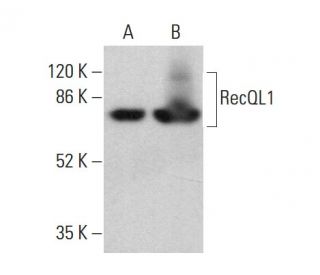
RecQL1 Antibody (A-9): sc-166388
- RecQL1 Antibody (A-9) is a mouse monoclonal IgG2a κ RecQL1 antibody, cited in 7 publications, provided at 200 µg/ml
- raised against amino acids 1-110 of RecQL1 of human origin
- RecQL1 Antibody (A-9) is recommended for detection of RecQL1 of mouse, rat and human origin by WB, IP, IF, IHC(P) and ELISA
- Anti-RecQL1 Antibody (A-9) is available conjugated to agarose for IP; HRP for WB, IHC(P) and ELISA; and to either phycoerythrin or FITC for IF, IHC(P) and FCM
- also available conjugated to Alexa Fluor® 488, Alexa Fluor® 546, Alexa Fluor® 594 or Alexa Fluor® 647 for WB (RGB), IF, IHC(P) and FCM, and for use with RGB fluorescent imaging systems, such as iBright™ FL1000, FluorChem™, Typhoon, Azure and other comparable systems
- also available conjugated to Alexa Fluor® 680 or Alexa Fluor® 790 for WB (NIR), IF and FCM; for use with Near-Infrared (NIR) detection systems, such as LI-COR®Odyssey®, iBright™ FL1000, FluorChem™, Typhoon, Azure and other comparable systems
- m-IgG2a BP-HRP and m-IgGκ BP-HRP are the preferred secondary detection reagents for RecQL1 Antibody (A-9) for WB and IHC(P) applications. These reagents are now offered in bundles with RecQL1 Antibody (A-9) (see ordering information below).

QUICK LINKS
RecQL1 Antibody (A-9) is a mouse monoclonal IgG2a kappa light chain antibody that detects RecQL1 protein of mouse, rat, and human origin by western blotting (WB), immunoprecipitation (IP), immunofluorescence (IF), immunohistochemistry with paraffin-embedded sections (IHCP), and enzyme-linked immunosorbent assay (ELISA). Anti-RecQL1 antibody (A-9) is available in both non-conjugated and various conjugated forms, including agarose, horseradish peroxidase (HRP), phycoerythrin (PE), fluorescein isothiocyanate (FITC), and multiple Alexa Fluor® conjugates. RecQL1 plays a crucial role in maintaining genomic stability by unwinding DNA during replication and repair processes, which is vital for preventing mutations that can lead to cancer and other genetic disorders. As a member of the RecQ helicase family, which includes other important proteins such as WRN and BLM, RecQL1 is involved in critical cellular functions, and dysregulation can contribute to genomic instability. Expression levels of RecQL1 are particularly important in cells that are actively proliferating or undergoing transformation, as these levels help ensure genome integrity under stress conditions. The gene encoding human RecQL1 is located on chromosome 12p12.1, and understanding function and interactions with other proteins can provide insights into cellular processes and potential implications in disease.
Alexa Fluor® is a trademark of Molecular Probes Inc., OR., USA
LI-COR® and Odyssey® are registered trademarks of LI-COR Biosciences
RecQL1 Antibody (A-9) References:
- Mutations in RECQL4 cause a subset of cases of Rothmund-Thomson syndrome. | Kitao, S., et al. 1999. Nat Genet. 22: 82-4. PMID: 10319867
- Covalent modification of the Werner's syndrome gene product with the ubiquitin-related protein, SUMO-1. | Kawabe, Y., et al. 2000. J Biol Chem. 275: 20963-6. PMID: 10806190
- Differential regulation of human RecQ family helicases in cell transformation and cell cycle. | Kawabe, T., et al. 2000. Oncogene. 19: 4764-72. PMID: 11032027
- Cloning, genomic structure and chromosomal localization of the gene encoding mouse DNA helicase RecQ helicase protein-like 4. | Ohhata, T., et al. 2000. Gene. 261: 251-8. PMID: 11167012
- Human RECQL1 participates in telomere maintenance. | Popuri, V., et al. 2014. Nucleic Acids Res. 42: 5671-88. PMID: 24623817
- The level of RECQL1 expression is a prognostic factor for epithelial ovarian cancer. | Matsushita, Y., et al. 2014. J Ovarian Res. 7: 107. PMID: 25424877
- RECQL1 and WRN DNA repair helicases: potential therapeutic targets and proliferative markers against cancers. | Futami, K. and Furuichi, Y. 2014. Front Genet. 5: 441. PMID: 25620975
- Clinicopathological and Functional Significance of RECQL1 Helicase in Sporadic Breast Cancers. | Arora, A., et al. 2017. Mol Cancer Ther. 16: 239-250. PMID: 27837030
- Human RECQL1 participates in telomere maintenance. | Popuri, V., et al. 2017. Nucleic Acids Res. 45: 2935. PMID: 27923931
- RECON syndrome is a genome instability disorder caused by mutations in the DNA helicase RECQL1. | Abu-Libdeh, B., et al. 2022. J Clin Invest. 132: PMID: 35025765
- Elevated RECQL1 expression predicts poor prognosis and associates with tumor immune infiltration in low-grade glioma. | Wang, G., et al. 2022. Transl Cancer Res. 11: 1552-1564. PMID: 35836526
- Molecular cloning of cDNA encoding human DNA helicase Q1 which has homology to Escherichia coli Rec Q helicase and localization of the gene at chromosome 12p12. | Seki, M., et al. 1994. Nucleic Acids Res. 22: 4566-73. PMID: 7527136
Ordering Information
| Product Name | Catalog # | UNIT | Price | Qty | FAVORITES | |
RecQL1 Antibody (A-9) | sc-166388 | 200 µg/ml | $322.00 | |||
RecQL1 Antibody (A-9): m-IgGκ BP-HRP Bundle | sc-521585 | 200 µg Ab, 40 µg BP | $361.00 | |||
RecQL1 Antibody (A-9): m-IgG2a BP-HRP Bundle | sc-546101 | 200 µg Ab; 10 µg BP | $361.00 | |||
RecQL1 Antibody (A-9) AC | sc-166388 AC | 500 µg/ml, 25% agarose | $424.00 | |||
RecQL1 Antibody (A-9) HRP | sc-166388 HRP | 200 µg/ml | $322.00 | |||
RecQL1 Antibody (A-9) FITC | sc-166388 FITC | 200 µg/ml | $336.00 | |||
RecQL1 Antibody (A-9) PE | sc-166388 PE | 200 µg/ml | $349.00 | |||
RecQL1 Antibody (A-9) Alexa Fluor® 488 | sc-166388 AF488 | 200 µg/ml | $364.00 | |||
RecQL1 Antibody (A-9) Alexa Fluor® 546 | sc-166388 AF546 | 200 µg/ml | $364.00 | |||
RecQL1 Antibody (A-9) Alexa Fluor® 594 | sc-166388 AF594 | 200 µg/ml | $364.00 | |||
RecQL1 Antibody (A-9) Alexa Fluor® 647 | sc-166388 AF647 | 200 µg/ml | $364.00 | |||
RecQL1 Antibody (A-9) Alexa Fluor® 680 | sc-166388 AF680 | 200 µg/ml | $364.00 | |||
RecQL1 Antibody (A-9) Alexa Fluor® 790 | sc-166388 AF790 | 200 µg/ml | $364.00 |