
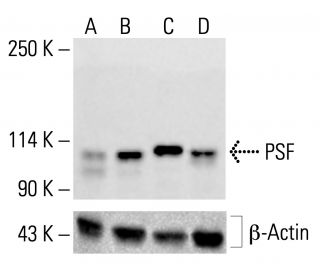
PSF Antibody (39-1): sc-101137
- PSF Antibody (39-1) is a mouse monoclonal IgG2a κ PSF antibody, cited in 14 publications, provided at 100 µg/ml
- raised against recombinant PSF of human origin
- recommended for detection of PSF of mouse, rat and human origin by WB, IP, IF, IHC(P) and ELISA
- m-IgG2a BP-HRP is the preferred secondary detection reagent for PSF Antibody (39-1) for WB and IHC(P) applications. This reagent is now offered in a bundle with PSF Antibody (39-1) (see ordering information below).

QUICK LINKS
SEE ALSO...
PSF Antibody (39-1) is a mouse monoclonal IgG2a kappa light chain antibody that detects PSF protein of mouse, rat, and human origin by western blotting (WB), immunoprecipitation (IP), immunofluorescence (IF), immunohistochemistry with paraffin-embedded sections (IHCP), and enzyme-linked immunosorbent assay (ELISA). Anti-PSF antibody (39-1) is available as a non-conjugated format. PSF protein, also known as polypyrimidine tract-binding protein-associated splicing factor, plays a crucial role in pre-mRNA splicing regulation, a vital process in gene expression involving intron removal from precursor mRNA. PSF protein facilitates spliceosome formation, a large ribonucleoprotein complex, particularly in early stages. PSF protein features two RNA recognition motifs, a proline- and glutamine-rich amino terminal domain, and two carboxy-terminal nuclear localization signals, critical for function and localization. PSF protein predominantly resides in nuclear speckles distinct from nucleoli, with localization influenced by its second RNA recognition motif. PSF protein interacts with DNA binding domains of thyroid hormone receptors and retinoic acid receptors, functioning as a repressor by recruiting histone deacetylases. This interaction demonstrates PSF protein′s multifaceted role in gene regulation, particularly during neuronal differentiation and maturation in developing neurons. PSF protein undergoes proteolytic cleavage in myeloid cells, resulting in a shorter fragment with potentially distinct functional implications.
Alexa Fluor® is a trademark of Molecular Probes Inc., OR., USA
LI-COR® and Odyssey® are registered trademarks of LI-COR Biosciences
PSF Antibody (39-1) References:
- Identification of PSF, the polypyrimidine tract-binding protein-associated splicing factor, as a developmentally regulated neuronal protein. | Chanas-Sacré, G., et al. 1999. J Neurosci Res. 57: 62-73. PMID: 10397636
- Differential nuclear localization and nuclear matrix association of the splicing factors PSF and PTB. | Meissner, M., et al. 2000. J Cell Biochem. 76: 559-66. PMID: 10653975
- Enhanced proteolysis of pre-mRNA splicing factors in myeloid cells. | Shav-Tal, Y., et al. 2000. Exp Hematol. 28: 1029-38. PMID: 11008015
- An RNA recognition motif (RRM) is required for the localization of PTB-associated splicing factor (PSF) to subnuclear speckles. | Dye, BT. and Patton, JG. 2001. Exp Cell Res. 263: 131-44. PMID: 11161712
- PSF is a novel corepressor that mediates its effect through Sin3A and the DNA binding domain of nuclear hormone receptors. | Mathur, M., et al. 2001. Mol Cell Biol. 21: 2298-311. PMID: 11259580
- Binding of the polypyrimidine tract-binding protein-associated splicing factor (PSF) to the hepatitis delta virus RNA. | Greco-Stewart, VS., et al. Virology. 356: 35-44. PMID: 16938326
- Phosphorylation by SR kinases regulates the binding of PTB-associated splicing factor (PSF) to the pre-mRNA polypyrimidine tract. | Huang, CJ., et al. 2007. FEBS Lett. 581: 223-32. PMID: 17188683
- Interplay between polypyrimidine tract binding protein-associated splicing factor and human myometrial progesterone receptors. | Tyson-Capper, AJ., et al. 2009. J Mol Endocrinol. 43: 29-41. PMID: 19339282
- PTB-associated splicing factor (PSF) is a PPARγ-binding protein and growth regulator of colon cancer cells. | Tsukahara, T., et al. 2013. PLoS One. 8: e58749. PMID: 23516550
- Interaction of HIV-1 integrase with polypyrimidine tract binding protein and associated splicing factor (PSF) and its impact on HIV-1 replication. | Yadav, P., et al. 2019. Retrovirology. 16: 12. PMID: 31036027
- A novel set of spliceosome-associated proteins and the essential splicing factor PSF bind stably to pre-mRNA prior to catalytic step II of the splicing reaction. | Gozani, O., et al. 1994. EMBO J. 13: 3356-67. PMID: 8045264
- Cloning and characterization of PSF, a novel pre-mRNA splicing factor. | Patton, JG., et al. 1993. Genes Dev. 7: 393-406. PMID: 8449401
Ordering Information
| Product Name | Catalog # | UNIT | Price | Qty | FAVORITES | |
PSF Antibody (39-1) | sc-101137 | 100 µg/ml | $339.00 | |||
PSF Antibody (39-1): m-IgG2a BP-HRP Bundle | sc-546016 | 100 µg Ab; 10 µg BP | $361.00 |