
santa cruz biotechnology, inc.
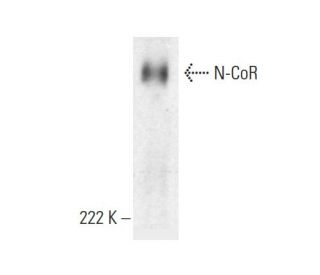
rabbit polyclonal IgG, 200 µg/ml epitope corresponding to amino acids 1881-2183 mapping near the C-terminus of N-CoR of human origin recommended for detection of N-CoR of mouse, rat and human origin by WB, IP, IF and ELISA; also reactive with additional species, including equine, canine and bovine
Ordering Information Product Citations
Recommended Support Products:
(click button of application of choice)
Species
Gene Name
Gene ID
Chromosome Location
Isoform (mRNA) Accession #
Protein Accession #
OMIM™ Number
Human
NCOR1
9611
17p12
NM_006311
O75376
600849
Mouse
Ncor1
20185
11 B2
Q60974
N/A
N-CoR Background Information Retinoids are metabolites of vitamin A (retinol) and are believed to represent important signaling molecules during vertebrate development and tissue differentiation. Two families of retinoid receptors have been identified. Retinoic acid receptors (RARs), include RARå, RAR∫ and RAR©, each of which have a high affinity for all-trans retinoic acids and belong to the same class of nuclear transcription factors as thyroid hormone receptors, vitamin D3 receptor and ecdysone receptor. Two cofactors that function to repress transcription, designated SMRT and N-CoR, have been shown to associate with the thyroid receptor and RAR in their unliganded state and are released from them upon ligand binding. The carboxy termini of both proteins contain receptor interacting domains while their amino termini contain two previously undescribed repressor domains. SMRT (silencing mediator for RARs and TRs) is 1495 amino acids in length. N-CoR (nuclear receptor corepressor) is a protein 2453 amino acids in length.
N-CoR (H-303) Product Citations
See how others have used N-CoR (H-303): sc-8994 antibody and or N-CoR (H-303) antibody conjugates.
30 total citations Loading citations.
N-CoR (H-303)
Click on image to enlarge
N-CoR (H-303): sc-8994. Immunofluorescence staining of methanol-fixed K-562 cells showing nuclear localization.
Download
