
 |
- rabbit polyclonal IgG, 200 µg/ml
- epitope mapping at the C-terminus of E2F-4 of human origin
- recommended for detection of E2F-4 and, to a lesser extent, E2F-5 of mouse, rat and human origin by WB, IP, IF and ELISA; also reactive with additional species, including equine, canine, bovine, porcine and avian
- blocking peptide, sc-866 P
- TransCruz reagent for Gel Supershift and ChIP applications, sc-866 X, 200 µg/0.1 ml
- agarose conjugate for IP studies, sc-866 AC, 500 µg/0.25 ml agarose
|
|
| |
Ordering InformationProduct Citations
Recommended Support Products:
(click button of application of choice)
| |
| Species |
Gene Name |
Gene ID |
Chromosome Location |
Isoform (mRNA) Accession # |
Protein Accession # |
OMIM™ Number |
| Human |
E2F4 |
1874 |
16q22.1 |
NM_001950 |
Q16254
|
600659 |
| Mouse |
E2f4 |
104394 |
8 D3 |
|
Q8R0K9
|
N/A |
| |
E2F-4 Background Information The human retinoblastoma gene product appears to play an important role in the negative regulation of cell proliferation. Functional inactivation of Rb can be mediated either through mutation or as a consequence of interaction with DNA tumor virus-encoded proteins. Of all the Rb associations described to date, the identification of a complex between Rb and the transcription factor E2F most directly implicates Rb in regulation of cell proliferation. E2F was originally identified through its role in transcriptional activation of the adenovirus E2 promoter. Sequences homologous to the E2F binding site have been found upstream of a number of genes that encode proteins with putative functions in the G1 and S phases of the cell cycle. E2F-1 is a member of a broader family of transcription regulators including E2F-2, E2F-3, E2F-4, E2F-5, E2F-6 and E2F-7 each of which forms heterodimers with a second protein, DP-1, forming an “active” E2F transcriptional regulatory complex.
| E2F-4 (C-20) Product Citations |
See how others have used E2F-4 (C-20): sc-866 antibody and or E2F-4 (C-20) antibody conjugates.
79 total citations Loading citations.
|
| |
|
 |
|
E2F-4 (C-20)
Click on image to enlarge
|
|
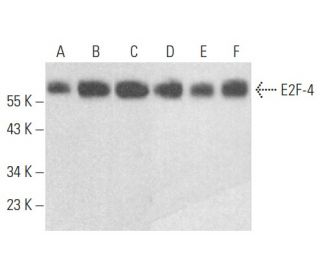
E2F-4 (C-20): sc-866. Western blot analysis of E2F-4 expression in MM-142 (A), 3611-RF (B), HeLa (C), A-431 (D), Y79 (E) and A-673 (F) nuclear extracts.
ChIP analysis of c-Myc promoter occupancy in response to lithium stimulation in serum synchronized C2C12 cells. Antibodies tested include HDAC1 (H-15): sc-7872, HDAC1 (C-19): sc-6298 and HDAC1 (H-11): sc-8410 (A), β-catenin (H-120): sc-7199, β-catenin (C-18): sc-1496 and β-catenin (E-5): sc-7963 (B), E2F-4 (A-20): sc-1082, E2F-4 (D-3): sc-6851, E2F-4 (RK-13): sc-511 and E2F-4 (C-20): sc-866 (C), and p130 (C-20): sc-317, p130 (211.6): sc-9963 and p130 (H-125): sc-20678 (D). Data kindly provided by M.G. Rosenfeld and reproduced with permission from Proc. Natl. Acad. Sci. 100: 3245-3250. Copyright 2003 National Academy of Sciences, USA.
ChIP analysis of E2F transcription factor binding to the c-Myc promoter in NBS cells. Antibodies tested include E2F-1 (C-20): sc-193 (A), E2F-2 (C-20): sc-633 (B), E2F-3 (C-18): sc-878, E2F-3 (N-20): sc-879 (C) and E2F-4 (C-20): sc-866 (D). Data kindly provided by Dr. J. H. J. Petrini and reproduced with permission from Master, et al. 2001. Mol. Cell. Biol. 21: 6006-6016.
ChIP analysis of E2F transcription factor binding to the oriP (I.) and c-Myc (II.) promoters in Raji cells as a function of the cell cycle. Antibodies tested include E2F-1 (C-20): sc-193 (A), E2F-2 (C-20): sc-633 (B), E2F-3 (C-18): sc-878, E2F-3 (N-20): sc-879 (C) and E2F-4 (C-20): sc-866 (D). Data kindly provided by Dr. J. H. J. Petrini and reproduced from Master, et al., 2001. Mol. Cell. Biol. 21: 6006-6016.
E2F-4 (C-20): sc-866. Western blot analysis of E2F-4 expression in non-transfected: sc-117752 (A) and mouse E2F-4 transfected: sc-119883 (B) 293T whole cell lysates.
E2F-4 (C-20): sc-866. Immunofluorescence staining of methanol-fixed HeLa cells showing nuclear and cytoplasmic localization.
|
|
Download
|
|
