
Subscrever / Inscrever-se Conta
Corrinho de compra (0)
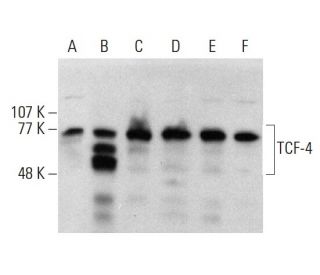

Este anticorpo policlonal foi descontinuado. Consulta o nosso anticorpo monoclonal TCF-4 (D-4) recomendado (dados de amostra apresentados).
TCF-4 Anticorpo (N-20): sc-8631
- TCF-4 Anticorpo N-20é um anticorpo policlonal produzido em cabra IgG fornecido em 200 µg/ml
- epítopo mapeado perto do N-terminus de TCF-4 de human origem
- Anticorpo policlonal descontinuado

Para uso em exclusivo em pesquisa. Não se destina a uso em diagnostico e tratamento.
Alexa Fluor® é uma marca comercial da Molecular Probes Inc., OR., EUA
Informacoes sobre ordens
TCF-4 (D-4): sc-166699 [ anticorpo monoclonal substituto recomendado para TCF-4 (N-20) ]
| Nome do Produto | Numero de Catalogo | UNID | Preco | Qde | FAVORITOS | |
TCF7L2/TCF4 Anticorpo (D-4) | sc-166699 | 200 µg/ml | $322.00 | |||
Pacote do TCF7L2/TCF4 (D-4): m-IgG Fc BP-HRP | sc-529033 | 200 µg Ab; 10 µg BP | $361.00 | |||
Pacote do TCF7L2/TCF4 (D-4): m-IgGκ BP-HRP | sc-521715 | 200 µg Ab, 40 µg BP | $361.00 | |||
Pacote do TCF7L2/TCF4 (D-4): m-IgG1 BP-HRP | sc-543280 | 200 µg Ab; 20 µg BP | $361.00 | |||
TCF7L2/TCF4 Anticorpo (D-4) X | sc-166699 X | 200 µg/0.1 ml | $322.00 | |||
TCF7L2/TCF4 Anticorpo (D-4) AC | sc-166699 AC | 500 µg/ml, 25% agarose | $424.00 | |||
TCF7L2/TCF4 Anticorpo (D-4) HRP | sc-166699 HRP | 200 µg/ml | $322.00 | |||
TCF7L2/TCF4 Anticorpo (D-4) FITC | sc-166699 FITC | 200 µg/ml | $336.00 | |||
TCF7L2/TCF4 Anticorpo (D-4) PE | sc-166699 PE | 200 µg/ml | $349.00 | |||
TCF7L2/TCF4 Anticorpo (D-4) Alexa Fluor® 488 | sc-166699 AF488 | 200 µg/ml | $364.00 | |||
TCF7L2/TCF4 Anticorpo (D-4) Alexa Fluor® 546 | sc-166699 AF546 | 200 µg/ml | $364.00 | |||
TCF7L2/TCF4 Anticorpo (D-4) Alexa Fluor® 594 | sc-166699 AF594 | 200 µg/ml | $364.00 | |||
TCF7L2/TCF4 Anticorpo (D-4) Alexa Fluor® 647 | sc-166699 AF647 | 200 µg/ml | $364.00 | |||
TCF7L2/TCF4 Anticorpo (D-4) Alexa Fluor® 680 | sc-166699 AF680 | 200 µg/ml | $364.00 | |||
TCF7L2/TCF4 Anticorpo (D-4) Alexa Fluor® 790 | sc-166699 AF790 | 200 µg/ml | $364.00 | |||
TCF7L2/TCF4 (D-4) peptídeo neutralizante | sc-166699 P | 100 µg/0.5 ml | $69.00 |