
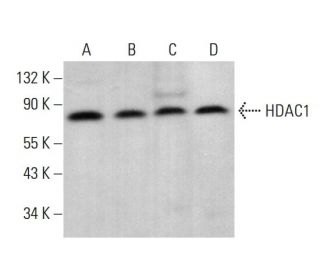
Histone Deacetylase 1 (HDAC1) Antibody (H-11): sc-8410
- Histone Deacetylase 1 (HDAC1) Antibody (H-11) is a mouse monoclonal IgG1 κ, cited in 98 publications, provided at 200 µg/ml
- raised against amino acids 432-482 mapping at the C-terminus of HDAC1 of human origin
- Anti-Histone Deacetylase 1 (HDAC1) Antibody (H-11) is recommended for detection of HDAC1 of mouse, rat and human origin by WB, IP, IF, FCM and ELISA
- Anti-Histone Deacetylase 1 (HDAC1) Antibody (H-11) is available conjugated to agarose for IP; HRP for WB, IHC(P) and ELISA; and to either phycoerythrin or FITC for IF, IHC(P) and FCM
- also available conjugated to Alexa Fluor® 488, Alexa Fluor® 546, Alexa Fluor® 594 or Alexa Fluor® 647 for WB (RGB), IF, IHC(P) and FCM, and for use with RGB fluorescent imaging systems, such as iBright™ FL1000, FluorChem™, Typhoon, Azure and other comparable systems
- also available conjugated to Alexa Fluor® 680 or Alexa Fluor® 790 for WB (NIR), IF and FCM; for use with Near-Infrared (NIR) detection systems, such as LI-COR®Odyssey®, iBright™ FL1000, FluorChem™, Typhoon, Azure and other comparable systems
- TransCruz reagent for ChIP application (sc-8410 X, 200 µg/0.1 ml)
- m-IgG1 BP-HRP is the preferred secondary detection reagent for Histone Deacetylase 1 (HDAC1) Antibody (H-11) for WB applications. This reagent is now offered in a bundle with Histone Deacetylase 1 (HDAC1) Antibody (H-11) (see ordering information below).

HDAC1 Antibody (H-11) is a mouse monoclonal IgG1 kappa light chain antibody specifically engineered to target the C-terminal region of human HDAC1, recognizing amino acids 432-482. HDAC1 monoclonal antibody (H-11) exhibits cross-species reactivity, effectively detecting HDAC1 in mouse, rat, and human samples across a variety of applications including western blotting (WB), immunoprecipitation (IP), immunofluorescence (IF), flow cytometry (FCM), and enzyme-linked immunosorbent assay (ELISA). HDAC1 mouse monoclonal antibody (H-11) is available in both non-conjugated form and multiple conjugated variants such as agarose, HRP, PE, FITC, and various Alexa Fluor® conjugates, providing versatile options for diverse experimental needs. HDAC1, also called GON-10, HD1, KDAC1, RPD3, and RPD3L1, plays a pivotal role in the regulation of gene expression by modulating chromatin structure through the removal of acetyl groups from lysine residues on histone proteins, leading to chromatin condensation and transcriptional repression. This enzymatic activity is essential for processes such as cell cycle progression, differentiation, and development. HDAC1 is involved in maintaining genomic stability and regulating various signaling pathways. Dysregulation of HDAC1 has been implicated in numerous diseases, including cancer, neurological disorders, and inflammatory conditions, making HDAC1 a critical target for therapeutic intervention and a key focus in epigenetic research.
Alexa Fluor® is a trademark of Molecular Probes Inc., OR., USA
LI-COR® and Odyssey® are registered trademarks of LI-COR Biosciences
Ordering Information
| Product Name | Catalog # | UNIT | Price | Qty | FAVORITES | |
Histone Deacetylase 1 Antibody (H-11) | sc-8410 | 200 µg/ml | $322.00 | |||
Histone Deacetylase 1 (HDAC1) Antibody (H-11): m-IgG1 BP-HRP Bundle | sc-531634 | 200 µg Ab; 20 µg BP | $361.00 | |||
Histone Deacetylase 1 (HDAC1) Antibody (H-11) X | sc-8410 X | 200 µg/0.1 ml | $322.00 | |||
Histone Deacetylase 1 (HDAC1) Antibody (H-11) AC | sc-8410 AC | 500 µg/ml, 25% agarose | $424.00 | |||
Histone Deacetylase 1 (HDAC1) Antibody (H-11) HRP | sc-8410 HRP | 200 µg/ml | $322.00 | |||
Histone Deacetylase 1 (HDAC1) Antibody (H-11) FITC | sc-8410 FITC | 200 µg/ml | $336.00 | |||
Histone Deacetylase 1 (HDAC1) Antibody (H-11) PE | sc-8410 PE | 200 µg/ml | $349.00 | |||
Histone Deacetylase 1 (HDAC1) Antibody (H-11) Alexa Fluor® 488 | sc-8410 AF488 | 200 µg/ml | $364.00 | |||
Histone Deacetylase 1 (HDAC1) Antibody (H-11) Alexa Fluor® 546 | sc-8410 AF546 | 200 µg/ml | $364.00 | |||
Histone Deacetylase 1 (HDAC1) Antibody (H-11) Alexa Fluor® 594 | sc-8410 AF594 | 200 µg/ml | $364.00 | |||
Histone Deacetylase 1 (HDAC1) Antibody (H-11) Alexa Fluor® 647 | sc-8410 AF647 | 200 µg/ml | $364.00 | |||
Histone Deacetylase 1 (HDAC1) Antibody (H-11) Alexa Fluor® 680 | sc-8410 AF680 | 200 µg/ml | $364.00 | |||
Histone Deacetylase 1 (HDAC1) Antibody (H-11) Alexa Fluor® 790 | sc-8410 AF790 | 200 µg/ml | $364.00 |