
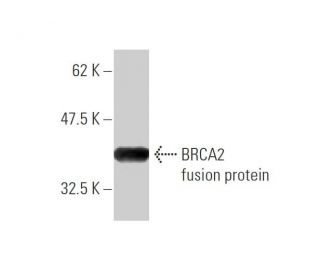

This polyclonal antibody has been discontinued. See our recommended BRCA2 (3D12) monoclonal antibody (sample data shown).
BRCA2 Antibody (H-300): sc-8326
- BRCA2 Antibody (H-300) is a rabbit polyclonal IgG; 200 µg/ml
- epitope corresponding to amino acids 2520-2819 mapping within an internal region of BRCA2 of human origin
- Discontinued polyclonal antibody

QUICK LINKS
Description
In 1990, a breast cancer susceptibility gene designated BRCA1 was localized to chromosome 17q. Mutations within this gene are believed to account for approximately 45% of families with high incidence of breast cancer and at least 80% of families with increased incidence of both early-onset breast cancer and ovarian cancer. A second breast cancer susceptibility gene, BRCA2 (breast cancer 2, early onset), located on chromosome 13q12.3, also confers a high incidence of breast cancer but, unlike BRCA1, does not confer a substantially elevated risk of ovarian cancer. Both BRCA1 and BRCA2 play a role in the maintainance of genome stability, particularly in the homologous recombination pathway for double-strand DNA repair. BRCA2 is regarded as a tumor suppressor gene; tumors with BRCA2 mutations exhibit loss of heterozygosity (LOH) of the wildtype allele. The protein encoded by the BRCA2 gene contains multiple copies of a 70 amino acid motif called the BRC motif. These motifs effect binding to the Rad51 recombinase, which operates in DNA repair.
Ordering Information
BRCA2 (3D12): sc-293185 [ Recommended monoclonal replacement for BRCA2 (H-300) ]
| Product Name | Catalog # | UNIT | Price | Qty | FAVORITES | |
BRCA2 Antibody (3D12) | sc-293185 | 100 µg/ml | $322.00 | |||
BRCA2 Antibody (3D12): m-IgG3 BP-HRP Bundle | sc-550414 | 100 µg Ab; 40 µg BP | $361.00 |